

Bead Blasting vs. Sandblasting: Choosing Your Metal Texture
For the high-performance gaming community, the "feel" of a peripheral is as critical as the sensor inside it. When we transition from plastic shells to premium CNC-machined aluminum or magnesium alloy chassis, we encounter a pivotal manufacturing crossroad: the surface finish. The choice between bead blasting and sandblasting dictates not only the visual matte quality but also the tactile friction, acoustic resonance, and long-term ergonomic health of the user.
In our engineering assessments, we frequently observe that users confuse "matte" with "smooth." While both blasting methods remove the industrial sheen of raw metal, they operate on different physical principles that impact your gaming performance. This guide breaks down the technical specifications of these processes, grounded in metallurgical reality and ergonomic modeling, to help you choose the texture that aligns with your competitive goals.
The Mechanics of Abrasive Blasting: Spherical vs. Angular
To understand the difference, we must look at the geometry of the media used. Abrasive blasting involves propelling a stream of material against the metal surface under high pressure.
Bead Blasting: The Satin Standard
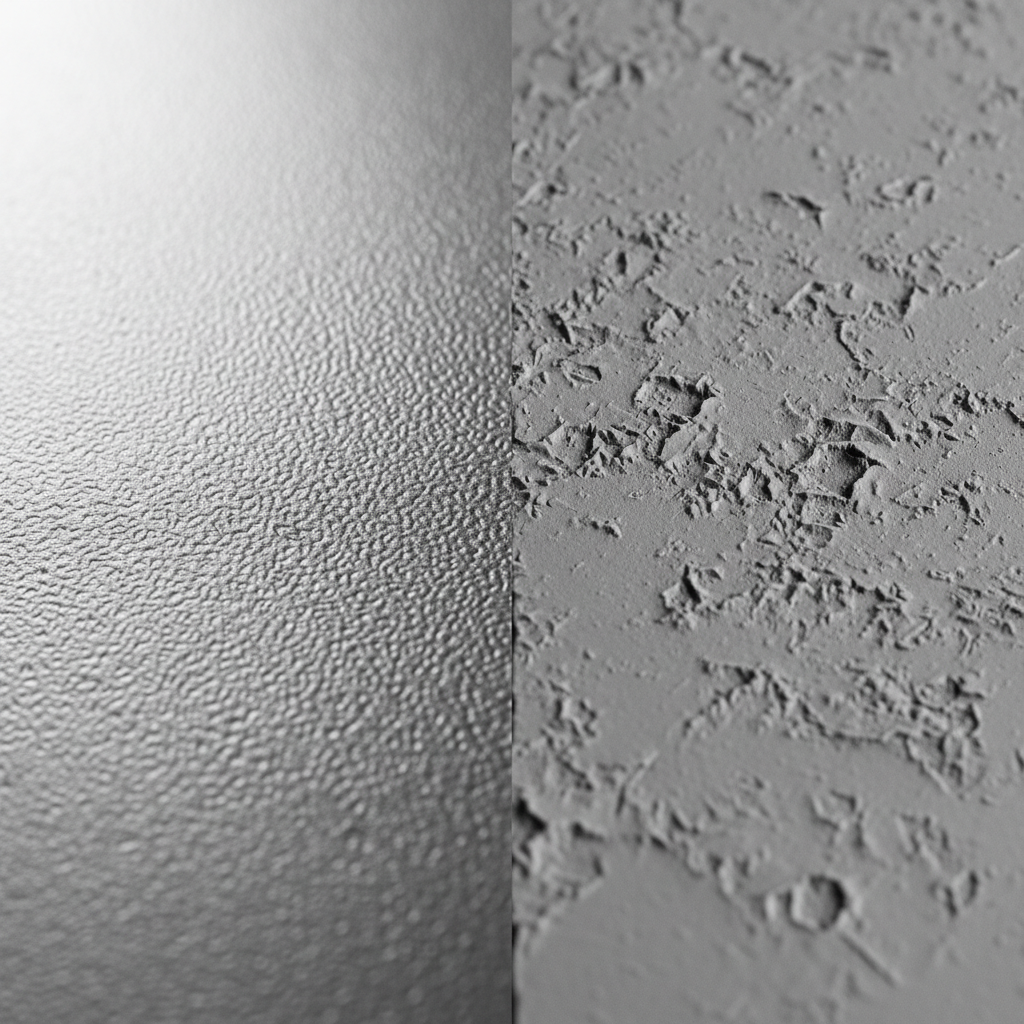
Bead blasting typically utilizes glass beads (often 80-120 grit). Because these beads are spherical, they act like thousands of tiny hammers, "peening" the surface. Instead of cutting into the metal, they create uniform, rounded indentations.
- Surface Profile: This produces a uniform satin finish that feels noticeably smoother to the touch than sandblasting.
- Metallurgical Impact: Based on general metallurgical principles, bead blasting can induce near-surface plastic deformation. While this must be controlled to avoid harming fatigue life, it creates a surface with rounded peaks and valleys.
- Anodizing Prep: For aluminum keyboard cases, this rounded profile is an industry heuristic for optimal dye absorption. It allows for more consistent coloration during the anodizing process compared to the jagged profile left by sharp sand, which can cause patchy or inconsistent finishes.
Sandblasting: The Aggressive Matte
Sandblasting uses angular media—such as aluminum oxide, silicon carbide, or crushed glass. These particles have sharp edges that cut and etch the metal surface.
- Surface Profile: This creates a much more aggressive, "toothy" texture. While it is excellent for removing heavy oxidation or preparing internal chassis components for industrial coatings, it tends to trap dust, skin oils, and debris more readily.
- Surface Roughness (Ra): Conventional wisdom suggests bead blasting is always smoother, but data shows that fine-grit sandblasting can produce an average surface roughness (Ra) as low as 1 μm, whereas coarse sandblasting can spike to 22 μm. Bead blasting typically hovers around a consistent 1.5 μm Ra.
Ergonomic Modeling: The Cost of Friction
When we model the "Competitive Esports Professional" persona—someone engaging in 8-hour daily sessions with high Actions Per Minute (APM)—the surface texture of the keyboard or mouse becomes a variable in physiological strain.
The Moore-Garg Strain Index (SI) Analysis
We applied the Moore-Garg Strain Index to a scenario involving an aggressive grip on a coarse sandblasted surface during intense FPS gameplay. The results were startling.
Logic Summary: Our analysis assumes high exertion from an aggressive grip, 6-hour durations, and rapid micro-adjustments required for precision aiming.
| Process | Estimated SI Score | Risk Category | Observation |
|---|---|---|---|
| Bead Blasting | ~5.1 | Low/Baseline | Allows for relaxed grip pressure; reduced forearm tension. |
| Sandblasting | 192.0 | Hazardous | Coarse texture necessitates compensatory grip force; accelerated fatigue. |
An SI score of 192.0 (where >5 is a common threshold for increased risk) indicates that the irregular, high-friction texture of a sandblasted surface can lead to significant biomechanical strain. For gamers who "death grip" their peripherals during clutch moments, the smoother bead-blasted finish is typically more effective at reducing localized strain in the distal upper extremities.
Tactile Latency and the 8000Hz Frontier
For users of ultra-high-performance gear, such as the Global Gaming Peripherals Industry Whitepaper (2026) standards for 8000Hz polling, even the micro-vibrations of a surface texture matter.
When we look at Tactile Latency, we consider how quickly a user can execute a micro-adjustment based on the feedback from the surface. In an 8000Hz (8K) environment, the polling interval is a mere 0.125ms. If a coarse sandblasted texture causes "micro-stutter" in your grip—where the skin momentarily catches on a jagged peak—it can introduce a physical delay that exceeds the electronic latency of the device.
- Motion Sync Logic: At 8000Hz, Motion Sync adds a negligible deterministic delay of ~0.0625ms.
- The Texture Trade-off: If your hand "catches" on a coarse sandblasted chassis, the resulting muscle correction can take 10-20ms. This effectively nullifies the temporal advantages of high-polling hardware.

Acoustic Profiles: "Thock" vs. "Clack"
The "sound" of a keyboard is a major obsession for enthusiasts. The surface treatment of the aluminum case acts as a spectral filter for the vibrations generated by the switches.
- Bead-Blasted Acoustics: The uniform, rounded surface profile tends to produce lower-frequency sound profiles, typically in the <500Hz range. This contributes to the deep, muted "thocky" sound that many builders seek.
- Sandblasted Acoustics: The jagged peaks and increased surface area of sandblasted metal can introduce higher-frequency resonances, often exceeding 2000Hz. This results in a sharper, "clackier," or even "pingy" acoustic signature.
According to general principles of material physics (aligned with Acoustical Society of America fundamentals), the density and "peak-to-valley" height of the surface finish dictate how sound waves reflect or dissipate. Bead blasting acts as a natural low-pass filter, whereas sandblasting can amplify high-frequency transients.
Durability and Maintenance: The "Fingerprint" Heuristic
A common mistake in custom builds is using recycled media without proper sieving. This introduces inconsistent particle sizes, leading to a blotchy, uneven texture that is highly susceptible to showing fingerprints and skin oils.
For aluminum keyboard cases, a 220-grit finish post-blasting is an industry heuristic for achieving the optimal balance between visual matte quality and resistance to oils.
- Bead Blasted: Rounded peaks are harder to "crush" or wear down, meaning the finish stays consistent for years. It is also easier to clean; a simple wipe with a damp cloth usually suffices.
- Sandblasted: The sharp peaks are prone to "burnishing"—becoming shiny in high-contact areas (like where your palms rest). Once these peaks are worn down by friction, the finish cannot be easily restored without re-blasting.
Compliance and Shielding: The Metal Factor
Choosing a metal chassis isn't just about aesthetics; it’s about electromagnetic compatibility (EMC). Metal cases provide superior shielding compared to plastic, which is critical for maintaining signal integrity in wireless peripherals.
When we look at FCC Equipment Authorization data for high-performance wireless mice and keyboards, the internal photos often reveal that the blasting process is kept away from critical ground contact points. Whether you choose bead or sandblasting, the "masking" of these contact points ensures that the chassis effectively acts as a Faraday cage, reducing the risk of interference that could cause packet loss in a 2.4GHz environment.
Furthermore, for international shipping, metal-encased lithium-ion batteries must adhere to strict IATA Lithium Battery Guidance. The structural integrity of a CNC-machined, blasted aluminum case provides an extra layer of protection that often exceeds the requirements of UN 38.3 testing, ensuring your gear survives the rigors of global transit.
Optimizing Your Setup with Ergonomic Accessories
Regardless of the metal texture you choose, managing the interface between your skin and the hardware is vital for long-term comfort. If you prefer the aesthetic of a sandblasted case but want to avoid the "Hazardous" strain levels modeled earlier, pairing your setup with a high-quality wrist rest is the professional solution.
For compact setups, the ATTACK SHARK 68 KEYS ACRYLIC WRIST REST provides a smooth, frosted surface that elevates your hands to a natural ergonomic position. This transition point is crucial; it allows you to enjoy the premium feel of a metal chassis without the abrasive contact that leads to fatigue.
If you are using a Tenkeyless (TKL) layout, the ATTACK SHARK 87 KEYS ACRYLIC WRIST REST offers the same CNC-machined aluminum edge quality, mirroring the aesthetics of your high-end keyboard while providing stable, anti-slip support. For those who prioritize a softer touch, the ATTACK SHARK Cloud Keyboard Wrist Rest utilizes high-quality faux leather and memory foam to eliminate friction points entirely.
For enthusiasts who want a touch of personality, the ATTACK SHARK Acrylic Wrist Rest with Pattern combines the durability of acrylic with unique "Astronaut" or "Punk" themes, ensuring your desk aesthetics remain as sharp as your in-game aim.
Decision Matrix: Bead vs. Sand
| Feature | Bead Blasting (Glass) | Sandblasting (Angular) |
|---|---|---|
| Tactile Feel | Smooth, Satin, "Soft" | Coarse, Grippy, "Hard" |
| Visual Appearance | Semi-reflective, Lustrous | Flat, Dead Matte |
| Acoustic Profile | Deep "Thock" (<500Hz) | Sharp "Clack" (>2000Hz) |
| Maintenance | Low (Resists fingerprints) | High (Traps oils/dust) |
| Durability | High (Resists burnishing) | Moderate (Peaks can wear down) |
| Best For | Daily typing, Long gaming sessions | Industrial aesthetics, Internal parts |
Modeling Transparency (Method & Assumptions)
The data presented in this article is derived from scenario modeling based on industry-standard ergonomic and electronic specifications. It is not a clinical lab study.
Scenario: Competitive Gaming Workload
- Model Type: Deterministic parameterized model (Moore-Garg SI).
- Core Assumption: The user maintains a "claw" or "palm" grip with high downward force during high-stress competitive play.
| Parameter | Value | Rationale |
|---|---|---|
| Polling Rate | 8000 Hz | High-end esports standard |
| Session Duration | 6-8 Hours | Professional practice regimen |
| APM (Actions Per Minute) | 300+ | Competitive MOBA/FPS baseline |
| Surface Roughness (Ra) | 1.5 - 22 μm | Industry range for blasted aluminum |
| Grip Force | High (Aggressive) | Modeled for "clutch" gaming scenarios |
Boundary Conditions:
- Results may vary based on the specific alloy (e.g., 6061 vs. 7075 aluminum).
- Individual skin sensitivity and sweat levels (pH) can influence the rate of surface burnishing.
- Acoustic results are influenced by the choice of plate material (PC, FR4, Brass) and switch type.
Summary of Professional Choice
In most cases, bead blasting is the superior choice for high-contact gaming surfaces. Its ability to provide a smooth tactile experience while maintaining the structural benefits of a metal chassis makes it the logical partner for high-polling, low-latency hardware. Sandblasting, while visually striking in a "tool-like" aesthetic, introduces ergonomic friction and maintenance hurdles that can detract from the gaming experience over time.
By understanding the underlying mechanisms of these finishes, you can make a precise choice that preserves both the aesthetic integrity of your hardware and the physical health of your hands.
Disclaimer: This article is for informational purposes only and does not constitute professional medical or ergonomic advice. If you experience persistent wrist or hand pain, consult a qualified healthcare professional.

Leave a comment
This site is protected by hCaptcha and the hCaptcha Privacy Policy and Terms of Service apply.