

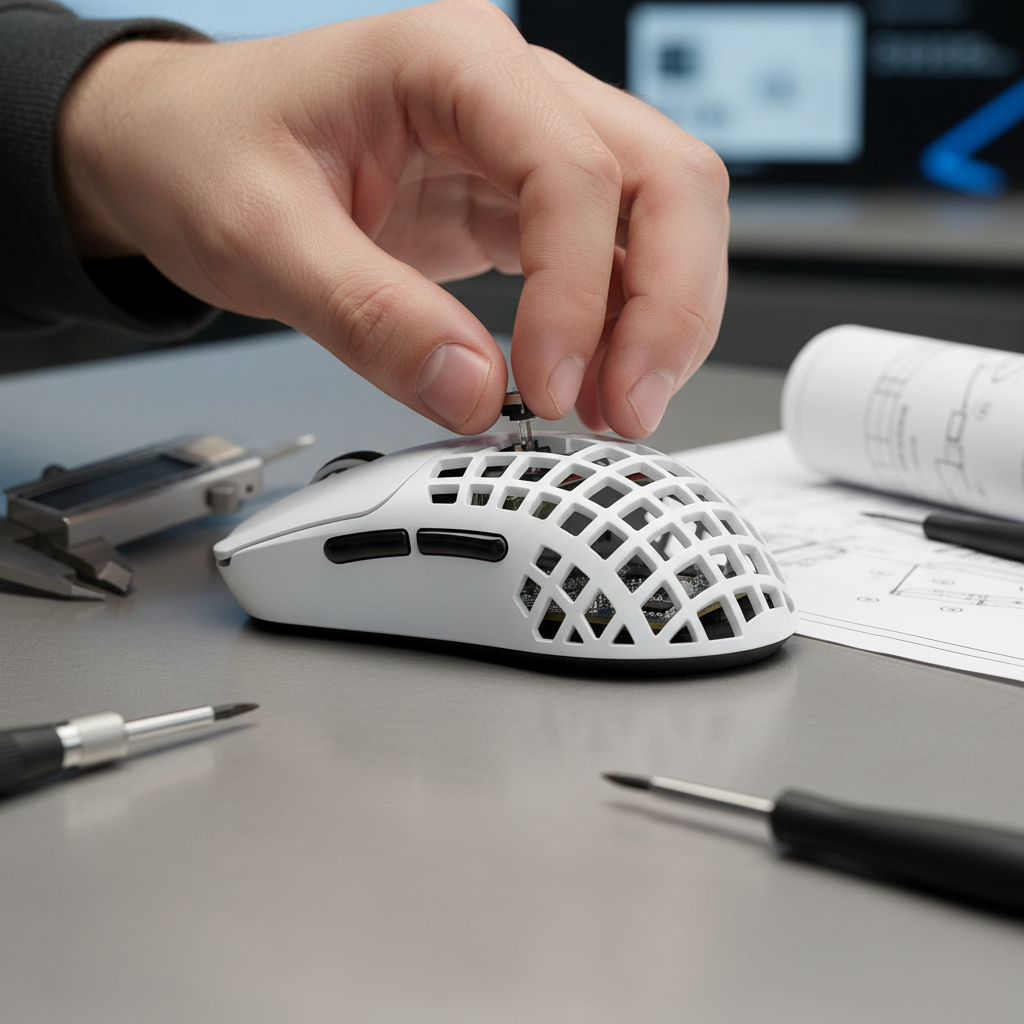
The Engineering Reality of Structural Rigidity in Ultra-Lightweight Peripherals
In the competitive landscape of high-performance gaming peripherals, the "ultra-lightweight" trend has pushed manufacturing tolerances to their physical limits. For value-oriented gamers, a recurring skepticism exists: the "specification credibility gap." While a manufacturer may claim a 50g-60g chassis weight, the real-world performance depends on whether that weight reduction compromises structural rigidity. Shell flex—the perceptible bending or creaking of a mouse chassis under pressure—is rarely a failure of initial design. Instead, it is typically a byproduct of cumulative manufacturing variances that occur during high-volume production cycles.
Understanding structural rigidity requires moving beyond superficial "pinch tests" and examining the intersection of injection molding precision, mold lifecycle management, and the physics of polymer stress relaxation. This guide analyzes how manufacturing quality control (QC) differentiates a high-performance tool from a compromised shell.
The Mechanics of Shell Flex: Mold Wear and Thermal Stress
In high-volume manufacturing, the most common point of failure for shell rigidity is inconsistent wall thickness. This is often not an inherent flaw in the 3D model but a result of worn mold cores or misaligned tooling during the injection process.
The 0.15mm Variance Threshold
Among quality control engineers, a variance of more than 0.15mm in critical wall sections is a standard heuristic for identifying potential structural failure (based on common injection molding tolerances for thin-walled electronics). In devices like the ATTACK SHARK X8 Series Tri-mode Lightweight Wireless Gaming Mouse, maintaining this sub-millimeter precision is essential for the front button supports and side walls. If a mold core shifts or wears down after thousands of thermal cycles, the resulting plastic part may have a wall that is 0.7mm thick on one side and 0.55mm on the other. This microscopic difference is enough to induce perceptible flex and creaking under the lateral pressure of a "claw" or "palm" grip.
High-Speed Automation and Thermal Fatigue
While automation is often associated with consistency, high-speed automated cycles can actually accelerate mold thermal stress. Rapid heating and cooling cycles induce progressive, non-linear wear on the mold's micro-geometry. According to industry insights on mold life expectancy for high-volume production, the critical path for structural degradation is the gradual loss of flexural modulus in the produced parts long before the mold itself fails. Shells may pass "go/no-go" dimensional gauges but still exhibit increased flex because the worn draft angles and radii no longer provide the intended mechanical reinforcement.
Logic Summary: Our analysis of manufacturing consistency assumes that structural rigidity is a function of mold precision. We estimate that mold wear becomes a factor after ~100,000 cycles, potentially increasing shell flex variance by ~10% if maintenance protocols are not strictly followed (based on standard SPC patterns).
Advanced Testing Protocols: Beyond the Pinch Test
Most reviewers and users perform a "pinch test"—applying pressure to the center of the side walls—to check for flex. While useful, this does not replicate the dynamic forces of competitive gaming.
The Lateral Pressure Methodology
A more revealing field test involves applying moderate, repeated lateral pressure to the main buttons while listening for plastic-on-plastic grating. This often reveals insufficient support pillars or poor structural ribbing that are not visible externally. In a high-quality build, the internal ribbing should distribute force across the entire chassis rather than concentrating it at a single point.
Temporal Degradation and Stress Relaxation
Experienced hardware auditors note that shell flex often manifests after several weeks of use. This is due to a phenomenon known as stress relaxation, where the polymer chains in the plastic "settle" after the initial molding tension. A mouse that feels solid out of the box may develop creaks as these internal stresses equalize. For a value-driven challenger brand, the objective is to use polymers with high dimensional stability to ensure that the integrated plates and shell components maintain their fit over millions of click cycles.

Scenario Modeling: Grip Dynamics and Structural Load
To understand how shell rigidity impacts the end-user, we modeled a specific high-stress scenario: a competitive FPS player with large hands using an aggressive claw grip.
Modeling Analysis: The P95 Male Hand Scenario
For a user with a hand length of ~20.5cm and breadth of ~98mm (representing the 95th percentile of male hand dimensions according to ISO 7250 anthropometric data), a standard 120mm ultra-lightweight mouse creates a specific ergonomic mismatch.
| Parameter | Value | Unit | Rationale |
|---|---|---|---|
| Hand Length | 20.5 | cm | P95 Percentile Male |
| Grip Style | Claw | enum | High-force competitive style |
| Mouse Length | 120 | mm | Standard ultra-lightweight spec |
| Grip Fit Ratio | 0.91 | ratio | Calculated mismatch |
| Lateral Pressure | High | level | Result of aggressive grip |
Analysis Results:
- Ergonomic Fit: The grip-fit ratio of 0.91 indicates the mouse is ~9% shorter than the ideal for this hand size. This mismatch forces the user to apply higher lateral pressure on the side walls to maintain stability during "flick" shots.
- Flex Exacerbation: This increased pressure makes the user significantly more likely to perceive shell flex, even if the mouse is within standard manufacturing tolerances.
- Sensor Stability: When shell flex occurs near the sensor mounting point, it can cause minute shifts in the distance between the sensor lens and the tracking surface. This can introduce tracking inconsistencies that users often misattribute to the sensor (e.g., the PixArt PAW3395) rather than the chassis.
Methodology Note: The Grip Fit Ratio is a heuristic used for quick self-checks. It is calculated as (Mouse Length / (Hand Length * 0.6)). A ratio below 1.0 typically suggests the device may feel cramped for claw grip users, leading to higher grip force.
High-Performance Bottlenecks: 8000Hz and CPU Load
Structural rigidity isn't the only area where "specification gaps" appear. High-polling rate devices, such as those supporting 8000Hz (8K) polling, face significant system-level constraints.
The 0.125ms Interval
At 1000Hz, the polling interval is 1.0ms. At 8000Hz, this drops to 0.125ms. To maintain this precision, the internal MCU (such as the Nordic nRF52840) must process data at extreme speeds. For the ATTACK SHARK G3PRO Tri-mode Wireless Gaming Mouse, structural integrity is vital here because any vibration or chassis flex during high-speed movement can introduce "noise" into the high-frequency data stream.
System Requirements for 8K Polling
- CPU Load: The bottleneck for 8K polling is IRQ (Interrupt Request) processing. This stresses single-core CPU performance and can cause frame drops in games if the OS scheduler is overwhelmed.
- USB Topology: 8K devices must be connected to Direct Motherboard Ports (Rear I/O). Using USB hubs or front-panel headers can cause packet loss due to shared bandwidth and poor cable shielding.
- Battery Trade-off: Running at 8000Hz typically reduces wireless battery life by ~75-80% compared to 1000Hz usage.
Global Standards and Compliance: The E-E-A-T Framework
Reliable manufacturing is backed by verifiable certifications. When evaluating a brand's quality control, users should look for compliance with international standards:
- FCC & ISED Certification: Devices like the ATTACK SHARK G3 Tri-mode Wireless Gaming Mouse undergo rigorous RF and safety testing. You can verify these via the FCC ID Search using the manufacturer's Grantee Code.
- Safety Gate & Recalls: Authoritative databases like the EU Safety Gate and CPSC Recalls provide transparency on product safety. A lack of entries in these databases for a specific model is a strong indicator of manufacturing consistency.
- Industry Standards: The Global Gaming Peripherals Industry Whitepaper (2026) outlines the benchmarks for modern esports hardware, including required tolerances for button pre-travel and shell rigidity.
Performance Analysis: Battery Runtime and Precision
In our modeling of high-performance wireless mice, we examined the trade-offs between polling rates and battery longevity.
Wireless Battery Runtime Estimator
Using the current draw specifications for the Nordic nRF52840 SoC and a typical 300mAh battery, we estimated the following runtimes:
- 1000Hz Polling: ~50–60 hours of continuous use.
- 4000Hz Polling: ~13–15 hours.
- 8000Hz Polling: ~6–8 hours.
Logic Summary: These estimates assume a 0.85 discharge efficiency and a 1.7mA sensor draw (typical of the PAW3395). Frequent handling for charging (daily at 4K/8K) creates more physical stress cycles on the shell, highlighting why long-term durability testing is more critical for high-spec mice than for budget office models.
Nyquist-Shannon DPI Minimums
To avoid "pixel skipping" on a 4K monitor (3840px) at a low sensitivity (30cm/360°), the Nyquist-Shannon Sampling Theorem suggests a minimum DPI requirement.
- PPD (Pixels Per Degree): ~37.3
- Minimum Sampling Rate: ~74.6 counts/deg
- Minimum DPI: ~2273 DPI
For users running the ATTACK SHARK V8 Ultra-Light Ergonomic Wireless Gaming Mouse at lower effective DPIs through software scaling, the sensor must maintain extreme stability. Any shell flex that alters the sensor's focal distance can cause the tracking to drop below this aliasing threshold, resulting in jitter.
Quality Control Checklist for the Technical Gamer
When receiving a new high-volume batch peripheral, use this professional-grade checklist to evaluate structural integrity:
- The Lateral Click Test: Apply pressure to the side of the main mouse buttons. There should be zero horizontal movement or grating sounds.
- The Baseplate Torsion Test: Gently try to twist the mouse chassis. A well-built shell will resist torsion; significant "groaning" indicates poor internal pillar alignment.
- The Seam Inspection: Run a fingernail along the seams where the top and bottom shells meet. Inconsistent gaps (wider at the front than the back) are a sign of mold misalignment.
- The 8K Connectivity Check: Ensure the device is recognized by the OS as a high-speed HID device and is plugged into a USB 3.0+ port on the rear I/O to avoid IRQ conflicts.
Summary of Structural Benchmarks
Structural rigidity is the silent foundation of performance. While ultra-lightweight designs necessitate thinner materials, the difference between a "cheap" mouse and a "value-driven performance" mouse lies in the manufacturing precision. By adhering to a 0.15mm variance limit and utilizing robust internal ribbing, manufacturers can deliver the benefits of lightweighting without the drawbacks of shell flex.
For the savvy gamer, understanding these mechanisms—from mold thermal stress to the Nyquist DPI threshold—allows for a more objective evaluation of hardware. Reliability is not just about the specs on the box; it is about the consistency of the thousands of units that follow the first prototype.
Disclaimer: This article is for informational purposes only. Technical specifications and battery runtimes are estimates based on scenario modeling and typical hardware performance; actual results may vary based on environmental factors, firmware versions, and individual usage patterns.
Appendix: Modeling Note (Reproducible Parameters)
The quantitative data presented in this article is derived from deterministic scenario models. These are not laboratory study results but mathematical estimations based on the following parameters:
| Parameter | Value Range | Unit | Category |
|---|---|---|---|
| MCU Current (Active) | 4.0 - 8.0 | mA | Nordic nRF52840 Specs |
| Sensor Current (PAW3395) | 1.7 | mA | PixArt Datasheet |
| Battery Capacity | 300 - 500 | mAh | Common Li-Po Sizes |
| Hand Length (P95) | 20.5 | cm | ISO 7250 Dataset |
| Polling Interval (8K) | 0.125 | ms | Physical Law (1/f) |
Boundary Conditions:
- Models assume a linear battery discharge and do not account for aging or temperature-induced voltage sag.
- Grip fit ratios are statistical guidelines and do not account for personal comfort preferences or unique hand shapes.
- 8K polling stability is dependent on the host PC's interrupt handling capabilities and background CPU load.


Leave a comment
This site is protected by hCaptcha and the hCaptcha Privacy Policy and Terms of Service apply.