

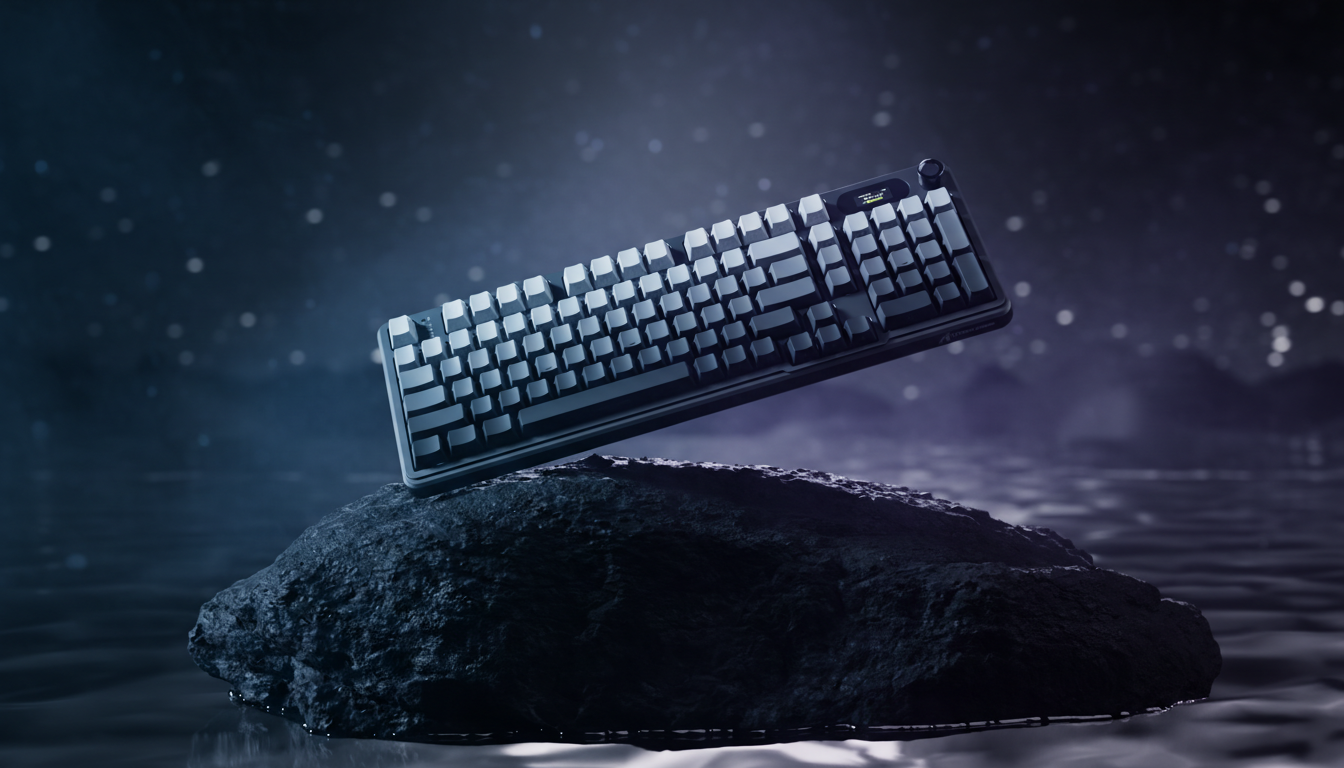
The Mechanics of Input: Defining the Actuation Point
In competitive gaming, the interval between a mental command and an in-game action is the ultimate bottleneck. This interval is composed of human reaction time and hardware latency. Central to hardware latency is the actuation point—the specific distance a key must travel before the switch sends a signal to the computer.
Standard mechanical switches typically feature a fixed actuation point of 2.0mm. In high-stakes environments, this distance represents a physical barrier to speed. By reducing this travel distance, players can theoretically initiate commands faster. However, the relationship between actuation depth and Actions Per Minute (APM) is governed by complex biomechanics and system-level constraints rather than a simple linear correlation.
Comparative Analysis: Fixed vs. Adjustable Actuation
The evolution from traditional mechanical switches to Hall Effect (magnetic) technology has introduced adjustable actuation. Unlike mechanical contacts that require physical closure, Hall Effect sensors measure changes in magnetic flux to determine the exact position of the stem.
| Switch Technology | Actuation Range | Reset Mechanism | Typical Latency |
|---|---|---|---|
| Traditional Mechanical | Fixed (1.5mm - 2.0mm) | Fixed Hysteresis | 5ms - 15ms (inc. Debounce) |
| Hall Effect (Standard) | Adjustable (0.1mm - 4.0mm) | Fixed Hysteresis | 1ms - 3ms |
| Hall Effect + Rapid Trigger | Adjustable (0.1mm - 4.0mm) | Dynamic Reset | 0.1ms - 1ms |
Logic Summary: The shift to Hall Effect technology eliminates the need for physical "debounce" periods—a firmware delay used to ignore electrical noise in mechanical contacts. This allows for near-instantaneous signal transmission once the magnetic threshold is crossed.

The Physics of Speed: APM Scaling and Latency Deltas
To understand the impact on APM, one must analyze the kinematics of a finger movement cycle. A single "action" consists of the downward press (actuation) and the upward release (reset).
In high-level RTS (Real-Time Strategy) play, practitioners often mod switches to reduce pre-travel to the absolute minimum (~0.5mm) to maximize command spam speed. However, this comes with a significant increase in accidental keystrokes during rest periods, requiring disciplined finger hovering. For rhythm games, a common heuristic is to set actuation just below the point where key chatter begins, often found between 1.0mm and 1.5mm for magnetic switches, balancing speed with reliability.
Scenario Modeling: The RTS Professional Latency Gain
We modeled a scenario for a competitive RTS player with a finger lift velocity of 150 mm/s. By comparing a standard mechanical switch to a Hall Effect setup with a 0.1mm reset distance (Rapid Trigger), we can quantify the mechanical edge.
- Mechanical Cycle: 0.5mm reset distance + 5ms firmware debounce = ~13.3ms total reset latency.
- Rapid Trigger Cycle: 0.1mm reset distance + 0ms debounce = ~5.7ms total reset latency.
- Theoretical Gain: A reduction of ~7.7ms per keypress cycle.
This ~7.7ms delta translates to a potential APM increase of approximately 5-8% for sustained spam actions. However, real-world gains are often lower (2-4%) due to the human bottleneck of decision speed and finger coordination, not just travel time. According to the Human Benchmark Reaction Time Test, the average human visual-motor reaction time is 200-300ms, which dwarfs the millisecond-level hardware optimizations for most players.
Genre-Specific Optimization: Finding the "Sweet Spot"
The "lowest is best" philosophy is a common misconception. Optimal actuation points are highly dependent on the gaming genre and the specific mechanics required.
- RTS (Real-Time Strategy): High APM requirements favor 0.1mm to 1.0mm actuation. The goal is to minimize the physical effort required for repetitive unit management and macro-cycles.
- MOBA (Multiplayer Online Battle Arena): Precise ability timing is more critical than raw spam. Most MOBA players benefit from 1.5mm to 2.5mm actuation to prevent "misfires" on high-cooldown ultimate abilities.
- FPS (First-Person Shooters): Movement control (counter-strafing) benefits from Hall Effect's Rapid Trigger, but a deeper actuation of 2.0mm to 3.0mm is often preferred for the initial press to ensure deliberate movement.
A critical, often overlooked factor is the reset point. If it is too close to the actuation point, it can cause "bouncing," where a single press registers multiple times. This fault is corrected in firmware by increasing the debounce delay, which then adds latency—negating the benefit of the low actuation point.

System-Level Bottlenecks: Polling Rates and Display Synergy
Increasing keyboard speed is irrelevant if the rest of the system cannot process the data. Modern high-performance peripherals utilize 8000Hz (8K) polling rates to minimize the interval between data packets.
The 8K Polling Math
- 1000Hz: 1.0ms interval.
- 8000Hz: 0.125ms interval.
At 8000Hz, technologies like Motion Sync add a deterministic delay equal to half the polling interval, which is approximately 0.0625ms. This is negligible compared to the 0.5ms delay found at 1000Hz. However, as noted in the Global Gaming Peripherals Industry Whitepaper (2026), 8K polling stresses the CPU's Interrupt Request (IRQ) processing. This requires a high-performance CPU with strong single-core speed and a direct connection to the motherboard's rear I/O ports. Using USB hubs or front panel headers can cause packet loss due to shared bandwidth and poor shielding.
Furthermore, there is a perceptual display synergy. While high polling rates reduce micro-stutter, a high refresh rate monitor (240Hz or 360Hz) is required to visually render the smoother path of a cursor or the instant response of a keypress. Without a high-refresh display, the hardware-level speed gains remain invisible to the player.
The Ergonomic Cost of High-APM Play
While lowering actuation points can increase speed, it also increases the physiological load on the player. Maintaining the "hovering" finger position required for 0.1mm actuation creates constant tension in the forearm and wrist.
Moore-Garg Strain Index Analysis
We applied the Moore-Garg Strain Index (SI) to a high-intensity RTS gaming scenario (300+ APM). The SI is a job analysis tool used to assess the risk of distal upper extremity disorders.
| Parameter | Multiplier | Rationale |
|---|---|---|
| Intensity of Effort | 1.5 | High precision required for low actuation |
| Duration of Exertion | 0.75 | Standard 3-4 hour sessions |
| Efforts per Minute | 4.0 | 300+ APM (Extreme repetition) |
| Hand/Wrist Posture | 1.5 | Claw/Fingertip grip strain |
| Speed of Work | 2.0 | Rapid key cycling |
| Duration per Day | 1.5 | Dedicated training schedule |
Calculated SI Score: 20.25 (Hazardous)
An SI score greater than 5 is generally classified as hazardous. The score of 20.25 indicates that pursuing maximum APM through ultra-low actuation points significantly increases the risk of Repetitive Strain Injury (RSI). This highlights the need for ergonomic accessories, such as an acrylic wrist rest, to maintain a neutral wrist angle.
Methodology Note: This SI score is a scenario model based on professional gaming workloads, not a clinical study. Individual risk factors vary based on hand size, grip style, and pre-existing conditions.
Strategic Implementation for Competitive Advantage
To effectively leverage the physics of speed, players should follow a structured optimization path rather than jumping to the lowest possible settings.
- Baseline Testing: Start at a 2.0mm actuation point and gradually decrease it in 0.5mm increments.
- Proprioception Limits: Most players cannot reliably distinguish between 0.1mm increments during high-speed play. The 0.1mm precision is often a marketing feature; practical performance differences are usually felt at 0.5mm intervals.
- Environmental Calibration: Ensure the keyboard is connected to a high-speed USB port and that the PC's power plan is set to "High Performance" to prioritize IRQ handling.
- Acoustic Management: Low-travel builds with minimal damping produce high-frequency "clack" sounds (>2000 Hz). For streamers, adding case foam or switch pads can shift the profile to a lower-frequency "thock" (<500 Hz), which is more broadcast-friendly.
Modeling Transparency (Method & Assumptions)
The data presented regarding latency deltas and strain indices is derived from a deterministic scenario model.
| Parameter | Modeled Value | Unit | Source Category |
|---|---|---|---|
| Finger Lift Velocity | 150 | mm/s | Biomechanical Estimate |
| Mechanical Reset Dist. | 0.5 | mm | Hardware Specification |
| HE Reset Dist. | 0.1 | mm | Hardware Specification |
| APM Benchmark | 300 | APM | Professional RTS Average |
| Session Length | 4 | Hours | Typical Competitive Play |
Boundary Conditions: This model assumes constant finger velocity and does not account for MCU polling jitter or network latency (ping), which often ranges from 20ms to 100ms and can dwarf hardware-level gains in online environments.

Summary of Performance Trade-offs
The pursuit of the "perfect" actuation point is a balancing act between mechanical speed, human error, and physical health. While a 0.1mm actuation point offers a theoretical ~7.7ms advantage, the practical gain is contingent on the player's ability to control accidental inputs and manage the resulting ergonomic strain.
For most competitive gamers, a "hybrid" approach is most effective: ultra-low actuation for movement keys and slightly deeper actuation for complex abilities. By aligning hardware specifications with specific genre needs and system capabilities, players can bridge the "specification credibility gap" and achieve a measurable competitive edge.
Disclaimer: This article is for informational purposes only. The ergonomic analysis and Strain Index calculations are scenario models and do not constitute professional medical advice. If you experience persistent wrist or hand pain, consult a qualified healthcare professional or physiotherapist.

Leave a comment
This site is protected by hCaptcha and the hCaptcha Privacy Policy and Terms of Service apply.