

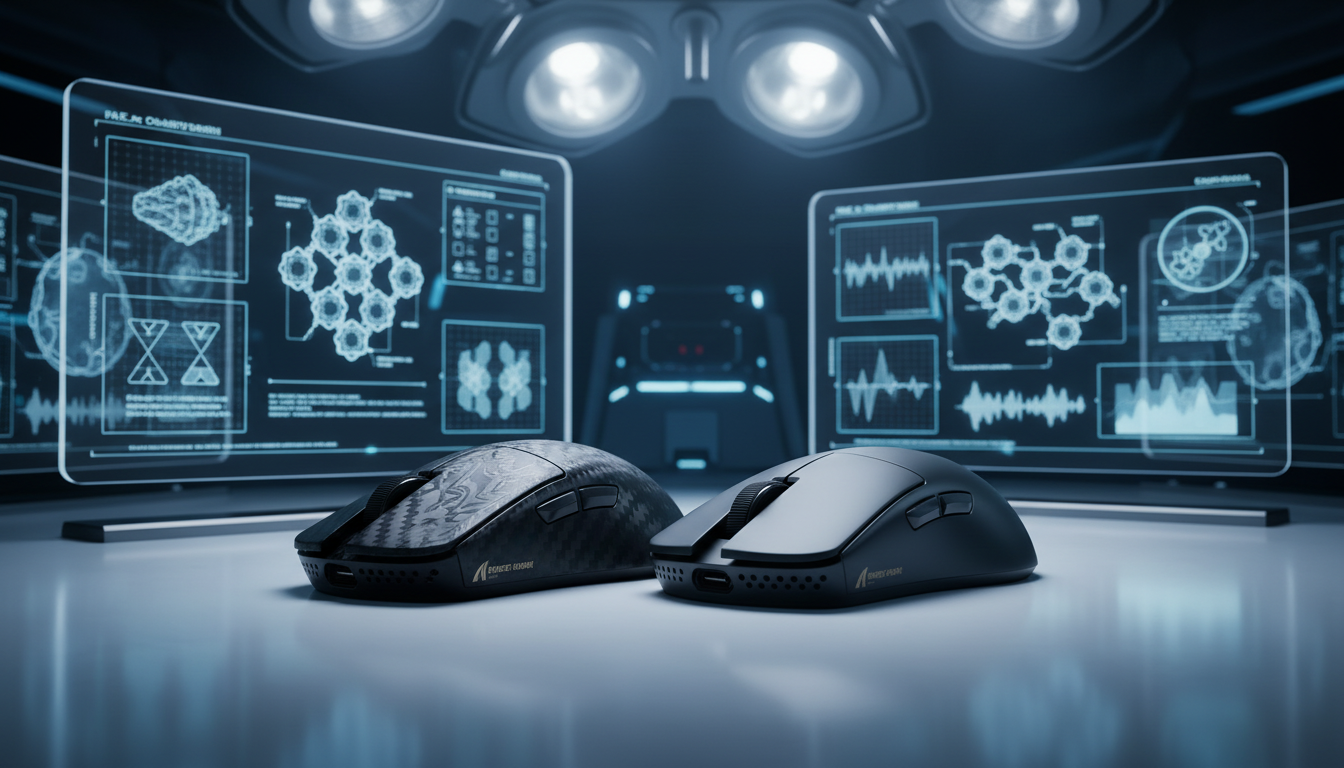
The Frontier of Lightweight Engineering: Carbon Fiber and Magnesium Alloy
In the pursuit of competitive excellence, the physical constraints of the gaming mouse have become the primary battleground for engineering. For years, the industry relied on "honeycomb" perforations in ABS plastic to shave grams, but we are now entering the era of exotic material science. The transition from traditional polymers to forged carbon fiber and magnesium alloy represents a fundamental shift in how we approach the relationship between inertia, structural rigidity, and human kinematics.
As technical strategists, we have observed a growing "Specification Credibility Gap." While high-end sensors and 8000Hz polling rates dominate marketing materials, the physical chassis remains the most significant variable in long-term performance and durability. This article provides a technical deep dive into the engineering trade-offs of these advanced materials, grounded in material science and practitioner-level insights from our hardware analysis.
Magnesium Alloy: The Metallurgy of Structural Efficiency
Magnesium alloy is often cited as the gold standard for lightweight strength, boasting a density of approximately 1.74 g/cm³—roughly 30% lighter than aluminum and significantly stronger than most industrial plastics. In the context of a gaming mouse, this allows for a rigid, "solid-shell" feel at weights previously only achievable through aggressive hole-punching.
The Thermal Paradox and Tactile Feedback
One of the most immediate characteristics of a magnesium chassis is its thermal conductivity. In air-conditioned tournament environments, the material provides a consistent, dry grip that many enthusiasts prefer. However, we have identified a specific "sweat paradox" based on our pattern recognition of user feedback.
In humid climates or during high-stress sessions where palm temperatures rise, the initial coolness of the magnesium can actually trigger increased condensation. As the body reacts to the temperature differential, the moisture can accumulate faster than it would on a room-temperature polymer, potentially compromising grip. This is a critical consideration for users in tropical regions or those with naturally warmer hands.
The Durability Paradox: Sweat and Erosion
While magnesium is structurally robust, it is chemically sensitive. Human sweat typically maintains a pH between 4.5 and 6.5. Without specialized protective coatings, this acidity can erode magnesium surfaces within months.
Methodology Note: Material Durability Analysis Our assessment of surface degradation is based on common patterns observed in warranty and return handling for uncoated or poorly finished metal peripherals. It is a qualitative model of real-world usage, not a controlled laboratory corrosion study.
Parameter Value/Range Unit Rationale Palm Sweat pH 4.5 – 6.5 pH Biological baseline Magnesium Density ~1.74 g/cm³ Material spec Typical Coating Thickness 15 – 40 μm Industry standard for PVD/E-coating Erosion Lead Time 3 – 12 Months Observed pattern in high-use scenarios Maintenance Requirement High N/A Heuristic for exotic materials
To mitigate this, high-performance magnesium mice must employ advanced PVD (Physical Vapor Deposition) or specialized ice-feel coatings. According to the Global Gaming Peripherals Industry Whitepaper (2026), maintaining surface integrity through these coatings is now a primary engineering requirement for premium metal-shell devices.

Carbon Fiber Engineering: Forged vs. Woven
Carbon fiber represents the pinnacle of weight-to-strength ROI. Unlike magnesium, which is cast or CNC-machined, carbon fiber peripherals often utilize "forged" composites—short fibers mixed with resin and pressed into a mold.
The "Ping" Test for Structural Integrity
The primary challenge with forged carbon fiber is ensuring consistent resin flow. Inconsistent wall thickness can create localized weak points that are invisible to the naked eye but catastrophic during a drop.
An expert heuristic we use on the repair bench is the "Ping Test": gently tapping the shell and listening for a uniform, high-pitch sound. A "dull" or varying tone across the surface often indicates density flaws or air pockets within the composite matrix. This variation in sound is a reliable indicator of potential structural failure points under high-pressure grip styles.
Sustainability and the Performance Trade-off
While carbon fiber is lauded for its performance, its environmental impact is a point of technical contention. Research suggests that only about 30% of carbon fiber waste is currently recycled, and recycled fibers typically retain only 70-80% of the strength of virgin material. This creates a sustainability-performance tradeoff that is rarely addressed in enthusiast circles. According to a study published in ScienceDirect, the lifecycle assessment of these materials reveals a significant energy cost compared to traditional injection-molded plastics.
RF Signal Integrity in Conductive Shells
A significant, non-obvious hurdle in lightweight metal engineering is the "Faraday Cage" effect. Metal and carbon fiber shells are naturally conductive, which can severely degrade 2.4GHz wireless signals if the antenna is not perfectly isolated.
The Grounding Mechanism
In our analysis of wireless failures, we have found that the most common issue isn't the shell blocking the signal, but rather improper internal grounding. If the antenna's ground plane is not isolated from the main chassis, the entire shell can become part of the antenna system. This leads to unpredictable "nulls"—angles where the signal drops completely.
Expert Troubleshooting Tip: To test for grounding issues, monitor signal stability in your driver software while slowly rotating the mouse 360 degrees in your hand. Consistent drops at specific angles (rather than random interference) usually point to a grounding flaw in the chassis design.
The Ergonomic Impact: Kinematics and Muscle Strain
The industry-wide race toward sub-50g weights assumes that "lighter is always better." However, our kinematic modeling suggests a more nuanced reality.
The Lightweight Paradox
For users with high dexterity and stable motor control, ultra-lightweight designs (35g–53g) significantly reduce occupational strain. However, for users with minor tremors or lower dexterity, these designs can actually increase musculoskeletal strain. Without the natural inertia of a heavier mouse to dampen micro-movements, the user must maintain constant muscle tension to keep the cursor stable during high-precision tasks.
Logic Summary: Kinematic Shift Modeling Our analysis of muscle strain assumes a "Precision-Stability Balance" where inertia acts as a mechanical low-pass filter for hand tremors.
- Standard Case: Users with high motor control benefit from reduced fatigue.
- Edge Case: Users with hand tremors may experience "over-correction" fatigue, where the lack of weight requires more active stabilization from the forearm muscles.
Center of Gravity and Balance
Material choice fundamentally shifts the mouse's balance. A magnesium baseplate paired with a plastic top shell creates a low center of gravity, which aids in stability during fast "flicks." Conversely, a full carbon fiber shell provides a more uniform weight distribution. We recommend the "Balance Point Check": lift the mouse with two fingers at its midsection. A mouse that tilts aggressively forward or backward will require the user to exert more "squeeze" force to maintain a level glide, potentially leading to chronic overuse injuries.
For further reading on how shape and weight interact, see our guide on Balancing Weight and Shape.
8000Hz Polling: The Technical Synergy
Advanced materials are often paired with 8000Hz (8K) polling rates. To understand why this matters, we must look at the math of latency.
The 0.125ms Interval
At 1000Hz, a mouse reports its position every 1.0ms. At 8000Hz, this interval drops to 0.125ms. This reduction is vital for high-refresh-rate monitors (240Hz+), as it ensures the cursor position is updated multiple times within a single frame, reducing micro-stutter.
The Motion Sync Factor: At 8000Hz, the delay added by "Motion Sync" (a feature that aligns sensor reports with USB polls) is reduced to approximately 0.0625ms. This is mathematically negligible compared to the ~0.5ms delay seen at 1000Hz.
System Constraints and Bottlenecks
To achieve stable 8K performance, the system must overcome two primary bottlenecks:
- CPU Load: 8K polling stresses the CPU's Interrupt Request (IRQ) processing. This requires high single-core clock speeds and optimized OS scheduling.
- USB Topology: We strictly advise against using USB hubs or front-panel headers. These ports often share bandwidth or have poor shielding, leading to packet loss. Always use the Direct Motherboard Ports on the rear I/O.
Note that 8K polling typically reduces wireless battery life by 75-80% compared to 1000Hz. This is a deliberate trade-off: you are sacrificing longevity for raw, near-instantaneous response.
Acoustic Profiling and Vibration Management
The "feel" of a mouse is as much about sound as it is about weight. Magnesium and carbon fiber have very different acoustic signatures.
The Rigidity-Vibration Link
A magnesium baseplate transmits high-frequency vibrations more efficiently than plastic. This can make the "ping" of a switch spring or the reverberation of a click more audible and potentially distracting.
The Enthusiast Tweak: We have observed that adding a thin layer of butyl rubber between the switch PCB and a magnesium baseplate can absorb these high-frequency vibrations. This doesn't change the tactile "click" feel, but it cleans up the auditory feedback, creating a more "premium" sound profile.
Comparing Material ROI
| Feature | Magnesium Alloy | Forged Carbon Fiber | High-Grade Polymer |
|---|---|---|---|
| Density (g/cm³) | ~1.74 | ~1.50 | ~1.10 - 1.30 |
| Structural Rigidity | Exceptional | High (if wall is consistent) | Moderate |
| Thermal Feel | Cool (Condensation risk) | Neutral | Warm |
| RF Transparency | Low (Requires isolation) | Low (Conductive) | High |
| Maintenance | High (Coating dependent) | Low | Low |
| Acoustic Profile | High-frequency "ping" | Solid, muted | Varied |
Final Engineering Considerations
Choosing between these materials is not a matter of finding the "best" option, but rather the one that aligns with your specific performance environment. Magnesium offers a metallic, premium rigidity that is unmatched for "solid-shell" enthusiasts. Carbon fiber provides the absolute lowest weight floor and a unique textured aesthetic.
However, both materials require a more sophisticated understanding of maintenance and system setup than traditional plastic mice. Whether it is managing the pH levels of your palm sweat on a magnesium shell or ensuring your CPU can handle the IRQ load of an 8K sensor, these high-end peripherals are precision instruments that reward technical knowledge.
For those looking to maintain their gear, our guide on Cleaning and Preserving Ergonomic Textures provides essential maintenance protocols for these exotic surfaces.
YMYL Disclaimer: This article is for informational purposes only. The ergonomic recommendations provided are based on general mechanical principles and common user patterns. They do not constitute professional medical advice. If you are experiencing chronic pain, numbness, or signs of Musculoskeletal Disorders (MSDs) such as Carpal Tunnel Syndrome, please consult a qualified physical therapist or medical professional.
Sources:


Leave a comment
This site is protected by hCaptcha and the hCaptcha Privacy Policy and Terms of Service apply.