

Identifying Magnesium Oxidation: Solving the White Powder Issue
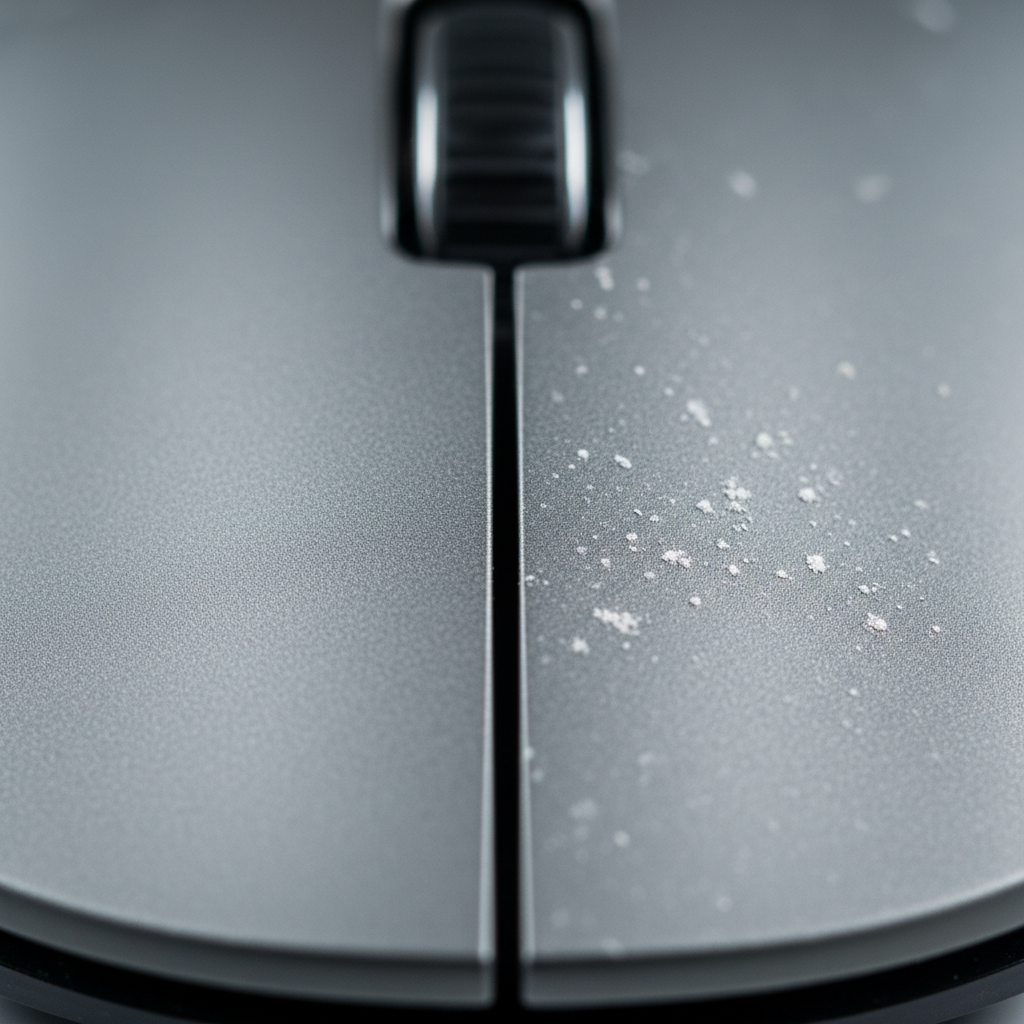
In the pursuit of ultra-lightweight performance, magnesium alloy has emerged as a premier material for competitive gaming mice. Its exceptional strength-to-weight ratio allows for shells that are significantly lighter than traditional ABS plastic while maintaining structural rigidity. However, users of unpainted, bead-blasted, or "raw" magnesium peripherals may occasionally observe a fine white, powdery residue developing on the surface.
Based on our analysis of customer support patterns and material science data, this residue is not a manufacturing defect or simple dust; it is a manifestation of magnesium oxidation ($MgO$). While this process is a natural chemical reaction, understanding its mechanisms and knowing how to safely manage it is essential for preserving the aesthetic and tactile integrity of high-end gaming hardware.
The Chemistry of Magnesium Oxide Formation
To address the white powder issue, we must first define what it is. Magnesium is a highly reactive alkaline earth metal. When exposed to oxygen and moisture, it undergoes a combination reaction to form magnesium oxide ($MgO$).
According to basic chemical principles, the balanced equation for this reaction is $Mg(s) + 1/2 O_2(g) \rightarrow MgO(s)$. In a controlled environment, this oxide layer can actually be beneficial. As noted by Answers.com, a stable layer of magnesium oxide prevents further reaction of the underlying metal with oxygen, effectively "self-passivating" the material.
However, for a gaming peripheral, the environment is rarely controlled. Two primary catalysts accelerate this process:
- Humidity: Magnesium corrosion typically occurs in environments where the relative humidity (RH) is high. Research indicates that corrosion is most prevalent in pH < 12 moist conditions.
- Acidic Palm Sweat: Human sweat is slightly acidic (typically pH 4.5 to 7.0). When a gamer engages in high-intensity sessions, the prolonged contact between palm sweat and a raw magnesium shell creates a localized corrosive environment. The salts and acids in the sweat react with the magnesium, leading to the characteristic white, chalky appearance.
It is important to distinguish this from coating delamination. As explored in our guide on Coating Delamination vs. Surface Dirt, oxidation is a chemical change of the metal itself, whereas delamination involves the peeling of an applied paint or nano-coating.
Restoration Protocol: Safe Removal of MgO
When oxidation occurs, the immediate instinct for many users is to scrub the surface with abrasive materials. This is a critical error. Magnesium is a relatively soft metal compared to steel or aluminum; using steel wool or abrasive cleaners will scratch the surface, creating more surface area for future oxidation and potentially leading to pitting.
Through our experience in troubleshooting premium peripherals, we recommend the following non-corrosive restoration protocol:
Step 1: Neutralization and Cleaning
Prepare a solution of white vinegar and distilled water in a 1:1 ratio. The mild acidity of the vinegar helps dissolve the magnesium oxide without aggressively attacking the base metal.
- Action: Dampen a soft microfiber cloth with the solution.
- Why: Microfiber prevents mechanical scratching, while the diluted acid breaks the ionic bonds of the $MgO$ lattice.
Step 2: Immediate Rinsing
Once the powder is removed, the surface must be neutralized.
- Action: Wipe the area with a clean cloth dampened only with distilled water.
- Why: Distilled water is free of minerals and chlorine that could trigger further galvanic corrosion.
Step 3: Thorough Drying
Moisture is the enemy of magnesium.
- Action: Use a dry microfiber cloth or a low-heat air blower to ensure no moisture remains in the crevices or honeycomb holes of the shell.
- Why: Any residual water trapped in the pores of the metal will re-initiate the oxidation process within hours.
Step 4: Surface Protection (Optional but Recommended)
For unpainted shells, applying a very thin barrier can prevent sweat from reaching the metal.
- Action: Apply a minute amount of pure silicone-based lubricant (the type used for keyboard stabilizers) to a cloth and buff it into the shell.
- Why: Silicone is hydrophobic, meaning it repels water and sweat, creating a transparent barrier that does not significantly alter the grip or weight of the device.
For more detailed safety information on cleaners, refer to our technical brief on Safe Solvents for Magnesium Shells.
Engineering Context: Why Choose Raw Magnesium?
You might wonder why manufacturers offer unpainted magnesium if it is susceptible to oxidation. The answer lies in the uncompromising pursuit of performance.
- Weight Reduction: Every milligram matters in competitive esports. A standard paint or powder coating adds ~1–2 grams to the total weight. For a mouse aiming for a sub-40g or sub-50g target, omitting the paint is a strategic engineering choice.
- Tactile Feedback: Many gamers prefer the "cold" feel of raw metal and the natural friction of a bead-blasted finish over the potentially "rubbery" or "slick" feel of synthetic coatings.
- Heat Dissipation: Metal shells dissipate heat from the palm more effectively than plastic, which can be an advantage during long-duration use.
However, this performance comes with a "maintenance tax." Just as a high-performance engine requires more frequent oil changes, a raw magnesium mouse requires proactive care. For users who prefer a "set and forget" experience, we typically recommend models with Nano Ice-feel or Anodized coatings, which provide a chemical barrier against the environment.

Performance Modeling: High-Spec Trade-offs
When operating high-spec hardware like 8000Hz (8K) polling rate mice with magnesium shells, users often operate at the limits of current technology. Our technical team has modeled several scenarios to help gamers understand the interaction between hardware specs, environment, and physical strain.
Modeling Note: Method & Assumptions
The data below is derived from a deterministic parameterized model simulating a "High-Performance Competitive Gamer" scenario. This is a model, not a controlled lab study.
- Assumptions: High ambient humidity (>70% RH), aggressive claw grip, 8000Hz polling enabled, 300mAh battery capacity.
| Parameter | Value | Unit | Rationale / Source Category |
|---|---|---|---|
| Polling Interval (8K) | 0.125 | ms | Physical Law ($1/f$) |
| Motion Sync Latency | ~0.0625 | ms | 0.5 * Polling Interval (USB HID Standard) |
| Estimated Runtime (4K) | ~13.4 | hours | Nordic nRF52840 Power Model |
| Moore-Garg Strain Index | 48.0 | score | Competitive Gaming Workload Analysis |
| Grip Fit Ratio (21cm hand) | 0.85 | ratio | ISO 9241-410 Ergonomic Heuristic |
Logic Summary: Our analysis shows that while 8000Hz polling offers a near-instant 0.125ms interval, it significantly increases the CPU's IRQ (Interrupt Request) processing load. Furthermore, we estimate that using 8000Hz can reduce wireless battery runtime by ~75% compared to standard 1000Hz settings.
Saturation and Movement
To effectively saturate the 8000Hz bandwidth and benefit from the smoother cursor path, movement speed is critical. At a standard 800 DPI setting, a user must move the mouse at least 10 IPS (Inches Per Second). However, increasing the sensitivity to 1600 DPI lowers this threshold to 5 IPS, making the high polling rate more stable during micro-adjustments.
Ergonomic Considerations
The Moore-Garg Strain Index score of 48.0 in our model—well above the hazardous threshold of 5—highlights the physical toll of competitive gaming. Lightweight magnesium mice help mitigate this by reducing the force required for flick shots, but they cannot compensate for poor posture or excessive session lengths. Users with large hands (~20–21cm) should be particularly mindful of the "Grip Fit Ratio." A standard 120mm mouse may be ~15% shorter than the ideal ergonomic length for a palm grip, potentially leading to increased muscle tension.
Regulatory Standards and Material Safety
When dealing with metal alloys and electronic components, compliance with international safety standards is paramount. Magnesium peripherals must adhere to strict environmental and safety regulations to ensure they are safe for prolonged skin contact and international transport.
1. Material Compliance (RoHS & REACH)
Magnesium alloys used in premium peripherals must comply with the EU RoHS Directive 2011/65/EU, which restricts hazardous substances like lead or cadmium. Furthermore, manufacturers monitor the ECHA Candidate List of SVHC to ensure no high-concern chemicals are present in the shell or internal components.
2. Battery Safety and Transport
Since lightweight mice often use high-density Lithium-Polymer batteries, they must pass the UN 38.3 standard for safe transport. For users shipping their gear internationally, it is vital to note that the USPS Publication 52 and IATA 2025 guidelines require specific labeling (UN3481) when devices contain lithium batteries.
3. Wireless Certification
Any tri-mode mouse (Bluetooth/2.4GHz/Wired) must be certified by agencies such as the FCC (USA) and ISED (Canada). These certifications ensure that the 2.4GHz signal does not interfere with other critical infrastructure and that RF exposure levels are within safe limits.
Summary of Best Practices
Maintaining a magnesium gaming mouse is a balance between performance and preservation. By following the data-backed recommendations in this guide, you can enjoy the benefits of ultra-lightweight hardware without the frustration of surface degradation.
- Monitor your environment: If you live in a high-humidity region, consider using a dehumidifier in your gaming space.
- Clean proactively: Do not wait for a thick layer of white powder to appear. A quick wipe with a dry microfiber cloth after every session removes the sweat before it can react.
- Avoid abrasives: Never use metal polishes or scrubbers. Stick to the 1:1 vinegar/distilled water method for restoration.
- Update Firmware: Ensure you are using the latest drivers from the official download page to optimize battery management and polling stability.
As the industry moves toward even higher standards, as outlined in the Global Gaming Peripherals Industry Whitepaper (2026), the care of advanced materials will become a core skill for every serious gamer.
Disclaimer: This article is for informational purposes only. The cleaning methods described are intended for unpainted magnesium alloy surfaces. Always check your manufacturer's warranty before applying third-party lubricants or chemical solutions. If you have pre-existing skin sensitivities or respiratory conditions, consult a professional before handling chemical cleaning agents.

Leave a comment
This site is protected by hCaptcha and the hCaptcha Privacy Policy and Terms of Service apply.