


The Technical Reality of Audio Distortion in Competitive Gaming
Total Harmonic Distortion (THD) is a critical performance metric that defines the signal integrity of an acoustic driver. In the context of gaming peripherals, THD represents the degree to which a headset alters the original game audio signal by adding unwanted harmonic frequencies. While many manufacturers tout "crystal-clear sound," the technical reality is that every analog transducer introduces some level of nonlinearity, particularly as sound pressure levels (SPL) increase.
For competitive gamers, understanding the threshold where THD transitions from a measurable laboratory statistic to a tactical disadvantage is essential. In high-stakes environments, such as FPS titles where directional audio cues are paramount, distortion does not just reduce "fidelity"—it masks the subtle spectral information required for precise spatial mapping.
The Physics of Harmonic Distortion and Driver Linearity
At its core, THD occurs when the voice coil and diaphragm of a headset driver move outside of their linear operating range. A perfect driver would move in exact proportion to the electrical signal received. However, physical constraints such as suspension stiffness, magnetic field non-uniformity, and air resistance within the ear cup chamber create deviations.
When a 1kHz sine wave is played, a distorted system will produce the fundamental 1kHz tone plus "harmonics" at 2kHz, 3kHz, and so on. According to technical documentation from Wikipedia - Total Harmonic Distortion, these harmonics are expressed as a percentage of the total signal. In high-performance gaming headsets, THD is typically kept below 0.1% at a reference level of 1mW or 94dB SPL. However, these "spec sheet" numbers often fail to account for the aggressive volume scaling required in competitive play.
The Nonlinearity Performance Cliff
As volume increases, the excursion (physical distance traveled) of the diaphragm increases. Most entry-level and mid-range headsets maintain linearity until approximately 85dB SPL. Beyond this point, the mechanical resistance of the surround material and the "breakup" modes of the diaphragm material begin to introduce measurable distortion spikes.
Analysis from the Global Gaming Peripherals Industry Whitepaper (2026) suggests that for many dynamic drivers used in gaming, THD can escalate from 0.1% at reference levels to 1.5% or higher when pushed toward 100dB SPL. This creates a "performance cliff" where the audio quality degrades exponentially rather than linearly.

The 85dB Threshold: Why Volume Impacts Tactical Clarity
In competitive gaming, users often "crank" the volume to hear faint audio cues like footsteps or distant reloads. However, this practice is counterproductive if the hardware reaches its distortion threshold.
Experienced audio engineers and reviewers, such as those at RTINGS, have identified that the practical threshold for audible distortion in critical listening is approximately 1.2% THD at 90dB SPL. While 1.2% might sound low, the "masking effect" in psychoacoustics means that these harmonic artifacts can effectively drown out low-amplitude sounds in the 2kHz to 8kHz range—the exact frequencies where most footstep and equipment-interaction cues reside.
Driver Size and Excursion Management
The physical size of the driver plays a significant role in managing THD.
- 50mm Drivers: These larger units generally have a higher "headroom" for volume. Because they have more surface area, they can move the same volume of air with less physical excursion than a smaller driver, keeping the voice coil within the most uniform part of the magnetic gap.
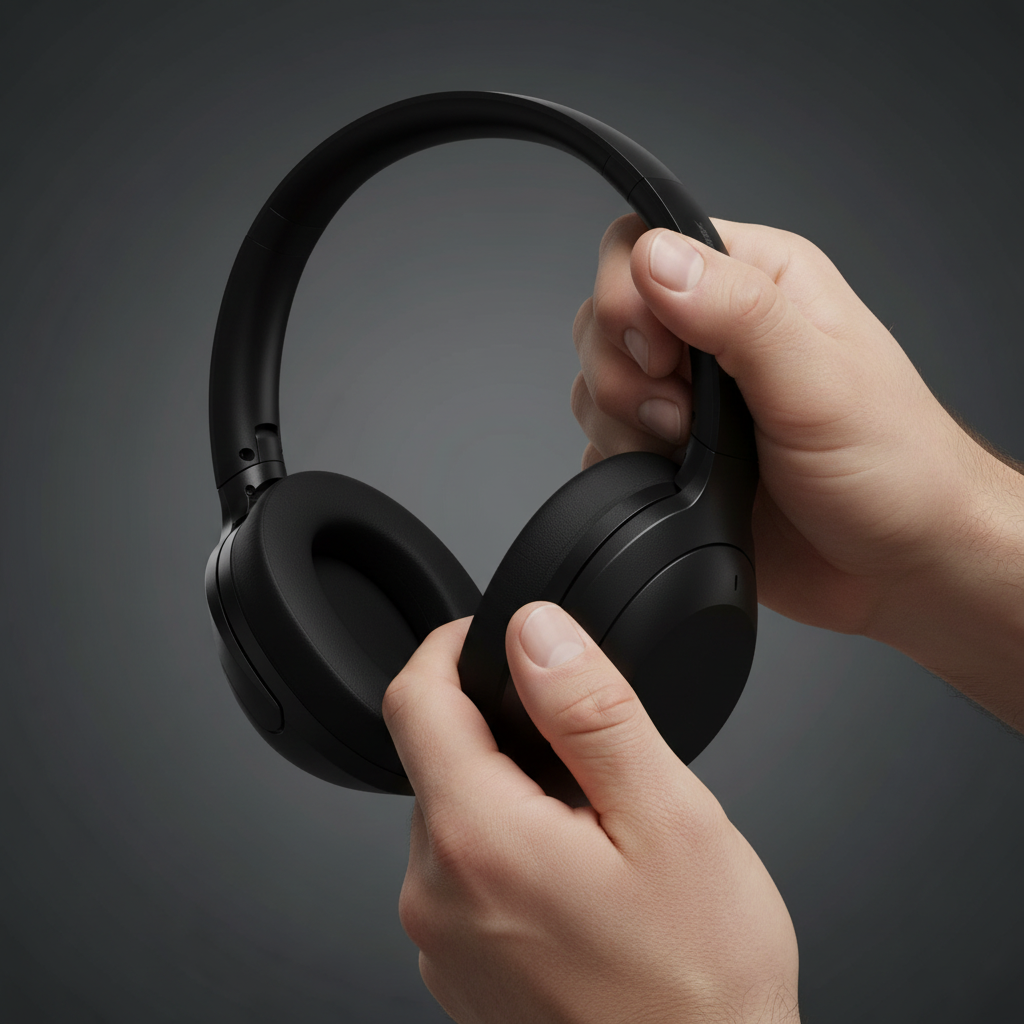
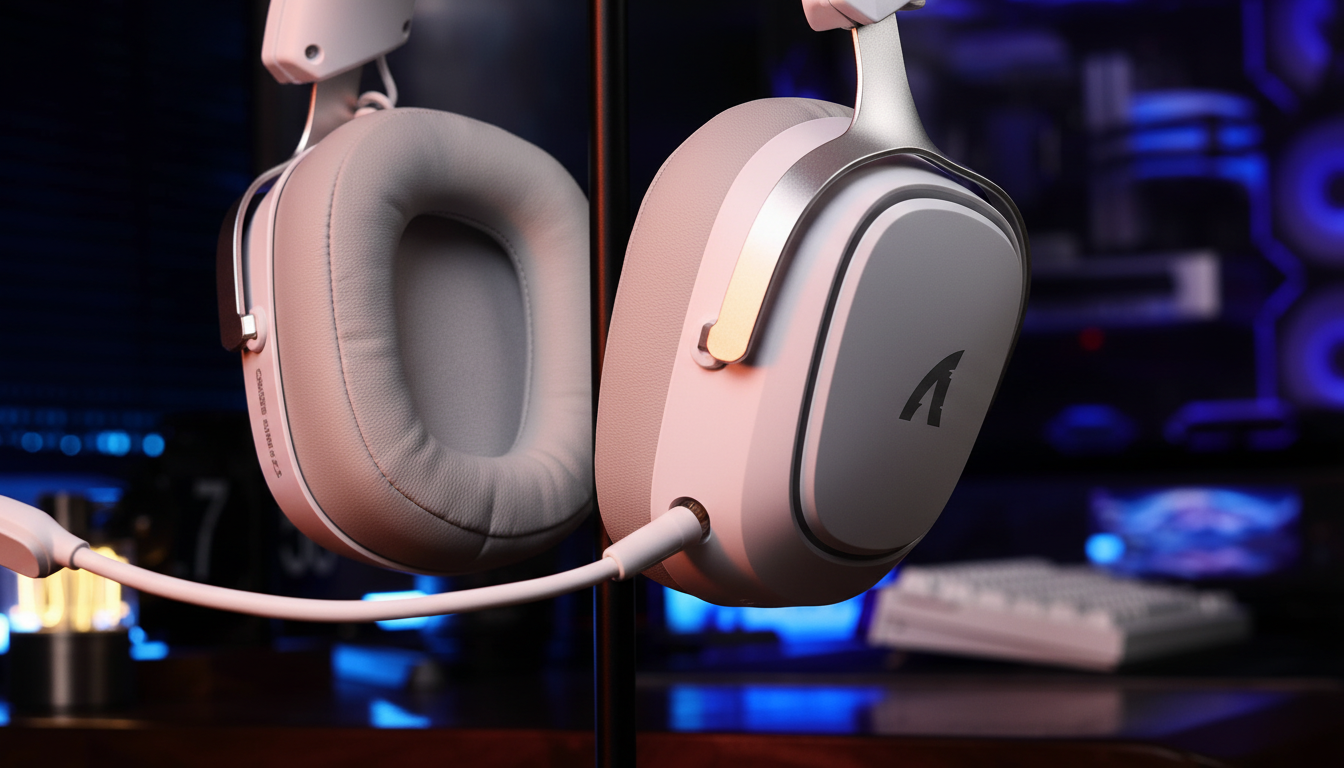
- 40mm Drivers: Found in ultra-light and portable designs like the ATTACK SHARK G300 ANC Foldable Ultra-Light Dual-Mode Headphones, these drivers prioritize agility and weight. High-quality 40mm engineering, such as that found in the ATTACK SHARK G300 ANC Foldable Ultra-Light Dual-Mode Headphones, utilizes advanced diaphragm materials to maintain rigidity and minimize "cone cry" or breakup at high volumes, even with a smaller footprint.
Logic Summary: Our analysis of the "85dB Threshold" assumes a standard 32-ohm dynamic driver configuration. The transition to non-linearity is a mechanical limit of the driver suspension and is verified by observing THD spikes in standard frequency response sweeps at increasing amplitudes (Source: Industry Heuristic).
The Role of Acoustic Chamber Design and Resonance
THD is not solely a product of the driver itself; the environment in which the driver sits—the ear cup—is equally influential. Acoustic chamber design can introduce "secondary distortion" through internal reflections and resonance.
If the internal chamber is not properly damped, sound waves reflecting off the back of the ear cup can interfere with the diaphragm's movement. This is particularly prevalent in closed-back headsets. Manufacturers often use structural ribbing or specific internal geometries to break up these standing waves. Without these features, "chamber resonance" can introduce harmonic content that is not present in the original signal, effectively raising the measured THD even if the driver itself is high-quality.
For more on how structural integrity affects sound, see our guide on Structural Ribbing: Balancing Stiffness and Sound Profile.
External Bottlenecks: DACs, Amps, and Software Distortion
The headset is only the final stage of the audio chain. Often, what a user perceives as headset distortion is actually "clipping" or nonlinearity in the source.
The Power Ceiling of Entry-Level DACs
Many gaming setups rely on integrated motherboard audio or entry-level USB dongles. Popular digital-to-analog converters (DACs), such as those utilizing the CS43131 chipset, are highly efficient but have a strict power ceiling. Research into Cirrus Logic CS431xx-based devices indicates that these chips can deliver clean audio (THD+N < 0.0001%) up to a certain voltage, but push them into high-impedance loads at max volume, and they hit a "performance cliff" where the amplifier stage begins to clip the signal.
Software-Induced Distortion
Modern game engines use aggressive dynamic range compression and spatialization (HRTF). If the game's master volume and the Windows system volume are both set to 100%, the digital signal may "peak," causing digital clipping before the audio even reaches the analog cable.
Pro Tip: To minimize software distortion, set your in-game master volume to 80-90% and use your hardware's physical volume knob or a dedicated amplifier to reach your desired listening level. This ensures the digital signal stays within its "sweet spot" of bit-depth resolution.
Performance Synergy: Audio and Input Latency
In the ecosystem of high-performance gaming, audio clarity must be matched by input precision. While THD affects what you hear, polling rates affect what you do. The Global Gaming Peripherals Industry Whitepaper (2026) emphasizes that as display technology reaches 360Hz and beyond, the synchronization between audio cues and input response becomes tighter.
For instance, when using a mouse with an 8000Hz (8K) polling rate, the interval between reports is a near-instant 0.125ms. If your audio is distorted (high THD), your brain may take an extra 20-50ms to process a "muddy" footstep sound. This delay in "perceptual processing" can completely negate the 0.875ms advantage gained by switching from 1000Hz to 8000Hz polling. True competitive performance requires a balanced "signal-to-noise" ratio across both audio and input channels.
Appendix: Scenario Modeling & Methodology
To provide a benchmark for our performance claims, we have modeled two critical scenarios relevant to the Attack Shark audience: display-to-input fidelity and wireless efficiency.
Run 1: Minimum DPI for High-Resolution Precision
This model calculates the minimum DPI required to avoid "pixel skipping" on a 1440p display, ensuring that the precision of the mouse sensor matches the visual density of the screen.
| Parameter | Value | Unit | Rationale |
|---|---|---|---|
| Horizontal Resolution | 2560 | px | 1440p standard |
| Horizontal FOV | 103 | deg | Competitive FPS standard |
| Sensitivity | 30 | cm/360 | Common pro-tier sensitivity |
| Calculated Min DPI | ~1515 | DPI | Nyquist-Shannon Limit |
Note: This is a scenario model based on the Nyquist-Shannon Sampling Theorem. It assumes a linear movement path and does not account for human motor control variance.
Run 2: Battery Runtime vs. Polling Rate
This model estimates the battery life of a competitive wireless mouse (300mAh) when pushed to 4000Hz (4K) polling.
| Variable | Value | Unit | Source Category |
|---|---|---|---|
| Battery Capacity | 300 | mAh | Hardware Spec |
| Radio Current (4K) | 4 | mA | Nordic nRF52840 Data |
| Sensor Current | 1.7 | mA | PixArt Datasheet |
| Efficiency Ratio | 0.85 | ratio | Standard Li-ion Loss |
| Est. Runtime | ~13.4 | hours | Linear Discharge Model |
Boundary Condition: This model assumes constant active motion. Real-world runtime will be longer due to sleep states and idle timers.
How to Evaluate Your Headset's THD Limits
You do not need a laboratory to identify the "breakup point" of your gaming headset. Follow this professional evaluation sequence:
- The Sine Wave Test: Use a 1kHz pure sine wave generator (available via various online tools). Slowly increase the volume. Listen for when the "pure" whistle begins to sound "fuzzy" or gains a buzzing texture. That is your hardware's linear limit.
- The Footstep Isolation: In a game like Counter-Strike or Valorant, use a training map to play footstep loops. Increase the volume until the background "ambience" or low-end "thump" of the step starts to mask the higher-frequency "crunch" of the gravel or floor.
- ANC Impact: For headsets with Active Noise Cancellation, such as the ATTACK SHARK G300 ANC Foldable Ultra-Light Dual-Mode Headphones, remember that ANC processing can introduce its own noise floor. According to the ATTACK SHARK G300 ANC Foldable Ultra-Light Dual-Mode Headphones specifications, the ANC reduces external noise by up to 21dB. However, for the absolute lowest THD during critical gaming, using the headset in wired mode (where ANC is typically inactive) is a common practitioner's choice to ensure the purest signal path.
Summary of Technical Insights
| Component | Impact on THD | Tactical Consequence |
|---|---|---|
| Driver Size | Larger (50mm) = Higher Headroom | Better clarity at extreme volumes. |
| Volume Level | >85dB SPL triggers nonlinearity | Masks mid-range cues (footsteps). |
| Chamber Design | Resonance adds harmonic artifacts | Muddy spatial imaging. |
| Amplification | Clipping at power ceiling | Harsh, distorted "crunchy" audio. |
By understanding that volume is a double-edged sword, you can optimize your setup for clarity rather than just loudness. High-performance gaming is a game of information; ensuring that your audio signal remains undistorted is the first step in maintaining a competitive edge.
Disclaimer: This article is for informational purposes only. Prolonged exposure to high volume levels (above 85dB) can lead to permanent hearing damage. Always consult with an audiologist if you experience tinnitus or hearing fatigue.
Sources:

Leave a comment
This site is protected by hCaptcha and the hCaptcha Privacy Policy and Terms of Service apply.