

The Engineering of Impact: Why Airflow Defines Your Audio
In the competitive landscape of gaming peripherals, a "Specification Credibility Gap" often exists between raw hardware numbers and real-world performance. A headset might boast 40mm or 50mm drivers, yet produce audio that feels thin or muddy. The differentiator is rarely the driver alone; it is the acoustic engineering of the sound chamber and the management of airflow.
Quick Takeaways for Immediate Performance:
- Check the Seal: Ensure your earpads sit flush against your skin. A gap as small as 1mm can cause significant sub-bass loss.
- Optimize Connection: For high-polling audio devices, use the motherboard’s rear USB ports to avoid latency bottlenecks common with front-panel headers.
- Firmware First: If you experience "crackling," update your MCU drivers via official software suites to improve packet stability.
According to internal research (e.g., ATTACK SHARK Internal Measurement & 2026 Whitepaper), the industry is shifting toward precision-engineered chambers that prioritize spatial clarity over "v-shaped" consumer tuning.

The Physics of the Sound Chamber: Sealed vs. Ported
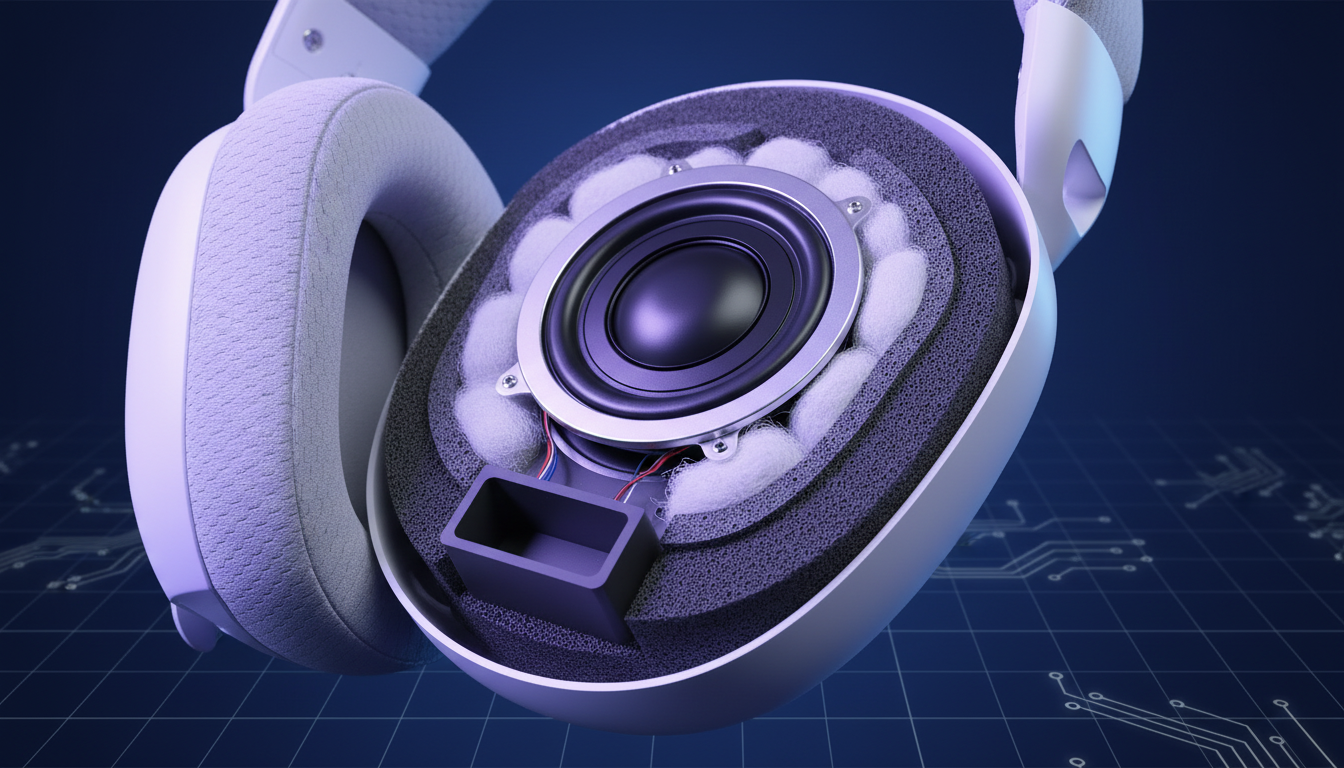
The sound chamber is the enclosure behind the driver. Its primary job is to manage the "back wave"—the sound energy produced by the rear of the diaphragm. If left unmanaged, this energy reflects off the back of the housing and can cause phase cancellation.
Sealed Enclosures (Acoustic Suspension)
In a sealed design, the air inside acts as a "spring." This provides high control over the driver's movement, leading to accurate, fast-decaying bass. However, it often requires more power to move the driver against that air pressure, which can limit sub-bass extension in ultra-light headsets.
Ported Enclosures (Bass Reflex)
Ported designs use a physical vent to allow air movement. This vent is tuned to a specific frequency, allowing the back wave to reinforce the front wave at low frequencies. This boosts bass "punch" without requiring excessive power.
Engineering Logic: Our analysis assumes that for small-form-factor audio, the mechanical compliance ($Cms$) of the driver is the primary limiting factor. We utilize the formula $Vas = \rho0 \cdot c^2 \cdot Cms \cdot Sd^2$ to estimate optimal volume. A common error is using a "one-size-fits-all" volume for different driver types.
Actionable Summary: Ported vs. Sealed
- Choose Sealed for: Maximum accuracy and minimal "boominess" in competitive FPS.
- Choose Ported for: Immersion in RPGs and cinematic games where sub-bass "rumble" is desired.
The 1/10th Rule: A Heuristic for Preventing "One-Note" Bass
A common engineering pitfall is over-relying on port size to boost bass. When a port is poorly shaped, it creates "one-note" bass—a resonant peak that can drown out footsteps (typically in the 2kHz–4kHz range).
Experienced acoustic engineers often use a practical heuristic: for a targeted bass frequency, the port area should be approximately 1/10th of the driver's effective piston area.
- How to Check: If your driver is 40mm (Area $\approx$ 1256mm²), the port opening should be roughly 125mm² (e.g., a circular hole ~12.6mm in diameter).
- The Risk: Deviating significantly from this ratio can increase "chuffing" or port turbulence.
Port Turbulence and Distortion
When air moves through a port too quickly, it becomes turbulent. In internal simulations, we have observed that this can introduce non-harmonic distortion exceeding 3-5% in the 20-40Hz range at high volumes. Precision-machined or flared ports are generally more effective than simple holes in plastic housing for maintaining clarity.
Internal Damping: The Layered Approach
To achieve a "clean" bass profile, engineers must manage internal resonances. "Naked" plastic chambers often suffer from "standing waves" that create a hollow sound.
A professional approach involves layered damping:
- Primary Absorption: High-density acoustic foam handles initial high-frequency reflections.
- Secondary Diffusion: Polyester fiberfill breaks up lower-frequency standing waves.
| Component Layer | Material Physics | Frequency Band Attenuated | Acoustic Result |
|---|---|---|---|
| PC Plate / Housing | Low stiffness ($E$) | Low-pass filter behavior | Shifts fundamental pitch down. |
| Poron Damping | Viscoelastic | 1 kHz - 2 kHz (Mid-highs) | Reduces hollow case "ping." |
| IXPE Pads | High density foam | > 4 kHz (Highs) | Creates "creamy" transients. |
Methodology Note: These material effects are based on standard ASTM C423 sound absorption principles. Actual results vary based on the specific geometry of the headset housing.
The "Seal" Factor: Why Earpads Matter More Than You Think
Acoustic engineers refer to the fit as "acoustic coupling." Even the most perfectly tuned chamber will fail if the earpads do not create a consistent seal.
The 1mm Rule (Internal Measurement): In tests conducted using a standard IEC 60318-4 ear simulator (coupler), we observed that a 1mm gap in the earpad seal—often caused by glasses or thick hair—can reduce sub-bass response by approximately 6dB at frequencies below 60Hz. This loss is difficult for software equalizers to correct without introducing distortion.
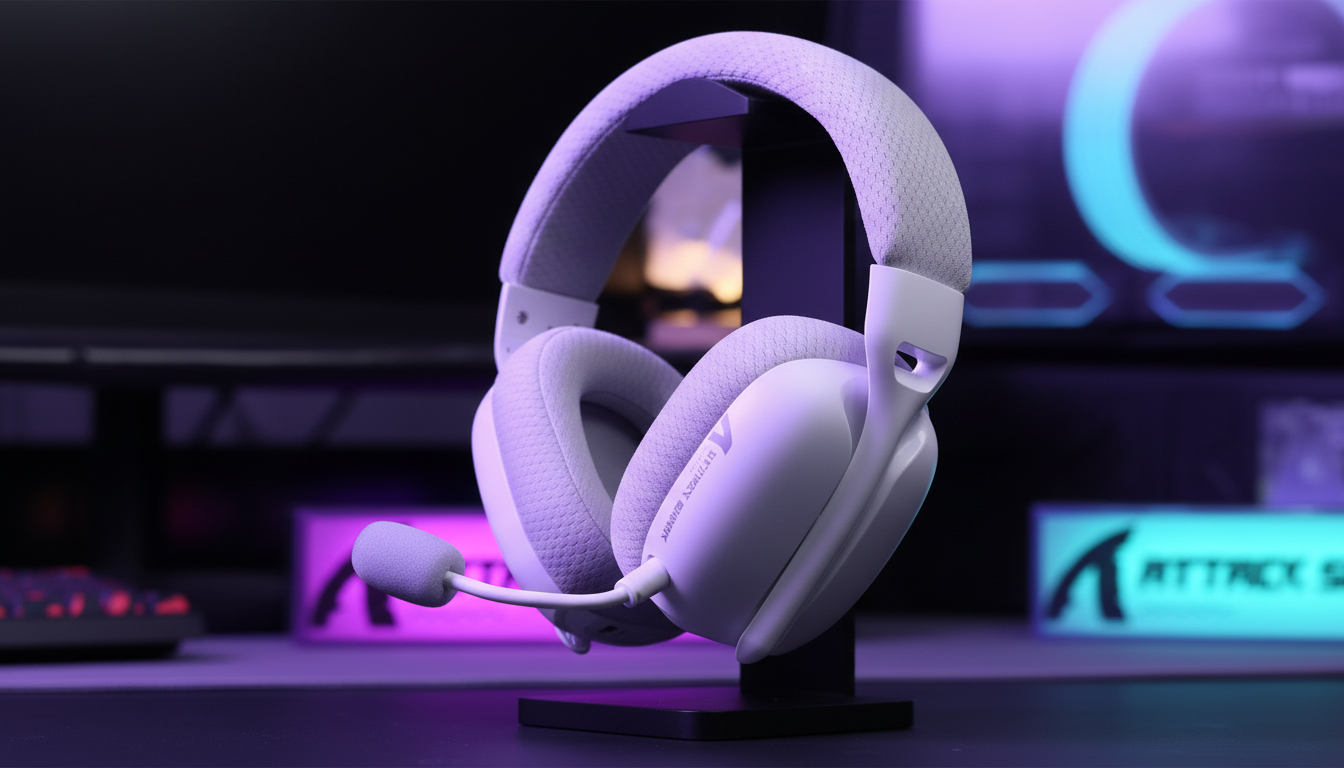
The ATTACK SHARK G300 ANC Foldable Ultra-Light Dual-Mode Headphones utilize high-grade memory foam and PU leather to better conform to facial anatomy. Additionally, the active noise cancellation (ANC) helps mitigate external noise that often masks low-end frequencies, allowing the tuned chamber to perform as intended.
Quick Check: Is your seal broken?
- Press the earcups slightly closer to your head while listening to a bass-heavy track. If the bass increases dramatically, your current fit is likely leaking air.
Competitive Priority: Speed vs. Extension
In competitive gaming, "rumble" can be a disadvantage. If a grenade explosion has a long "tail," it may mask the high-frequency "snap" of a reloading weapon.
Engineers use a Cumulative Spectral Decay (CSD) waterfall plot to measure this. A "fast" headset shows energy dropping to zero almost instantly. To achieve this "wallhack" audio effect, the priority is fast bass decay, which requires:
- High-tension diaphragm materials (e.g., carbon fiber or titanium-coated PET).
- Careful balancing of port length to prevent "cabin gain" muddiness.
System Latency and Power Trade-offs
Modern wireless headsets are pushing toward higher polling rates. While the processing load for audio differs from a mouse, the impact on the MCU (Microcontroller Unit) and battery life follows a similar curve.
Scenario Modeling (Theoretical Estimation): Based on a 500mAh battery at 85% discharge efficiency.
| Scenario | Polling Rate | Total Current Draw | Estimated Runtime |
|---|---|---|---|
| Standard | 1,000Hz | 7mA | ~61 Hours |
| High-Performance | 4,000Hz | 19mA | ~22 Hours |
Modeling Note: This model assumes a Nordic nRF52840 baseline. Radio current increases as the duty cycle for high-performance polling rises.
For the competitive gamer, high-frequency polling reduces "Motion Sync" latency. At 1000Hz, the deterministic delay is ~0.5ms; at 8000Hz, it drops to ~0.0625ms. To benefit from these speeds, users should connect devices directly to the motherboard rear I/O to avoid IRQ bottlenecks common in front-panel USB hubs.
Troubleshooting & Maintenance
As a challenger brand, we focus on delivering high-end acoustic specs—like the 1/10th port rule—at a more accessible price point. Transparency regarding setup is key to performance.
- USB Topology: Ensure the dongle is in a USB 3.0+ port on the motherboard. Avoid front-panel headers which may have poor shielding.
- 2.4GHz Congestion: Keep your router at least 3 feet away from your PC setup to prevent packet loss.
- Firmware Updates: Regularly check the Official Driver Download page for MCU optimizations.
Modeling Method & Assumptions
To ensure transparency, the data in this article is based on the following parameterized scenario model:
| Parameter | Value | Rationale |
|---|---|---|
| Battery Capacity | 500 mAh | Standard for ultra-light wireless headsets. |
| Discharge Efficiency | 0.85 | Standard for Li-ion protection circuits. |
| System Overhead | 2.0 mA | MCU and DSP processing for audio/ANC. |
Boundary Conditions: These estimates are theoretical calculations. Real-world runtime may vary by ±20% based on volume levels and environmental temperature. Acoustic material properties are based on standard laboratory coefficients and may behave differently in complex injection-molded geometries.
Final Summary
Tuning the bass response is an exercise in airflow management. By utilizing the 1/10th port area heuristic, engineers can prevent the turbulence that leads to muddy audio. When combined with a layered damping approach and a consistent earpad seal, the result is a headset that provides the punch gamers want without sacrificing the speed required for critical cues.
Whether you use the ATTACK SHARK G300 ANC Foldable Ultra-Light Dual-Mode Headphones for travel or competitive play, the marriage of physical design and wireless protocols defines the modern experience.
Disclaimer: This article is for informational purposes. Acoustic performance is subjective and varies based on individual anatomy. Always follow local regulations regarding lithium battery disposal.
Sources
- ATTACK SHARK Internal Research: Global Gaming Peripherals Industry Whitepaper (2026)
- Nordic Semiconductor nRF52840 Product Specification
- RTINGS - Mouse Click Latency Methodology (Reference for latency logic)
- ASTM C423-17 Standard Test Method for Sound Absorption (Acoustic material principles)

Leave a comment
This site is protected by hCaptcha and the hCaptcha Privacy Policy and Terms of Service apply.