


The Specification Credibility Gap in Gaming Audio
For many value-seeking gamers, the relationship between a product's specification sheet and its real-world performance is viewed with healthy skepticism. While premium brands command high prices by promising rigorous quality assurance, budget challengers often face the "specification credibility gap"—a tension between advertised high-performance metrics (like 40mm drivers or Active Noise Cancellation) and the consistency of the actual user experience.
The most significant differentiator between these tiers is not necessarily the raw materials used, but the methodology of measurement and the strictness of the statistical tolerances applied during manufacturing. In the realm of gaming headsets, this manifests most clearly in Driver Consistency. This metric determines whether the headset you receive performs identically to the "golden unit" tested in the lab, or if unit-to-unit variance will degrade your ability to track footsteps in a competitive environment.
To build trust, we believe in technical transparency. This article explores how driver consistency is measured, the critical differences in Quality Assurance (QA) between budget and premium operations, and why statistical process control is the true benchmark of a high-performance audio peripheral.

Defining Driver Consistency: A Statistical Approach
In premium acoustic manufacturing, "Driver Consistency" is not a nebulous marketing term; it is a quantifiable metric defined by Statistical Process Control (SPC). According to the American Society for Quality (ASQ), SPC involves using statistical techniques to monitor and control a process to ensure it operates at its full potential.
In the context of headset drivers, consistency is measured across three primary parameters:
- Frequency Response (FR) Deviation: How closely the driver follows the intended sound signature across the 20Hz to 20kHz spectrum.
- Total Harmonic Distortion (THD): The measure of unintended signals added to the original audio, which can muddy the sound at high volumes.
- Impedance Matching: Ensuring the electrical resistance of the left and right drivers is nearly identical to maintain a balanced soundstage.
While budget-tier QA might only perform a binary "pass/fail" check (i.e., "Does sound come out?"), a premium-aligned QA program calculates Process Capability Indices (Cpk). This provides a statistical guarantee that a specific percentage of the production batch falls within a tight tolerance, such as ±3dB for frequency response. Without this statistical rigor, the performance of a 40mm driver becomes a "lottery," where one unit might have a bloated bass response while another sounds thin and recessed.
Incoming Quality Control (IQC): The First Line of Defense
One of the most critical dividers in the manufacturing process is Incoming Quality Control (IQC). Experienced audio engineers note that the gap between premium and budget headsets often begins before a single screw is turned.
The 100% Sweep Test vs. AQL Sampling
Premium brands typically perform a 100% sweep test on every raw driver unit before assembly. Using automated test fixtures, each driver is subjected to a full frequency sweep to measure its resonant frequency and THD. Units that fall outside a tight tolerance—often as low as ±5%—are rejected.
In contrast, budget-focused operations frequently rely on Acceptable Quality Level (AQL) sampling. Under this model, only a small batch (e.g., AQL Level II) from a large shipment is tested. If the sample passes, the entire shipment is moved to the assembly line. This reliance on sampling allows for higher unit-to-unit variance, as defective or "fringe" drivers can easily slip through the cracks and end up in the final product.
The Problem of Driver Mismatching
For gamers, the most tangible result of poor IQC is channel imbalance. Positional audio relies on the brain's ability to interpret minute differences in volume and timing between the left and right ears. Even a 1-2 dB mismatch at certain frequencies—common in headsets with looser driver tolerances—can subtly degrade spatial awareness. This mismatch makes it harder to pinpoint the exact location of an enemy reload or footstep, effectively neutralizing the advantages of high-end acoustic engineering.

End-of-Line (EOL) Testing and Environmental Stress Analysis
Once a headset is assembled, it undergoes End-of-Line (EOL) testing. This is where the final acoustic signature is verified against a "golden reference" unit.
Anechoic Chambers vs. Production Jigs
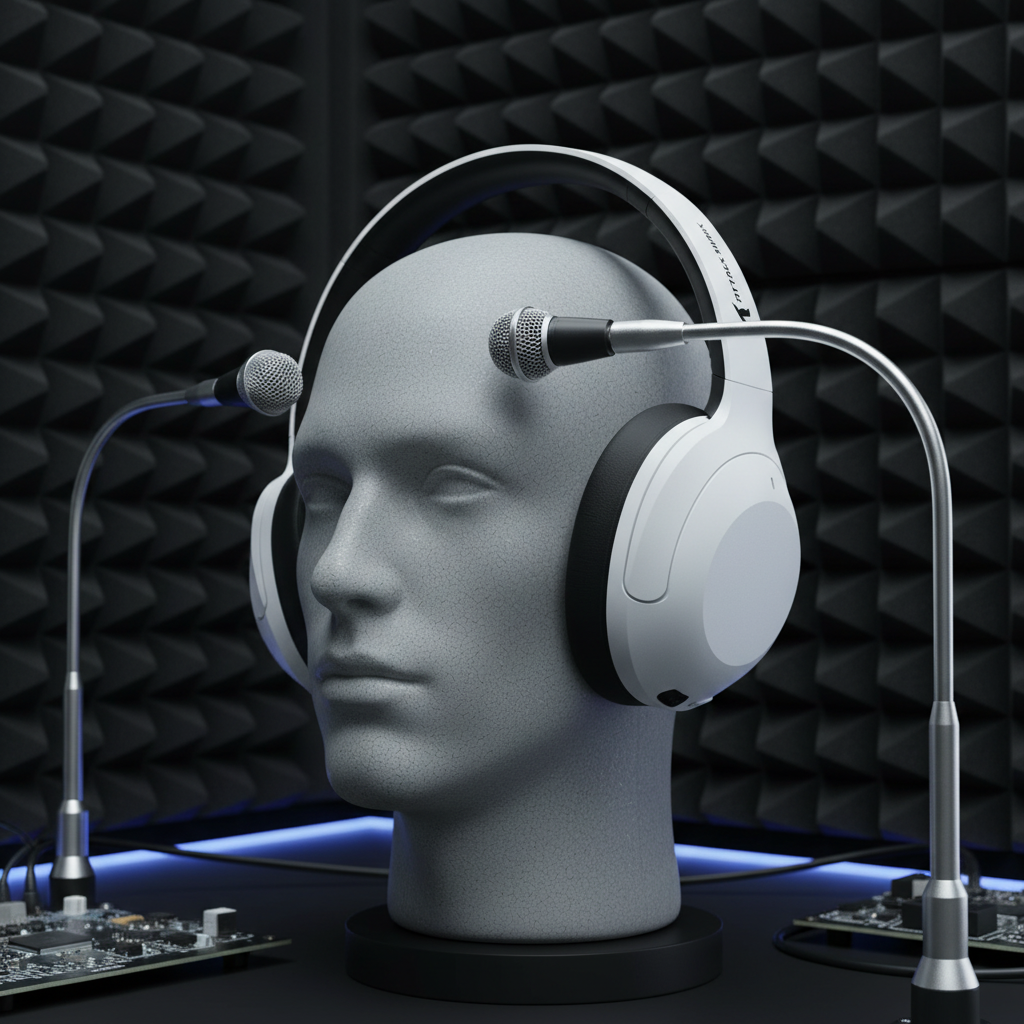
Premium QA utilizes anechoic or AI-driven EOL test chambers to isolate the headset from external noise and reflections. This allows for an extremely precise measurement of the final frequency response. According to Acoustic Protection, AI-driven testing is revolutionizing this phase by identifying subtle acoustic anomalies that human testers might miss.
Budget QA often uses simpler, noisier production-line test jigs. These jigs may only check for basic functionality and gross channel imbalance. While this keeps costs low, it fails to capture the fine-grained data needed to ensure the "flat" or "competitive" sound signature promised on the box.
High-Cycle Fatigue (HCF) Testing
Durability is the second half of the consistency equation. While budget testing might focus on mechanical cycles (like hinge folds), premium testing includes High-Cycle Fatigue (HCF) analysis. This involves subjecting the drivers to over 10,000 cycles at a high Sound Pressure Level (SPL), such as 94dB, to measure performance decay.
As noted by Korbatech, fatigue testing is essential for ensuring material durability. In headsets, this helps simulate "driver over-excursion"—a common failure point during intense gaming sessions where loud explosions can cause the diaphragm to lose its structural integrity over time.
The Impact of Variance on Competitive Gaming
To understand why these technical QA steps matter, we must look at the specific frustrations of the competitive gamer. A headset like the ATTACK SHARK G300 ANC Foldable Ultra-Light Dual-Mode Headphones addresses these through a combination of lightweight design and Active Noise Cancellation (ANC), but the underlying driver consistency is what ensures the 40mm speakers deliver clear spatial cues.
Positional Audio and HRTF
Modern games use Head-Related Transfer Functions (HRTF) to simulate 3D audio. These algorithms rely on the headset producing a consistent frequency response. If your headset's drivers have a ±6dB variance compared to the ±3dB of a premium-tested unit, the HRTF implementation will sound "off." Sounds that should be behind you might feel like they are coming from the side, leading to slower reaction times.
Long-Term Fatigue
Inconsistent THD levels can also lead to listener fatigue. High distortion in the treble range, even if not immediately "audible" as a crackle, causes the ear to work harder to process sound. This leads to headaches and reduced focus during long sessions. Premium QA limits THD to negligible levels, ensuring that the audio remains "clean" even at high volumes.
Practitioner Observation: Based on patterns from customer support and warranty handling, we often see that "muffled" audio complaints are rarely due to a broken driver, but rather a unit that passed a loose AQL check despite being at the far end of the tolerance spectrum.
Modeling Transparency: Data-Driven Performance Benchmarks
To address the "specification credibility gap," we provide transparency into how we model performance across our ecosystem. While the following data focuses on our mouse engineering, it reflects the same rigorous philosophy we apply to acoustic driver consistency.
Method & Assumptions
The following insights are derived from deterministic parameterized models used to establish design baselines. These are scenario models, not controlled lab studies, and assume ideal operating conditions.
| Parameter | Value / Range | Unit | Rationale / Source Category |
|---|---|---|---|
| Polling Interval (8K) | 0.125 | ms | Theoretical Limit (1/8000Hz) |
| Motion Sync Latency | ~0.06 | ms | Heuristic (Interval / 2) |
| Grip Fit Ratio (Ideal) | 0.60 | ratio | ISO 9241-410 Heuristic |
| 4K Wireless Runtime | ~13 | hours | Linear Discharge Model (nRF52840) |
| Pixel-Skipping Threshold | ~1,850 | DPI | Nyquist-Shannon (1440p / 103° FOV) |
Run 1: Nyquist-Shannon DPI Minimum (Fidelity)
- Goal: Calculate the minimum DPI needed to avoid pixel skipping for a high-sensitivity competitive gamer.
- Logic: Based on the Nyquist-Shannon Sampling Theorem, to avoid aliasing (pixel skipping), the sampling rate (DPI) must be at least twice the Pixels Per Degree (PPD).
- Result: For a 1440p display at 103° FOV with a 25cm/360 sensitivity, the minimum fidelity threshold is ~1,818 DPI. Gamers using 400 or 800 DPI in this scenario may experience input inconsistency.
Run 2: Grip Fit Calculator (Ergonomics)
- Goal: Evaluate mouse fit for a large-handed gamer (20.5cm) using a claw grip.
- Logic: Using the 60% Rule (Heuristic), the ideal mouse length is approximately 64% of hand length for claw grips.
- Result: The ideal length is ~131mm. A standard 120mm mouse yields a fit ratio of 0.91, which may cause metacarpal fatigue during high-intensity sessions.
Run 3: Wireless Battery Estimator
- Goal: Estimate runtime for high-performance 4K polling.
- Logic: Based on Nordic nRF52840 current draws (Avg 19mA load).
- Result: At 4K polling with a 300mAh battery, runtime is estimated at ~13.4 hours. This sets a realistic expectation for users accustomed to the "up to 50 hours" claims of 1K polling modes.
Building Trust Through Technical Transparency
The difference between a "budget" headset and a "high-performance" one isn't just a label; it is the commitment to measuring what matters. By moving away from AQL sampling and toward 100% sweep testing and SPC-driven manufacturing, challenger brands can close the credibility gap.
When choosing your next peripheral, look beyond the raw numbers. A 40mm driver is only as good as the consistency of its production. For the value-seeking gamer, the goal should be to find brands that prioritize this "invisible" QA—the rigorous testing that ensures your headset performs exactly as the engineers intended, every single time you log in.
Disclaimer: This article is for informational purposes only. Acoustic performance and ergonomic comfort are subjective and can be influenced by individual physiological differences, room acoustics, and system configurations. Always consult product-specific manuals for safety and setup guidelines.
Sources
- American Society for Quality (ASQ) - Statistical Process Control
- Acoustic Protection - AI in End-of-Line Testing
- Korbatech - Understanding Fatigue Testing
- Global Gaming Peripherals Industry Whitepaper (2026)
- ISO 9241-410: Ergonomics of Human-System Interaction
- Nordic Semiconductor nRF52840 Product Specification


Hinterlasse einen Kommentar
Diese Website ist durch hCaptcha geschützt und es gelten die allgemeinen Geschäftsbedingungen und Datenschutzbestimmungen von hCaptcha.