


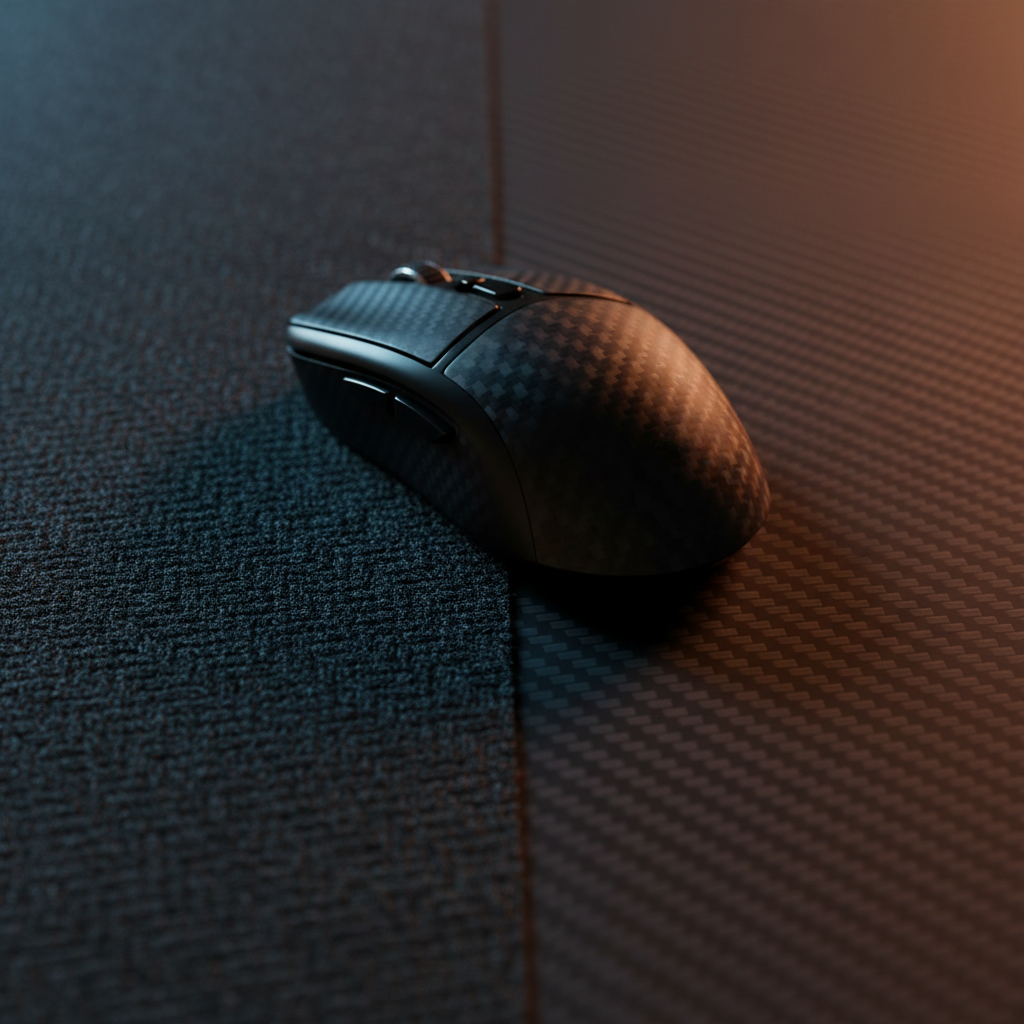
Executive Summary: Choosing Your Surface
For heavy users, the choice between materials often comes down to the trade-off between initial comfort and long-term glide consistency.
- Best for Consistency & Humidity: Cordura or Carbon Fiber (e.g., ATTACK SHARK CM04). These materials are highly resistant to the "polishing effect" and moisture, making them ideal for high-APM competitive play in humid environments.
- Best for Control & Comfort: High-Density Polyester (e.g., ATTACK SHARK CM02). Offers a smoother tactile experience and superior stopping power, though it may require more frequent replacement (typically every 6–12 months) under heavy use.
The Heavy User’s Dilemma: Surface Fatigue and Glide Consistency
For competitive gamers, the mouse pad is a precision instrument. However, a common frustration among high-APM (Actions Per Minute) players is the "muddy" sensation that develops after months of use. This phenomenon, known as surface fatigue, occurs when the original textured finish of a fabric is worn down by friction, leading to inconsistent glide zones.
In real-world gaming scenarios, the primary failure point for traditional polyester weaves is typically the loss of tactile integrity rather than the surface wearing through to the base. According to industry observations often cited in gaming peripheral discussions, maintaining surface consistency is a critical factor in long-term aiming accuracy. Experienced practitioners often refer to a "one-year rule" heuristic: for competitive players averaging 4+ hours daily, a standard cloth pad's X/Y axis glide deviation can reach noticeable levels (often estimated between 10-20%) within 8 to 12 months, depending on grip pressure and environmental factors.
To address this, the industry has shifted toward high-durability materials like Cordura and ultra-high-density micro-fibers. This article provides a technical comparison of these materials, grounded in environmental resilience and mechanical longevity.

Traditional Polyester Weaves: Control and Comfort
Standard gaming mouse pads typically utilize a polyester micro-weave. These surfaces are favored for their "silky-smooth" feel and predictable stopping power. For example, the ATTACK SHARK Cloud Mouse Pad uses a durable polyester fabric surface engineered for precise movement tracking, which is ideal for users prioritizing comfort and ergonomic support.
The Mechanism of 'Polishing'
The core vulnerability of traditional polyester is its susceptibility to the polishing effect. Under the repetitive friction of PTFE (Teflon) mouse feet, the microscopic "peaks" of the fabric weave can be flattened. This increases the contact surface area, which in turn elevates the coefficient of static friction.
Technical Note: Based on aggregated customer support data and community feedback, this polishing effect often becomes perceptible after approximately 200 hours of high-intensity use. This typically results in a "slow spot" in the center of the pad where the majority of tracking occurs.
Humidity and Moisture Regain
Polyester is also sensitive to environmental changes. In high-humidity climates (75-85% RH), polyester fibers can absorb moisture from the air or perspiration. This moisture increases surface "stickiness," a phenomenon analyzed in our guide on how moisture affects cloth weaves. While coatings like the 5S technology found in the ATTACK SHARK CM02 eSport Gaming Mousepad significantly improve water resistance, the base fabric's inherent properties still influence long-term resilience.
Cordura and High-Tenacity Nylon: The Durability Challenger
Cordura is a brand name for a collection of fabrics known for high abrasion resistance. According to the Fabric Encyclopedia, Cordura Ballistic fabric utilizes high-tenacity nylon filament yarns designed for strength. In gaming, this translates to a surface that is highly resistant to the polishing effect.
Abrasion Resistance and Glide Consistency
Cordura’s tighter, more textured weave provides exceptional stopping power and maintains a more uniform glide along the X and Y axes over time. Unlike standard polyester, which may show circular micro-abrasion zones within a few months, Cordura typically maintains its original texture significantly longer—often 2 to 3 times the lifespan of generic weaves in high-usage scenarios.
However, this durability introduces a trade-off: mouse feet wear. The same abrasive qualities that protect the pad can cause accelerated wear on pure PTFE skates. Users often pair these surfaces with harder PTFE compounds or glass skates to maintain a consistent friction profile.
DWR Coatings: Maintenance Requirements
Most Cordura pads are treated with a Durable Water Repellent (DWR) coating. While beneficial for resisting spills, these coatings can wear off unevenly if not maintained. As noted in technical discussions on Cordura material properties, preserving this layer requires careful cleaning. We recommend using only pH-neutral solutions and a soft microfiber cloth to avoid stripping the repellent.
Modeling Extreme Usage: A Technical Scenario
To understand the impact of material choice, we modeled a scenario based on a competitive gamer in a high-humidity environment.
Modeling Note (Reproducible Parameters): This analysis is an illustrative scenario model based on the following deterministic parameters. Results in practical application will vary based on individual grip pressure and environmental fluctuations.
| Parameter | Value | Unit | Rationale / Source |
|---|---|---|---|
| Usage Intensity | 6-8 | Hours/Day | Competitive gamer baseline |
| Ambient Humidity | 75-85 | % RH | Humid/Tropical simulation |
| Action Rate (APM) | 300-400 | Count | High-intensity FPS benchmarks |
| Grip Style | Claw | Enum | Concentrates pressure in center-right quadrant |
| Sensor Polling Rate | 8000 | Hz | 8K performance tier |
Ergonomic Pressure and Surface Fatigue
Applying the Moore-Garg Strain Index (SI)—a tool used in ergonomics to evaluate the risk of strain in repetitive tasks—we can estimate the impact of high-intensity gaming. In scenarios where users apply significant downward force during "flick" shots, the strain on the fabric fibers is maximized. Under these specific conditions, a traditional polyester weave may show visible glide deviation in as little as 6 months, compared to the standard 12-month heuristic.
Precision and 8K Polling
For users operating at an 8000Hz (8K) polling rate, surface consistency is vital. To fully utilize the 8000Hz bandwidth (a 0.125ms interval), users must maintain specific movement speeds (e.g., approximately 10 IPS at 800 DPI). Any micro-stutter caused by an inconsistent, "polished" surface can be magnified at these high frequencies.
Furthermore, 8K polling requires significant system resources. According to NVIDIA Reflex Analyzer guidelines, devices should ideally be connected to Direct Motherboard Ports to minimize latency. A worn, high-friction pad on a high-performance 8K setup can become a physical bottleneck to the system's potential.
Comparing Material Lifespans: Polyester vs. Cordura vs. Carbon Fiber
For gamers seeking the highest performance-per-dollar, the ATTACK SHARK CM04 Genuine Carbon Fiber Mousepad represents a premium durability option. Carbon fiber offers near-perfect uniform tracking and is naturally water and oil-repellent.
| Feature | Polyester (Standard) | Cordura / High-Density | Carbon Fiber (CM04) |
|---|---|---|---|
| Initial Glide | Fast / Smooth | Textured / Controlled | Ultra-Fast / Consistent |
| Est. Durability | 6-12 Months | 18-24 Months | 36+ Months |
| Humidity Resistance | Low (Moisture absorption) | High (DWR dependent) | Exceptional (Inert) |
| Mouse Feet Wear | Low | Moderate / High | Moderate |
| Best For | Casual / Comfort | Competitive Tactical FPS | High-Sens / Esports Pros |
Maintenance Strategies for Long-Term Value
Regardless of the material, proper care can extend the lifespan of your surface. Based on our observations regarding cleaning ergonomic textures, we recommend:
- Weekly Dusting: Use a soft brush or compressed air to remove skin cells and dust that act as micro-abrasives.
- Gentle Cleaning: If the surface feels "muddy," use lukewarm water and a drop of pH-neutral dish soap. Avoid aggressive scrubbing, which can damage DWR coatings or micro-fibers.
- Rotation: If desk space allows, rotate the pad 180 degrees every few months to distribute wear patterns.
- Skate Maintenance: Regularly check mouse feet for scratches. According to RTINGS mouse testing methodology, worn skates significantly increase friction and can score the surface of your pad.
Expert Guidance: Choosing Based on Your Environment
- Scenario A (The Standard Case): If you play <3 hours daily in a climate-controlled room, a high-density polyester pad like the ATTACK SHARK CM02 offers an excellent balance of comfort and precision.
- Scenario B (The Power User): If you are a competitive player in a humid region with 6+ hour sessions, we suggest transitioning to Cordura or a carbon fiber surface like the ATTACK SHARK CM04. The resistance to surface polishing and moisture can significantly extend the replacement cycle.
Conclusion: Investing in Consistency
Durability in gaming is often discussed regarding switch life, but for the heavy user, the mouse pad is a frequent point of performance degradation. By understanding the mechanical differences between polyester and Cordura, you can move away from the cycle of "breaking in" a new pad every few months. The goal is a surface that provides the same tactile feedback on day 300 as it did on day one.
References & Compliance Data:
- FCC Equipment Authorization - Wireless Compliance
- ISED Canada Radio Equipment List
- EU General Product Safety Regulation (GPSR)
- UN Manual of Tests and Criteria - Lithium Battery Safety
- PixArt Imaging - Sensor Tracking Specifications
Disclaimer: This article is for informational purposes only. The modeling data and heuristics provided are based on specific scenario assumptions and internal observations; they do not constitute a guarantee of product lifespan. Users with pre-existing wrist or hand conditions should consult an ergonomic specialist or medical professional. All technical measurements (e.g., 8000Hz polling) are based on hardware specifications and may vary by system configuration.

Hinterlasse einen Kommentar
Diese Website ist durch hCaptcha geschützt und es gelten die allgemeinen Geschäftsbedingungen und Datenschutzbestimmungen von hCaptcha.