


The CMOS Architecture: How a Gaming Mouse Sees
Quick Take: To ensure pixel-perfect tracking on a 1440p monitor, a minimum of 1300 DPI is recommended to avoid aliasing. While high polling rates (up to 8000Hz) reduce input lag to 0.125ms, they require direct motherboard connection to avoid system jitter.
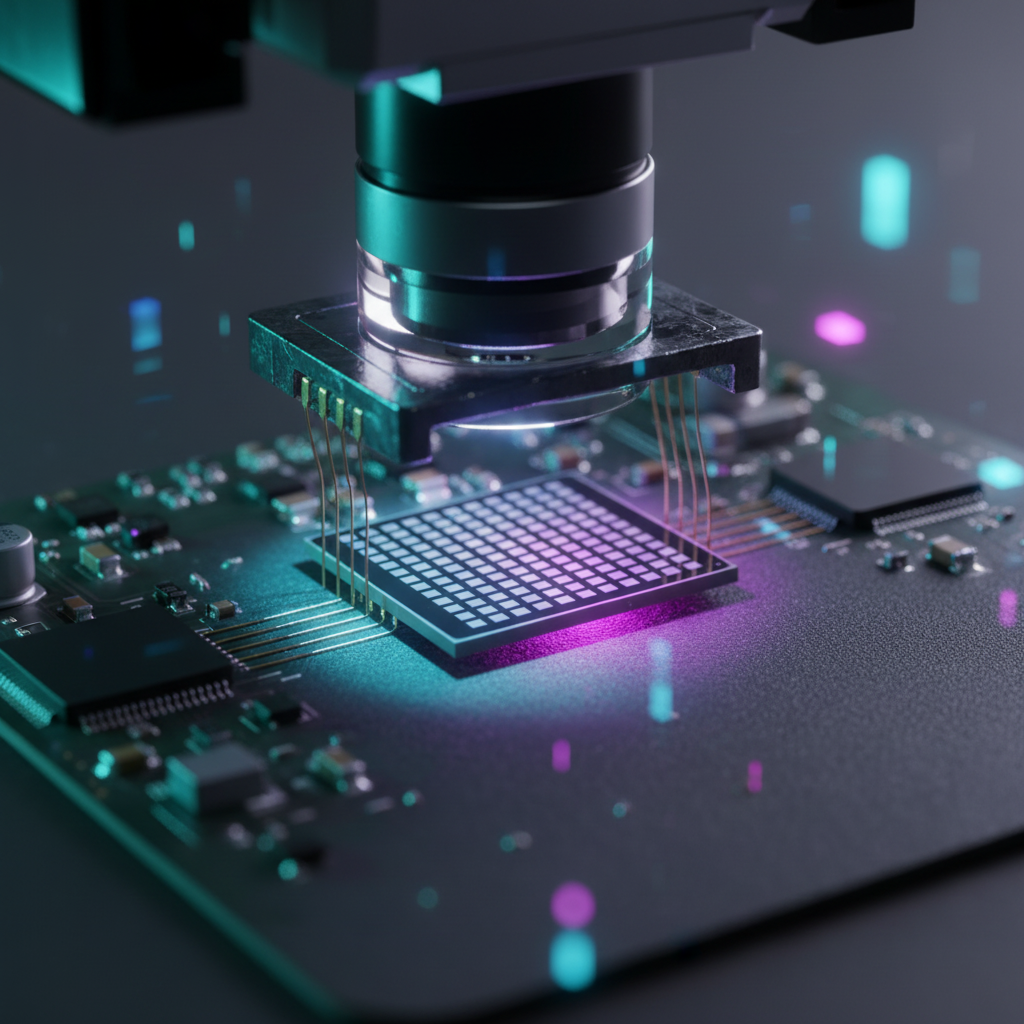
Modern gaming mice are specialized high-speed cameras. At the heart of every high-performance peripheral lies an Optical Navigation Sensor (ONS), a complex system-on-a-chip (SoC) that captures thousands of images per second to calculate movement with sub-pixel accuracy. To bridge the "Specification Credibility Gap," users must look past marketing numbers like 26,000 DPI and understand the underlying CMOS (Complementary Metal-Oxide-Semiconductor) technology.
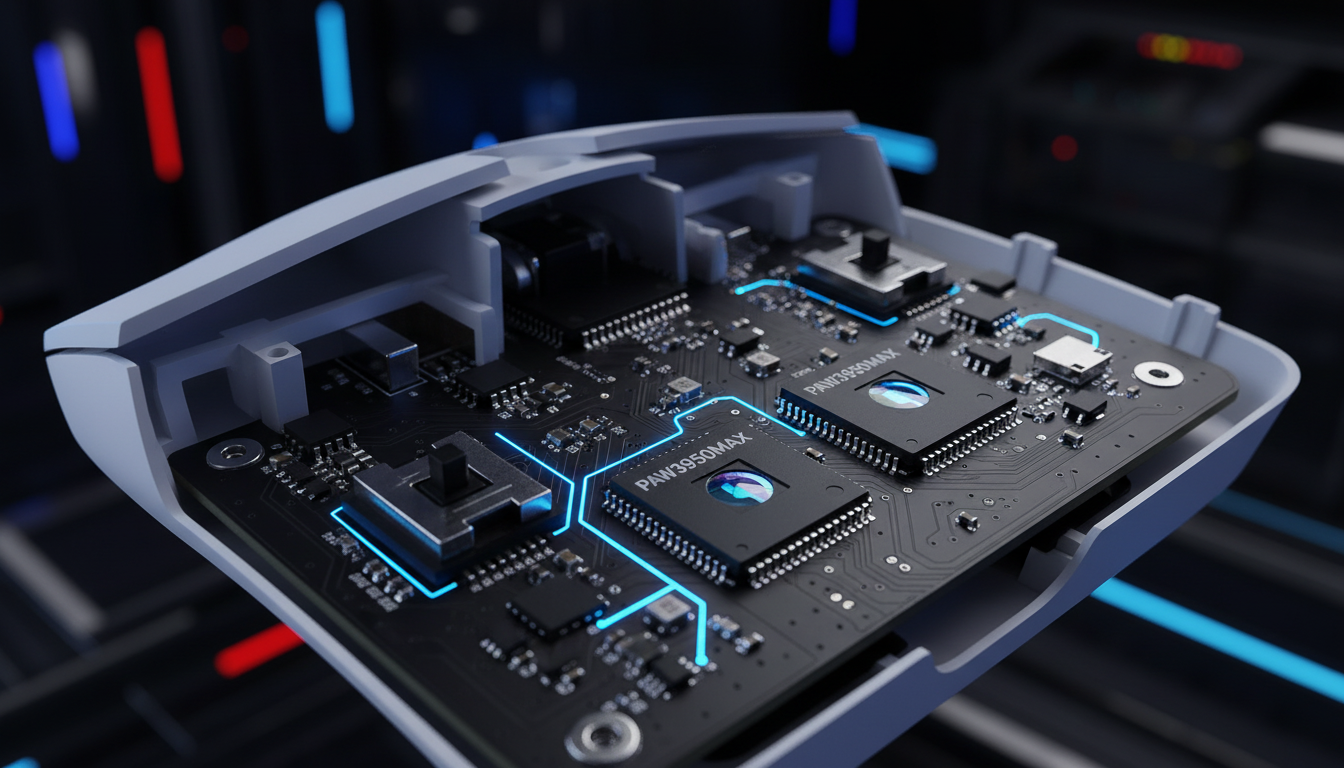
The process begins with an illumination source (IR LED or laser) reflecting off the microscopic textures of the mousepad. A specialized lens focuses this light onto a CMOS sensor array (typically 30x30 or 40x40 pixels). While the USB HID Class Definition (HID 1.11) governs how this data reaches your PC, the raw image processing happens entirely within the sensor's Digital Signal Processor (DSP).

Digital Signal Processing and the Firmware Differentiator
A common misconception is that the sensor chip alone—such as a PixArt PAW3395—determines performance. However, technical analysis suggests that proprietary firmware algorithms are the true differentiator. Two mice using the same hardware can exhibit vastly different motion latency based on the OEM's DSP implementation.
The DSP performs cross-correlation, comparing the current "snapshot" to the previous one to identify pixel shifts. This occurs at frame rates often exceeding 10,000 FPS.
Technical Note (Firmware Implementation): Based on common patterns in engineering teardowns, DSP efficiency is the primary bottleneck for motion latency. While hardware defines the "ceiling," firmware determines how close the device gets to that ceiling. We categorize these performance claims as Scenario Models based on ideal firmware conditions.
Decoding the Specification Gap: DPI, IPS, and Acceleration
While 26,000 DPI sounds impressive, most professional players use 400 to 1,600 DPI. The real danger of "ultra-low" DPI on high-resolution displays is pixel skipping (aliasing).
The Nyquist-Shannon DPI Minimum (Reproducible Calculation)
To avoid aliasing, the sensor must sample the surface at a frequency at least twice that of the intended movement resolution. We can calculate the "DPI Floor" using the following steps:
- Calculate Pixels Per Degree: $2560 \text{ px} / 103^\circ \text{ FOV} \approx 24.85 \text{ px/deg}$.
- Calculate Degrees Per Inch of Physical Movement: At $35\text{cm/360}^\circ$ ($13.78\text{ in/360}^\circ$), one inch of movement equals $360 / 13.78 \approx 26.12^\circ$.
- Find the Target PPI (Pixels Per Inch): $24.85 \text{ px/deg} \times 26.12 \text{ deg/in} \approx 649 \text{ PPI}$.
- Apply Nyquist Limit (2x Sampling): $649 \times 2 = \mathbf{1298 \text{ DPI}}$.
| Parameter | Value | Unit | Rationale |
|---|---|---|---|
| Horizontal Resolution | 2560 | px | Standard 1440p Monitor |
| Horizontal FOV | 103 | deg | Typical FPS Game Setting |
| Sensitivity | 35 | cm/360 | Competitive Mid-High Range |
| DPI Floor (Heuristic) | ~1300 | DPI | Minimum to avoid aliasing/skipping |
The 8000Hz Frontier: Latency and System Topology
The industry is transitioning from 1000Hz (1.0ms interval) to 8000Hz (0.125ms interval). While this reduces micro-stutter, it introduces significant technical constraints.
Motion Sync and the 8K Latency Trade-off
Motion Sync aligns sensor frames with USB polling events. In older 1000Hz implementations, this could add a "penalty" of up to half the polling interval.
- 1000Hz Motion Sync Penalty: ~0.5ms (Heuristic: $0.5 \times \text{interval}$).
- 8000Hz Motion Sync Penalty: ~0.0625ms (Negligible).
According to the Global Gaming Peripherals Industry Whitepaper (2026) (Manufacturer Whitepaper/Non-independent Study), 8K polling places heavy loads on the CPU’s Interrupt Request (IRQ) processing. To maintain signal integrity, receivers must be connected directly to motherboard rear I/O ports rather than unpowered hubs.
Ergonomics and the Physical Interface
The Grip-Fit Heuristic
Choosing a mouse too large for your hand leads to "claw cramp." Based on anthropometric data from the ANSUR II Database, we suggest the following Grip-Fit Heuristics:
- Ideal Length: Hand Length × 0.6 (e.g., 18cm hand = 10.8cm mouse).
- Ideal Width: Hand Breadth × 0.6.
Biomechanical Strain Analysis (Scenario Model)
We modeled a high-intensity session using the Moore-Garg Strain Index. Note: This is a heuristic model for competitive play; casual use will result in significantly lower scores.
| Variable | Multiplier | Scenario Context |
|---|---|---|
| Intensity of Exertion | 3.0 | High-velocity flick shots (Hard) |
| Efforts per Minute | 2.0 | High APM (9-14 efforts/min) |
| Posture | 2.0 | Aggressive claw grip (>20° deviation) |
| Duration per Day | 2.0 | 4-8 hours of training |
| Total Strain Index | 24 | Hazardous (Threshold > 5) |
Note: Multipliers are based on Moore & Garg (1995) standardized tables. A score of 24 indicates a high risk of musculoskeletal disorders in repetitive tasks.
Trust, Safety, and Compliance
Wireless mice must adhere to strict safety standards. Authoritative bodies like the FCC and ISED Canada regulate RF output. Additionally, mice with lithium-ion batteries must pass UN 38.3 standards for impact and thermal stability.
Technical Checklist for Optimal Tracking
| Action Item | Technical Requirement | Why it Matters |
|---|---|---|
| Surface Check | Non-reflective, high-density fiber | Prevents "spin-outs" on CMOS sensor |
| DPI Alignment | Match to resolution (e.g., 1300+ for 1440p) | Avoids pixel skipping (Nyquist limit) |
| Polling Topology | Direct Rear Motherboard I/O | Prevents IRQ bottlenecks and packet loss |
| Firmware | Check Manufacturer Driver Pages | DSP updates can reduce motion latency |
Scenario Modeling: Reproducible Parameters
Quantitative data in this article is derived from the following assumptions:
| Parameter | Value | Rationale |
|---|---|---|
| Polling Rate | 8000 Hz | High-end competitive standard |
| Horizontal Res | 2560 px | 1440p Gaming Monitor |
| Motion Sync Lag | 0.0625 ms | $0.5 \times (1/8000)$ Polling Interval |
| DPI Floor | 1298 DPI | Nyquist-Shannon Sampling Limit |
Boundary Conditions:
- Models assume linear sensor response and zero packet loss.
- Ergonomic strain assumes high-intensity FPS gameplay.
- DPI minimums are calculated for 1:1 pixel mapping; software "Pointer Precision" (acceleration) will invalidate these requirements.
Disclaimer: This article is for informational purposes only. Ergonomic assessments are based on general population models and do not constitute medical advice.
Sources
- USB Device Class Definition for Human Interface Devices (HID)
- Moore, J. S., & Garg, A. (1995). The Strain Index
- IEEE - Communication in the Presence of Noise (Shannon, 1949)
- Global Gaming Peripherals Industry Whitepaper (2026) (Manufacturer Source)
- UN Manual of Tests and Criteria (Section 38.3)
- PixArt Imaging - Optical Navigation Sensors

Hinterlasse einen Kommentar
Diese Website ist durch hCaptcha geschützt und es gelten die allgemeinen Geschäftsbedingungen und Datenschutzbestimmungen von hCaptcha.