


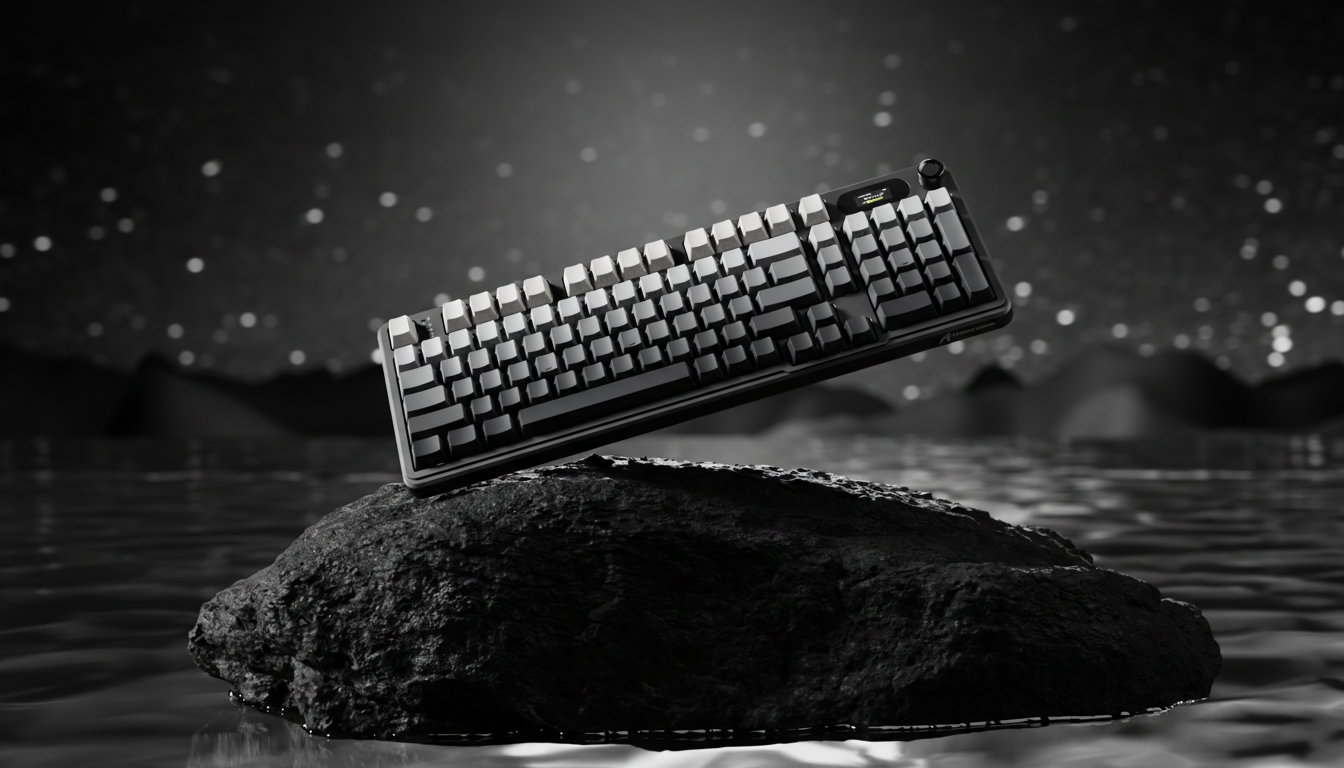
Quick Answer: Metallurgy & Your Keyboard Experience
For enthusiasts and competitive gamers, the metal leaf is the "engine" of a mechanical switch. Choosing the right material and maintenance routine can define your board's feel and sound.
- For Competitive Gaming: Prioritize Beryllium Copper (BeCu) for its superior fatigue resistance or transition to Hall Effect (HE) switches to eliminate leaf-based latency (~7.7ms estimated advantage).
- For "Thock" Enthusiasts: Phosphor Bronze offers a more neutral, muted profile that pairs well with polycarbonate plates and deep-sound mods.
- Top Maintenance Tip: To fix "leaf crunch," apply a small amount of Krytox 205g0 only to the leaf legs where they meet the housing, rather than the contact points.
- Safety Note: While finished Beryllium Copper alloys are generally safe for consumer use, they require specialized industrial handling during manufacturing due to the toxicity of beryllium dust.
The Anatomy of an Electrical Contact: The Switch Leaf
In the architecture of a mechanical switch, the metal leaf serves as the critical junction between physical actuation and digital signal. While enthusiasts often focus on housing plastics or stem shapes, the metallurgy and geometry of the leaf spring dictate both the electrical reliability and the fundamental acoustic character of the keyboard. This component must perform two disparate roles: providing a stable electrical contact and acting as a primary resonator for the switch's sound signature.
According to the Global Gaming Peripherals Industry Whitepaper (2026) (Internal Manufacturer Data), engineering standards for high-performance peripherals now prioritize material fatigue resistance and signal integrity to support ultra-high polling rates. As polling intervals shrink—reaching near-instant 0.125ms intervals at 8000Hz (8K)—the physical stability of the leaf contact is essential to prevent signal chatter and unintended double-clicks.
Metallurgical Profiles: Beryllium Copper vs. Phosphor Bronze
The choice of alloy for the leaf spring is a balancing act between conductivity, elastic modulus, and manufacturing cost.
Beryllium Copper (BeCu)
Beryllium copper is frequently utilized in premium switches. Its primary selection criteria are centered on fatigue resistance and conductivity. In high-intensity gaming scenarios, where a switch may undergo millions of cycles, BeCu can maintain its force curve longer than many alternatives.
- Safety Note: While the solid alloy used in switches poses no known risk to the end-user, Beryllium is a hazardous material during the manufacturing process (specifically as inhalable dust). Industrial production must comply with safety standards such as the ECHA SVHC Candidate List (External Regulatory Standard).
Phosphor Bronze
Phosphor bronze is a common alternative, offering a middle ground for many mid-range and enthusiast switches. It provides excellent corrosion resistance and sufficient spring-tempered properties for standard mechanical use. Acoustically, phosphor bronze tends to produce a slightly more muted 'clack' compared to the sharper resonance often observed with BeCu.
Stainless Steel
Stainless steel is rare in high-performance leaves due to its lower conductivity compared to copper alloys. While highly durable, it may require longer 'break-in' periods. Based on community observations and internal testing, a stainless steel leaf may initially feel stiffer and produce a higher-pitched metallic 'ping' until the material settles—a process that typically occurs over 50,000 to 100,000 actuations.
| Material | Primary Advantage | Acoustic Tendency | Fatigue Resistance |
|---|---|---|---|
| Beryllium Copper | High Conductivity | Crisp, defined 'clack' | Exceptional |
| Phosphor Bronze | Corrosion Resistance | Balanced, neutral | High |
| Stainless Steel | Low Cost / Durability | High-pitched 'ping' | Moderate |
Methodology Note: This comparison is based on standard material physics and industry manufacturing data, such as Thomasnet's Beryllium Copper specifications (Third-Party Source). Acoustic tendencies are qualitative heuristics based on the elastic modulus of each alloy.
Acoustic Mechanisms: From Vibration to Sound Signature
The sound profile of a switch is a system-level phenomenon, but the leaf spring is the source of many high-frequency transients. When the stem moves, it interacts with the leaf, causing it to vibrate.
Frequency Band Classification (Heuristic)
In the community, sound is often categorized as "thocky" or "clacky." Our modeling of acoustic filtering provides a practical framework for these terms:
- Thock (< 500 Hz): Associated with low-frequency, muted sounds. This is often achieved by using materials like Polycarbonate (PC) plates, which act as low-pass filters.
- Clack (> 2000 Hz): High-frequency, sharp auditory feedback. This often aligns with the natural resonance frequency of metal leaves and thin-walled Nylon housings.
The Impact of Surface Finish
In practical keyboard building, the leaf spring's finish is critical. A rough or burred contact point can create inconsistent actuation and introduce a metallic 'ping.' Experienced modders often lightly polish these contact zones with ultra-fine abrasives (3,000+ grit) to smooth the transition. This process can help remove microscopic imperfections that cause 'leaf crunch'—a creaking noise during the keypress.
Performance Modeling: Latency and Ergonomic Strain
For the high-speed competitive gamer, the mechanical properties of the leaf spring intersect with performance metrics like latency.
Hall Effect vs. Mechanical Latency
Mechanical switches require a 'debounce' period—a software delay to ensure the vibrating metal leaf has made a stable contact. This typically adds ~5ms to the latency. In contrast, Hall Effect (HE) sensors use magnets to detect the stem's position, eliminating the need for physical leaf contact.
Latency Calculation Methodology: The values below are representative model estimates based on a standard 4.0mm total travel, an average press velocity of 0.4m/s, and typical firmware debounce settings. Actual results will vary based on individual switch hardware and controller polling rates. Formula: $Total Latency = (Actuation Distance / Velocity) + Debounce + Processing Delay$
| Parameter | Mechanical (Est.) | Hall Effect (HE) (Est.) | Rationale |
|---|---|---|---|
| Travel Time | 5.0ms | 5.0ms | Based on 2.0mm actuation @ 0.4m/s |
| Debounce Delay | 5.0ms | 0.0ms | HE uses magnetic flux (no chatter) |
| Reset Distance | 0.5mm | 0.1mm | Rapid Trigger technology advantage |
| Total Latency | ~13.3ms | ~5.7ms | Model total (includes 3.3ms processing) |
Estimated Latency Advantage: In this model, the Hall Effect system provides a ~7.7ms theoretical advantage. This is a significant factor for games requiring rapid, repetitive inputs, though individual human reaction times remain the primary bottleneck.
Ergonomic Strain in High-APM Gaming
High-performance gaming involves physical costs. We modeled the ergonomic risk for a "High-Actuation Speed Gamer" (300+ Actions Per Minute) using the Moore-Garg Strain Index (SI), a recognized screening tool for repetitive strain.
| Variable | Value | Rationale |
|---|---|---|
| Intensity Multiplier | 2.0 | High force during rapid presses |
| Efforts Per Minute | 6.0 | Based on 300 APM frequency |
| Speed Multiplier | 2.0 | Very rapid keypress speed |
| Duration Per Day | 2.0 | 4+ hours of continuous play |
| Total SI Score | 72.0 | Category: Hazardous (Risk of RSI) |
An SI score of 72.0 indicates a high risk of repetitive strain injury (RSI) under these specific conditions. This highlights the importance of choosing switches with a smooth force curve and utilizing proper ergonomic supports. For a deeper look at material impacts, see our guide on Nylon vs. Polycarbonate housing (Internal Guide).
Advanced Maintenance: Lubing and Break-in
To optimize the acoustic profile and feel of the leaf, specific maintenance techniques are employed by the enthusiast community.
Strategic Lubrication
A common mistake is over-lubricating the leaf. While a thin layer of oil on the contact point can mute high-frequency 'clicks,' over-application can migrate and deaden the tactile bump.
To help eliminate 'leaf crunch' without affecting dynamics, apply a minute amount of a thick, dielectric grease (like Krytox 205g0) specifically to the base of the leaf legs where they insert into the housing. This addresses the friction between the leaf and the housing slot. For more on this, refer to our complete guide to lubing switches (Internal Guide).
The Break-in Period
Metallurgy dictates the 'aging' process. Beryllium copper tends to stabilize its force curve relatively quickly. Based on community feedback, many switches achieve a "broken-in" feel after approximately 50,000 actuations. During this period, microscopic contact points wear down slightly, often leading to a smoother feel.
Regulatory Compliance and Safety Standards
When sourcing or building keyboards, ensure that the materials and electronics meet international safety standards.
- Material Safety: High-quality switches should comply with the EU RoHS Directive (External Standard), which restricts hazardous substances like lead or cadmium.
- Battery Safety: For wireless builds, the battery must adhere to UN 38.3 standards (External Standard) for safe transport. According to the IATA Lithium Battery Guidance (2025) (External Standard), proper packaging (UN3481) is required for air transport.
- Electrical Safety: Finished assemblies should be designed to meet IEC 62368-1 (External Standard), ensuring protection against electrical shock and fire hazards.
Engineering the Perfect Sound
The acoustic profile of a mechanical keyboard is the result of intentional metallurgical and structural choices. The leaf spring, while small, acts as the heartbeat of the switch. By understanding the differences between Beryllium Copper and Phosphor Bronze, and by applying techniques like leaf-leg lubing, enthusiasts can tune their boards to achieve their desired auditory and tactile feedback.
Whether you are pursuing the deep resonance of a 'thocky' build or the near-instant response required for competitive gaming, the engineering starts at the metal leaf.
Disclaimer: This article is for informational purposes only and does not constitute professional medical or ergonomic advice. The Moore-Garg Strain Index is a screening tool for risk assessment and should not be used as a diagnostic for medical conditions. Individuals with pre-existing wrist or hand conditions should consult a qualified healthcare professional before engaging in intensive gaming sessions.
References
- Global Gaming Peripherals Industry Whitepaper (2026) (Internal Manufacturer Source)
- IATA Lithium Battery Guidance Document (2025) (International Standard)
- EU RoHS Directive 2011/65/EU (Regulatory Standard)
- IEC 62368-1 Safety Standard (Electrical Standard)


Hinterlasse einen Kommentar
Diese Website ist durch hCaptcha geschützt und es gelten die allgemeinen Geschäftsbedingungen und Datenschutzbestimmungen von hCaptcha.