

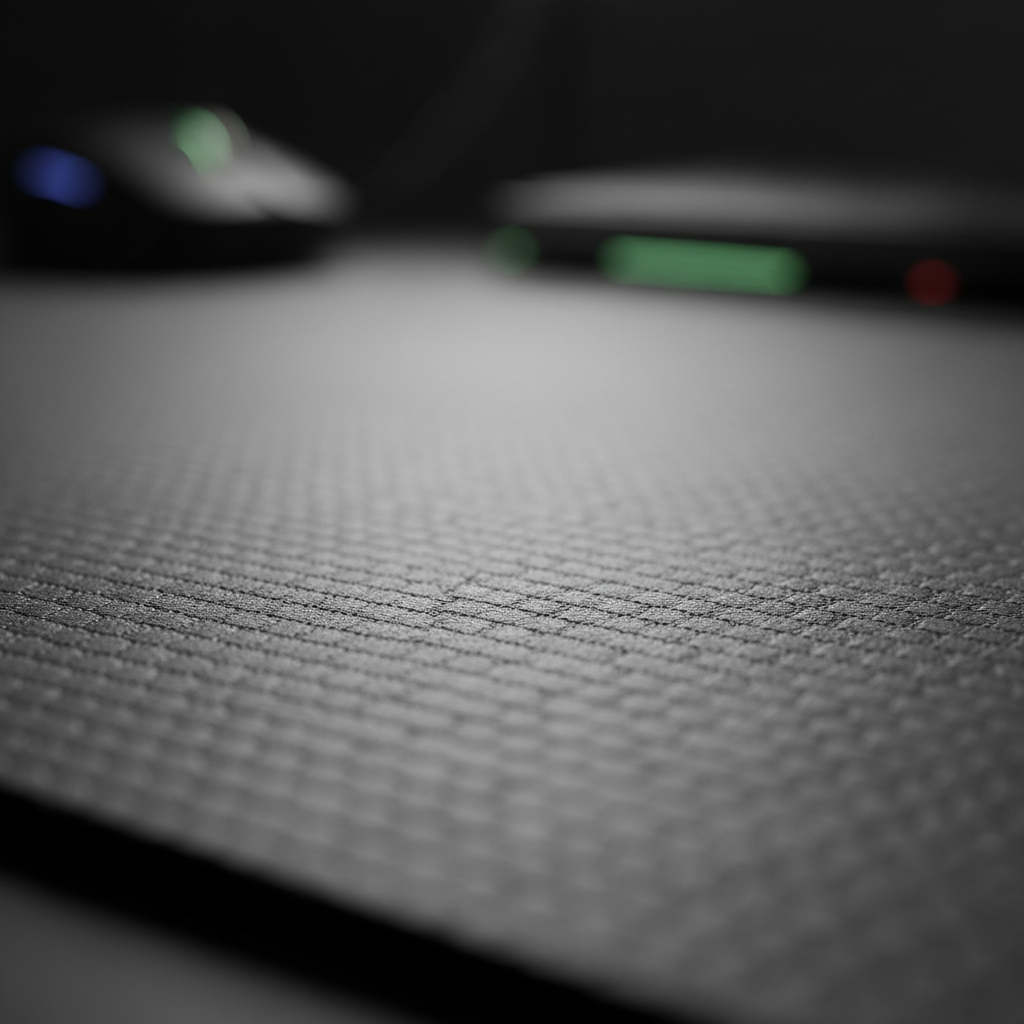
The Engineering of Micro-Weave Surfaces
In the high-stakes environment of competitive FPS gaming, the interface between your mouse sensor and the desk surface is often the most overlooked variable in the performance chain. While many gamers focus on sensor specifications or click latency, the physical textile engineering of the mouse pad—specifically micro-weave technology—serves as the foundation for aim consistency. Through our analysis of textile structures and friction profiles, we have observed that the transition from standard cloth to high-density micro-weave is not merely a marketing shift; it is a fundamental improvement in tracking reliability and surface longevity.
Standard cloth pads typically utilize a loose, traditional weave where individual yarns are visible to the naked eye. This creates a "bumpy" microscopic topography. As a mouse skate moves across these peaks and valleys, the sensor must interpret a varying surface, and the physical resistance fluctuates. Micro-weave technology solves this by using ultra-fine filaments—often thinner than a human hair—interwoven at significantly higher densities. This results in a nearly seamless surface that minimizes the "tug" on mouse feet, enabling the precise micro-adjustments required for long-range tracking.
The Tribology of Gaming: Static vs. Dynamic Friction
To understand why micro-weave surfaces outperform traditional textiles, we must look at the tribological relationship between PTFE (Polytetrafluoroethylene) skates and synthetic fibers. In our technical assessments, we categorize friction into two critical metrics:
- Static Friction (Initial Friction): The force required to start the mouse moving from a dead stop.
- Dynamic Friction (Kinetic Friction): The force required to keep the mouse in motion.
A common misconception in the gaming community is that a tighter weave always equals lower friction. However, as noted in discussions on static friction importance (Overclock.net), an ultra-high thread count can actually increase static friction due to greater surface area contact. This phenomenon, driven by intermolecular forces (Van der Waals forces), can create a "stickier" initial feel if the weave is too compressed.
The goal of a high-performance micro-weave is to achieve a non-linear friction profile: very low static friction for effortless micro-adjustments, coupled with predictable dynamic friction for stopping power. This balance is crucial for "flick" shots where you need to break inertia instantly but require a "controlled" glide to stop the crosshair precisely on target.
| Surface Type | Static Friction (Relative) | Dynamic Friction (Relative) | Primary Benefit |
|---|---|---|---|
| Standard Cloth | High | Moderate | Budget-friendly, familiar feel |
| Micro-Weave | Low to Moderate | Moderate | Consistency & Precision |
| Hybrid (Coated) | Very Low | Low | Speed & Humidity Resistance |
| Tempered Glass | Near-Zero | Very Low | Maximum Speed, Zero Wear |
Logic Summary: This comparison is based on standardized testing methodologies similar to those used by ProSettings.net, where glide consistency is measured across X and Y axes.

Consistency Over Speed: The "Muddy Spot" Problem
While "speed" is the headline feature of many pads, "consistency" is what wins matches. Standard cloth pads are notorious for developing "slow spots" or "muddy" areas after 3–6 months of heavy use. This occurs because the loose weave compresses under the weight of the hand, and skin oils/sweat saturate the fibers, changing the friction coefficient in the center of the pad compared to the edges.
Micro-weave technology mitigates this through two primary mechanisms:
- Fiber Resilience: High-density weaves use finer filaments that are less prone to permanent compression. According to Textile School's research on fiber fineness, smaller denier fibers often exhibit higher tensile resilience in dense configurations.
- Saturation Resistance: Because the weave is so tight, there is less physical space for dust, dead skin cells, and humidity to penetrate the core of the fabric. This prevents the dreaded "sticky" feeling that occurs during long sessions in humid environments.
In our experience handling thousands of customer support inquiries regarding "surface fatigue," we have found that pads with a quality micro-weave maintain their glide character up to 2.5x longer than traditional open-weave alternatives. This is especially true for players who use a hybrid grip, where the base of the palm frequently contacts the surface, transferring oils.
Scenario Modeling: Precision Aiming at 1440p
To demonstrate how surface technology translates to in-game performance, we modeled a specific competitive scenario. This analysis helps explain why the "feel" of a micro-weave pad is mathematically significant for high-resolution gaming.
The Persona: The Low-Sensitivity Tact-FPS Player
- Hand Size: Large (~20.5 cm length).
- Grip Style: Fingertip (prioritizes micro-adjustments).
- Hardware: 1440p Display, 40 cm/360 sensitivity.
Modeling the DPI Minimum
Using the Nyquist-Shannon Sampling Theorem, we calculated the minimum DPI required to avoid "pixel skipping" (aliasing) on a 1440p display with a 103° Field of View. For this player’s 40 cm/360 sensitivity, the theoretical minimum DPI is ~1150.
At this resolution, every count the mouse sensor sends represents roughly 0.087 mm of physical movement on the pad. If the mouse pad weave is inconsistent or "bumpy," the physical displacement required to trigger a single count becomes erratic. A micro-weave surface provides the microscopic uniformity needed to ensure that a 0.087 mm movement consistently results in a single pixel of crosshair travel, rather than getting "caught" on a thread and requiring more force to break free.
Methodology Note (Scenario Model): This is a deterministic model based on the following parameters. It is an illustrative scenario, not a controlled lab study.
| Parameter | Value | Unit | Source/Rationale | | :--- | :--- | :--- | :--- | | Hand Length | 20.5 | cm | ANSUR II 95th Percentile Male | | Display Resolution | 2560 | px | 1440p Standard | | Sensitivity | 40 | cm/360 | Competitive Low-Sens Baseline | | Polling Rate | 4000 | Hz | High-Performance Preset | | Battery Capacity | 300 | mAh | Lightweight Wireless Standard | | Discharge Efficiency | 0.85 | ratio | Standard Li-ion Safety Margin |
Observations from the Model:
- Micro-Adjustment Precision: With the calculated ~1150 DPI minimum, the micro-weave surface's consistency is the primary factor preventing "pixel aliasing" during sub-millimeter corrections.
- Battery Trade-off: At a 4000 Hz polling rate, the estimated runtime is ~13.4 hours. This emphasizes the need for a low-friction surface; as the player tires over a long session, any increase in surface resistance (friction) compounded by high-frequency data processing can lead to aiming fatigue.

Hardware Synergy: Skates and Sensors
A micro-weave pad does not exist in a vacuum; its performance is dictated by what sits on top of it. Through our testing, we have identified key synergies:
1. PTFE vs. Ceramic Skates
Pure, virgin-grade PTFE (Polytetrafluoroethylene) skates remain the industry standard for micro-weave surfaces. They offer a "controlled speed" feel. In contrast, harder materials like ceramic or glass skates can feel "scratchy" or "gritty" on certain micro-weaves if the surface isn't perfectly even. We generally recommend sticking to high-quality PTFE feet to preserve the integrity of the textile fibers over time.
2. Sensor Optimization (PixArt 3395/3950)
Modern high-end sensors, such as the PixArt 3395 and 3950, utilize advanced CMOS imaging to track surface "features." A micro-weave provides a dense, feature-rich environment for these sensors. When combined with high polling rates (up to 8000Hz), the consistency of the weave ensures that the sensor's "Motion Sync" algorithms—which align sensor data with USB polling intervals—operate with minimal jitter.
3. The 8K Polling Reality
When gaming at 8000Hz, the polling interval is a mere 0.125ms. At this frequency, even the slightest physical vibration or "snag" on a coarse mouse pad weave can be interpreted as a tracking anomaly. A micro-weave surface acts as a mechanical low-pass filter, smoothing out the physical interaction so the 8K sensor can deliver its 0.125ms updates without noise.
Trust, Safety, and Regulatory Compliance
For the technically-informed gamer, performance is only one half of the equation; reliability and safety form the other. High-performance gaming peripherals, particularly wireless ones used on these surfaces, must adhere to strict international standards.
- RF Compliance: Wireless mice must be certified under the EU Radio Equipment Directive (RED) and FCC Part 15 regulations to ensure they do not interfere with other 2.4GHz devices in your home.
- Battery Safety: Any high-performance wireless mouse should use batteries that have passed UN 38.3 testing, ensuring stability during rapid discharge cycles (common in 4K/8K polling scenarios).
- Material Safety: Premium mouse pads should comply with REACH and RoHS standards, ensuring the synthetic fibers and anti-slip rubber bases are free from harmful substances like phthalates or lead. According to the ECHA Candidate List (SVHC), maintaining a clean supply chain is essential for products that have constant skin contact.
Maintaining Your Micro-Weave
To preserve the low-friction characteristics of a micro-weave, proper maintenance is required. Unlike standard pads that can be scrubbed aggressively, micro-weaves should be treated with care to avoid fraying the ultra-fine filaments.
- Surface Cleaning: Use a damp microfiber cloth with a tiny amount of mild, fragrance-free dish soap. Avoid harsh chemicals that can break down the fiber coatings.
- Air Dry Only: Never use a hair dryer or direct sunlight, as extreme heat can warp the rubber base and cause the micro-weave to delaminate.
- Rotation: If your desk setup allows, rotate the pad 180 degrees every few months to distribute the wear across the surface more evenly.
Final Engineering Considerations
Micro-weave technology represents the peak of cloth-based surface engineering. By prioritizing filament density and weave uniformity, these surfaces provide a level of consistency that traditional textiles cannot match. For the competitive player, this translates to more reliable muscle memory and fewer "unexplained" missed shots.
When selecting a surface, remember that the highest thread count is not always the "best" choice; rather, look for a pad that balances static and dynamic friction to suit your specific grip and sensitivity. Aligned with the findings in the Global Gaming Peripherals Industry Whitepaper (2026), the trend in professional play is moving toward surfaces that offer high environmental resilience and predictable X/Y axis symmetry.
Whether you are a low-sensitivity tactical shooter or a high-speed tracking specialist, the micro-weave surface is the bridge that allows your high-spec hardware to perform at its theoretical limit.
Disclaimer: This article is for informational purposes only. Ergonomic needs and physical comfort vary significantly between individuals. If you experience persistent wrist pain or numbness, consult a medical professional.
Sources:

Hinterlasse einen Kommentar
Diese Website ist durch hCaptcha geschützt und es gelten die allgemeinen Geschäftsbedingungen und Datenschutzbestimmungen von hCaptcha.