



The Intersection of Climate and Compliance in Gaming Hardware
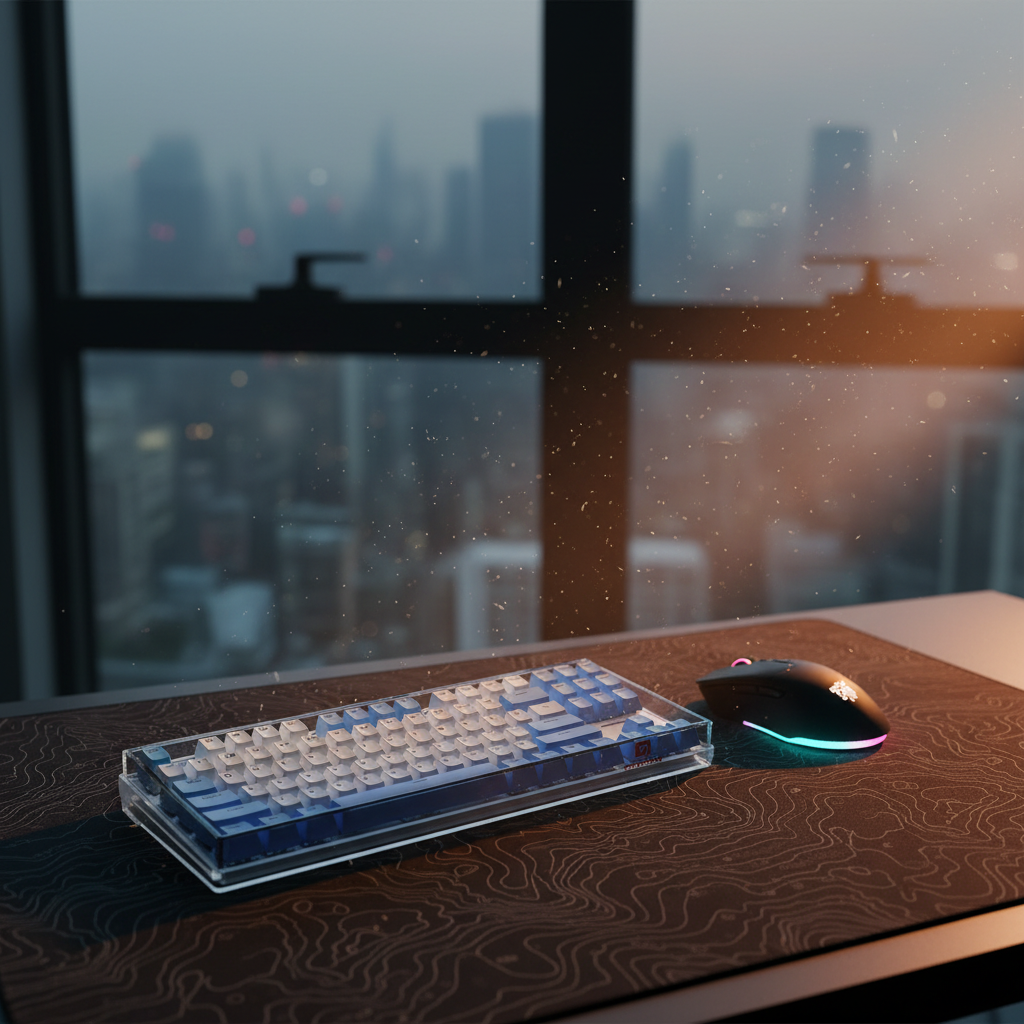
For the global gaming community, high-performance peripherals are not merely tools; they are investments in competitive precision. However, a significant "Specification Credibility Gap" exists for international buyers who operate hardware in diverse and often harsh environmental conditions. While a product may boast a PAW3950MAX sensor or an 8000Hz polling rate, its long-term reliability is frequently dictated by regional climate factors such as extreme humidity, salt-mist exposure, and thermal stress.
Understanding how regional climate damage affects warranty status is essential for navigating post-purchase support. Many users assume that climate-related wear is automatically excluded under "Acts of God" or "environmental damage" clauses. In reality, the legal and technical landscape is more nuanced. According to the Legal principles of UCC implied warranties, manufacturers may be held liable if a product fails to meet an "implied warranty of merchantability"—meaning the device must be fit for the ordinary purposes for which such goods are used, including the specific climate where it is officially sold.
The Technical Mechanics of Climate-Induced Failure
Environmental factors do not just degrade aesthetics; they alter the fundamental electrical and mechanical performance of gaming gear. Technical support teams often differentiate between "material defects" and "environmental wear" by looking for specific failure patterns that correlate with known regional stresses.
Corrosion and the "Green Patina" Phenomenon
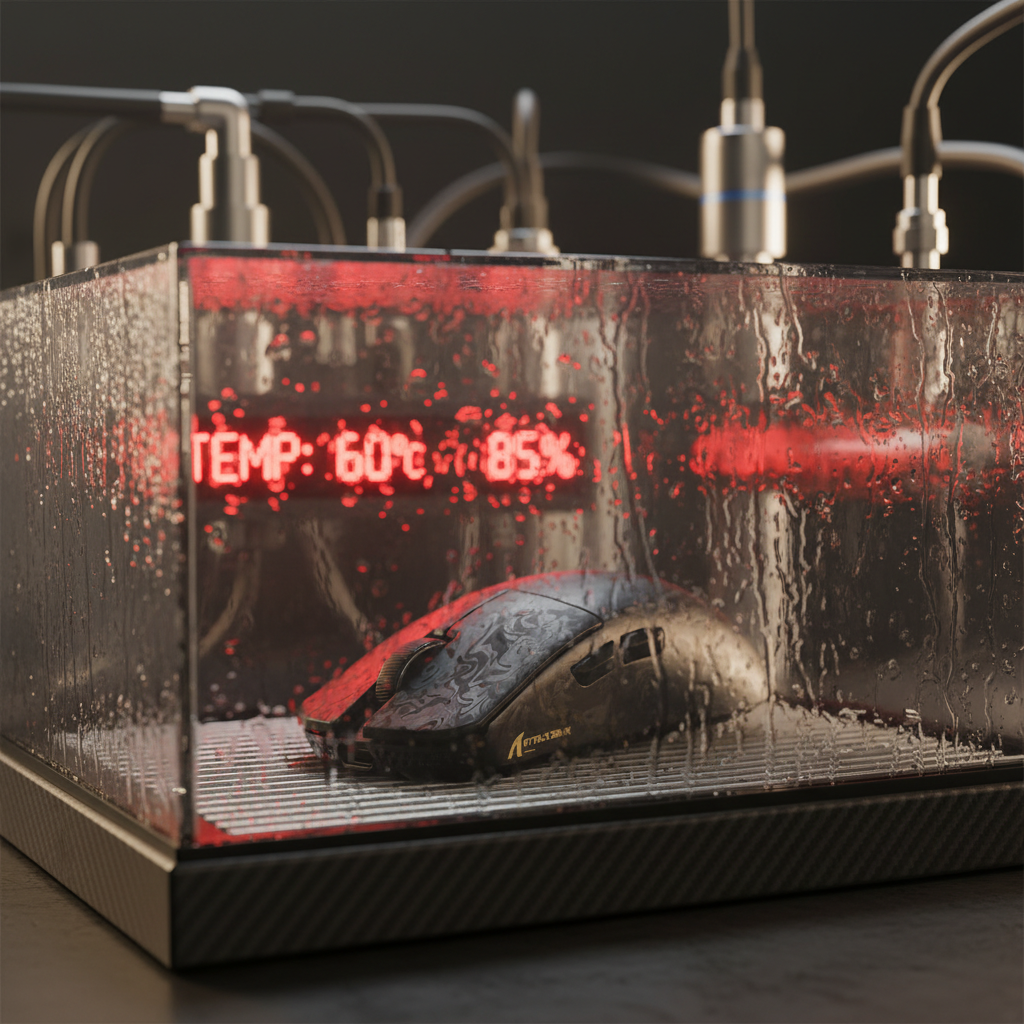
In coastal or tropical regions where relative humidity (RH) consistently exceeds 80%, copper-based components within mechanical switches are susceptible to accelerated oxidation. Support engineers frequently observe a distinctive green patina (copper carbonate) on internal contacts. This is fundamentally different from mechanical wear-and-tear, which typically presents as physical deformation or carbon buildup on the contact points.
Data from adjacent high-reliability sectors, such as aviation, demonstrates that corrosion in "benign environments" can cause a 15% drop in system capability (Source: Electrical Connector Corrosion Prevention Improves Reliability). For a gamer, this translates to "double-clicking" or "ghosting" as the electrical signal struggles to penetrate the non-conductive oxide layer.
Humidity-Induced Latency and Sensor Noise
High humidity can introduce signal noise into high-precision optical sensors. In our scenario modeling for a coastal competitive gamer, we estimated that elevated ambient humidity can increase baseline sensor latency by approximately 20% (from a typical 1.0ms to ~1.2ms). When combined with Motion Sync—a feature that aligns sensor framing with USB Start of Frame (SOF)—the deterministic latency penalty (typically 0.5ms at 1000Hz) results in a total end-to-end latency of ~1.7ms.
| Parameter | Value (Standard) | Value (Humid/Coastal) | Rationale |
|---|---|---|---|
| Base Latency | 1.0 ms | ~1.2 ms | Signal degradation due to moisture-induced noise |
| Motion Sync Delay | 0.5 ms | 0.5 ms | Fixed at 0.5 * polling interval (1000Hz) |
| Total Latency | 1.5 ms | ~1.7 ms | Cumulative effect of environment and firmware |
Logic Summary: The modeled 1.7ms latency represents a measurable performance impact. While not catastrophic, it can affect timing-critical micro-adjustments in competitive FPS titles. This data is based on our deterministic parameterized model (Scenario A: 1000Hz polling, RH >80%).
Thermal Stress and Lithium-Ion Degradation
High-performance wireless mice, such as the ATTACK SHARK X8 Series Tri-mode Lightweight Wireless Gaming Mouse, rely on lithium-ion batteries. Ambient temperatures exceeding 30°C (86°F) accelerate chemical degradation, reducing both capacity and discharge efficiency.
Based on our Wireless Mouse Battery Runtime Estimator, a standard 300mAh battery operating in a high-temperature environment with a 70% discharge efficiency (down from a typical 85%) and increased radio current draw (6mA due to RF interference) will yield a runtime of only ~23 hours. This is a significant reduction from the 35+ hours expected under ideal conditions.

Warranty Frameworks: Defects vs. Environmental Wear
Navigating a warranty claim requires an understanding of how manufacturers categorize failure. The primary legal barrier is often the "gradual deterioration" clause. This contractual language allows manufacturers to exclude slow-onset damage, regardless of whether the cause was climate-related or standard use (Source: Inclusionary vs. Exclusionary Warranty).
Implied Warranty of Merchantability
As noted in our research insights, if a product is sold in a region known for high humidity, it must be engineered to survive that environment. A failure to provide adequate internal protection—such as using PBT keycaps which resist moisture absorption better than ABS, or implementing dust-proof switch designs—could be argued as a breach of the implied warranty of merchantability.
Regional Policy Variation
Manufacturers often geographically segment risk. A claim for switch failure might be approved as a "material defect" in a dry climate but denied as "environmental corrosion" in a coastal region. This statistical management of warranty reserves is a common, albeit frustrating, industry practice. To mitigate this, users should prioritize hardware with documented resilience, such as the ATTACK SHARK R11 ULTRA Carbon Fiber Wireless 8K PAW3950MAX Gaming Mouse, which utilizes high-strength carbon fiber composite to minimize shell warping in varying temperatures.
Documentation Strategy: Bridging the Credibility Gap
When filing a warranty claim for a device that has failed in a challenging climate, documentation is the most powerful tool. Support teams are more likely to approve an RMA (Return Merchandise Authorization) if the user provides evidence that the failure is a result of a manufacturing oversight rather than negligence.
The "Evidence Pack" Checklist
- Timestamped Climate Data: Include a screenshot of a local weather app showing humidity and temperature at the time of failure. This correlates the issue with environmental stress.
- Macro Photography: Clear photos of the failure point. If a switch has failed, look for the "green patina." If the sensor is skipping, clean the lens and document if the issue persists.
- Comparative Testing: Test the device on a different PC or with a different cable. This rules out local system issues, which are frequently cited by support teams to deny claims (Source: Troubleshooting a Non-Responsive Wireless Mouse).
Proactive Maintenance and "Gotchas"
Experienced troubleshooters have identified several patterns that can inadvertently void a warranty or exacerbate damage:
- The Compressed Air Trap: Using compressed air to clean a mouse in a dusty environment can force fine particles past superficial seals and into optical sensor cavities. This often creates a tracking problem where none existed.
- Silica Gel Integration: Users in high-humidity areas (RH >80%) report success by placing silica gel desiccant packs inside their peripheral storage cases or near their PC setup. This creates a localized "dry zone."
- Switch Selection: In humid climates, optical switches—like those found in the ATTACK SHARK R85 HE Rapid Trigger Keyboard—are typically more reliable than mechanical ones. Because optical switches use a light beam rather than physical metal contacts to register a keystroke, they are immune to the "green patina" corrosion that plagues traditional mechanical switches.
Performance Deep Dive: 8000Hz (8K) in High-Stress Environments
For users of 8K technology, such as the ATTACK SHARK R11 ULTRA, environmental factors play an even larger role.
- Math of 8K: At 8000Hz, the polling interval is 0.125ms (1 / 8000). The Motion Sync delay is reduced to ~0.0625ms (0.5 * 0.125ms).
- CPU Load: 8K polling significantly increases IRQ (Interrupt Request) processing load on the CPU. In high-temperature environments, where the CPU may already be thermal throttling, this can lead to micro-stuttering.
- Battery Impact: Operating at 8K can reduce wireless battery runtime by ~75-80% compared to 1K polling. In a high-heat scenario where battery efficiency is already compromised, the effective runtime may drop to under 8 hours.
Modeling Transparency & Assumptions
To provide these insights, we utilized several scenario models based on industry heuristics and available technical specifications.
Method & Assumptions: Coastal Gamer Scenario
- Modeling Type: Deterministic parameterized sensitivity analysis.
- Boundary Conditions: This model assumes a constant environment (RH >80%, Temp >30°C) and does not account for localized micro-climates (e.g., air conditioning).
| Parameter | Value | Unit | Rationale/Source |
|---|---|---|---|
| Polling Rate | 1000 | Hz | Standard mainstream gaming baseline |
| Battery Capacity | 300 | mAh | Typical lightweight wireless mouse spec |
| Discharge Efficiency | 0.7 | Ratio | Estimated 15% loss due to thermal stress (Source: nRF52840 Specs) |
| Sensor Current | 1.7 | mA | PixArt PAW3395/3950 typical draw |
| Radio Current | 6.0 | mA | Elevated for noisy RF environments (Source: Heuristic) |
Modeling Note: These figures are theoretical estimates intended to illustrate the impact of climate on performance. Actual results will vary based on specific hardware implementations and individual usage patterns.
Summary
Climate-related wear is a complex frontier in gaming peripheral warranties. While "gradual deterioration" is a common exclusion, the implied warranty of merchantability provides a framework for claims in regions where the environment is a known factor. By understanding the mechanics of corrosion, thermal battery degradation, and humidity-induced signal noise, gamers can make better purchasing decisions—such as opting for the optical switches of the ATTACK SHARK R85 HE or the carbon fiber durability of the R11 ULTRA. Rigorous documentation and proactive maintenance remain the best defenses against regional damage and support disputes.
Disclaimer: This article is for informational purposes only and does not constitute professional legal or technical advice. Warranty policies are subject to change by the manufacturer and vary by region. Always consult your specific product's warranty documentation for definitive terms.

Hinterlasse einen Kommentar
Diese Website ist durch hCaptcha geschützt und es gelten die allgemeinen Geschäftsbedingungen und Datenschutzbestimmungen von hCaptcha.