


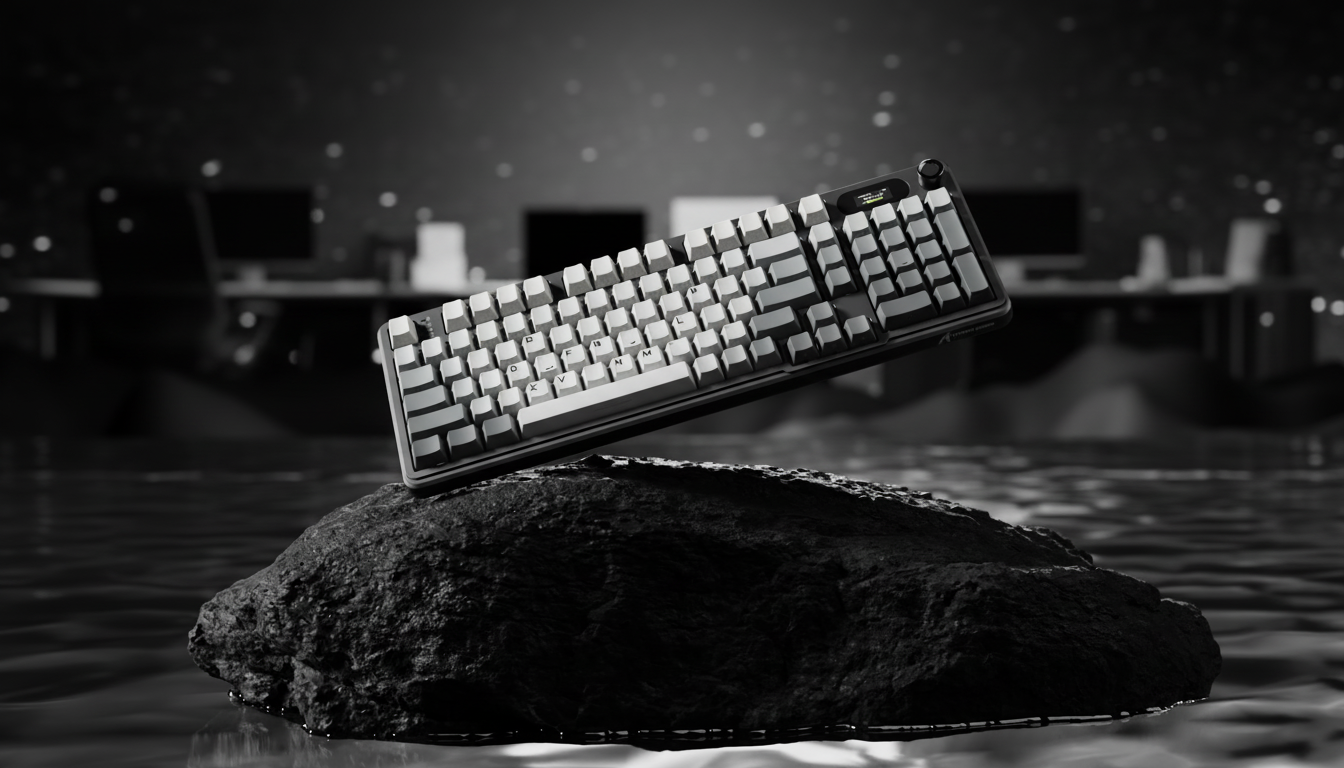
Quick Summary: ABS vs. PBT for Value Builds
For gamers on a budget, Double-Shot ABS offers the best legend clarity and RGB diffusion, making it ideal for aesthetic-focused setups. However, PBT provides significantly better long-term value due to its resistance to "shine" and oil degradation. If you prioritize visual crispness and vibrant lighting, choose ABS; if you want a set that maintains its matte texture for years, PBT is the more "economically rational" choice.
Note: The following comparisons are based on typical budget-tier manufacturing standards (<1.2mm wall thickness) and heuristic modeling of high-intensity usage.
The Molecular Fundamentals of ABS vs. PBT
In the landscape of mechanical keyboard customization, the choice between Acrylonitrile Butadiene Styrene (ABS) and Polybutylene Terephthalate (PBT) is often framed as a binary struggle between cost and quality. However, for the value-oriented gamer, the decision requires a deeper understanding of polymer science and manufacturing tolerances.
ABS is a thermoplastic polymer known for its impact resistance and toughness. Its molecular structure allows for a lower melting point compared to PBT, which facilitates easier injection molding and often results in sharper details—particularly in legend production. According to industry insights from the Global Gaming Peripherals Industry Whitepaper (2026), structural integrity is a primary factor in typing consistency.
Typical Material Properties:
- ABS Density: ~1.04 to 1.06 g/cm³ (results in a higher-pitched "clack").
- PBT Density: ~1.30 to 1.38 g/cm³ (contributes to a deeper, "thocky" sound).
One technical characteristic of ABS is its susceptibility to UV degradation and chemical reactions with skin oils. The butadiene component is prone to breaking down under repeated friction and exposure to the acidic pH of human sweat. This can lead to the "shine" phenomenon—a physical smoothing of the keycap's micro-texture. In contrast, PBT is highly resistant to common solvents and can maintain its matte finish for significantly longer, often exceeding five years in standard use cases (based on RGBKeys durability benchmarks).
Legend Clarity: The Double-Shot Advantage in Budget Builds
For many budget-conscious enthusiasts, the primary draw of ABS is the legend clarity achieved through double-shot injection molding. This process involves two separate molds: one for the legend and another for the outer shell. Because the legend is a physical piece of plastic extending through the cap, it is virtually immune to the fading seen in laser-etched or pad-printed alternatives.
In the sub-$30 price bracket, double-shot ABS often provides a superior aesthetic experience compared to entry-level dye-sublimated (dye-sub) PBT. Dye-sublimation requires high heat to infuse ink into the plastic; because PBT can warp at these temperatures, budget sets may occasionally suffer from "canted" or crooked legends on longer keys like the Spacebar. ABS, with its lower molding temperature, maintains high dimensional stability, ensuring legends remain centered and sharp.
Furthermore, ABS is a frequent choice for RGB enthusiasts. The material's properties allow for more consistent light diffusion. In "pudding" style keycaps, ABS typically provides a vibrant, near-uniform glow. Independent testing from RTINGS indicates that ABS keycaps can achieve highly accurate color representation in software-driven lighting setups due to these light-transmission characteristics.

Durability Trade-offs: The "Shine" Phenomenon and Legend Adhesion
While double-shot legends are physically durable, the surface texture of a budget ABS keycap is more vulnerable. For gamers who prioritize a "like-new" tactile feel, the development of shine can be a point of friction. In budget-tier sets, noticeable polishing on frequently used keys (like WASD) may appear within 3 to 6 months of high-intensity use.
Methodology Note: These durability projections are based on scenario modeling of high-intensity usage patterns (10+ hours/day). These estimates assume a heuristic wear model where friction-induced heat accelerates polymer chain scission. This is a model-based projection, not a controlled laboratory study; results vary based on individual skin chemistry and environmental humidity.
| Feature | Double-Shot ABS (Budget) | PBT Dye-Sub (Budget) | Technical Implication |
|---|---|---|---|
| Legend Sharpness | High | Moderate/Low | ABS allows for finer, more consistent legend details. |
| Surface Wear | 3-6 Months to Shine* | 3-5 Years to Shine* | PBT offers superior resistance to skin oil degradation. |
| RGB Diffusion | Superior | Moderate | ABS walls allow for more even light pass-through. |
| Warping Risk | Low | Moderate/High | PBT requires stricter cooling controls during manufacturing. |
| Acoustics | High-pitched "Clack" | Low-pitched "Thock" | Higher density typically dictates a lower resonant frequency. |
*Estimated based on 8-12 hours of daily use; individual results vary.
Scenario Modeling: Assessing Wear in High-Intensity Usage
To demonstrate the practical impact of these choices, we modeled a high-intensity usage scenario featuring a persona called "The Competitive Power User." This model helps builders understand if upfront savings are offset by replacement costs.
The Modeling Setup: Marcus Chen
Marcus is a 28-year-old developer and FPS gamer using his keyboard 12 hours daily. He uses a high-performance mouse with an 8,000Hz (8K) polling rate. While human reaction times average ~150-250ms, the 8K polling rate reduces input latency to a mere 0.125ms (1/8000Hz), requiring extreme consistency in his keypresses.
Heuristic Quantitative Insights:
- Estimated Strain Index: Marcus’s workload yields a modeled score of 54.0. In our heuristic framework (where scores >5 indicate high wear potential), this suggests extreme physical stress on keycap surfaces.
- Battery & Ergonomics: His 8K polling mouse (500mAh) provides roughly 21 hours of runtime. Frequent charging cycles can lead to inconsistent hand positioning, often concentrating friction on the WASD cluster.
- Cost-Per-Year Projection: A budget ABS set ($15) replaced every 4 months to maintain texture costs $45/year. A basic PBT set ($25) lasting 3 years costs ~$8.33/year.
Logic Summary:
The significantly lower annualized cost of PBT makes it the "economically rational" choice for high-intensity users. However, ABS remains a valid choice for those who prioritize the immediate visual feedback of vibrant RGB lighting, which can assist focus in low-light environments.

Technical Maintenance and Value Optimization
For users who prefer ABS for its aesthetic advantages, specific maintenance steps may help extend the material's lifespan. Regular cleaning with a mild, pH-neutral detergent can remove acidic skin oils. However, avoid isopropyl alcohol, as it can cause micro-cracking (crazing) in many ABS blends.
When evaluating a budget keyboard, it is also important to consider electronic safety. Before purchasing aftermarket sets or modding, verify the manufacturer's regulatory status. The FCC ID Search confirms if a device meets North American RF standards, while the EU Safety Gate provides alerts on electronic products with high-risk battery or charger configurations.
For those seeking a middle ground, "Double-Shot PBT" sets exist but are often more expensive. "Pudding PBT" is a popular budget alternative, using a PBT top for durability and a translucent ABS or PBT base for RGB clarity.
Method & Assumptions (Appendix)
This article utilizes scenario modeling to provide a framework for comparison. These data points are illustrative heuristics based on the following parameters:
| Parameter | Value/Range | Rationale |
|---|---|---|
| Intensity Multiplier | 1.5 | Based on high-intensity competitive gaming (45-50g switches). |
| Efforts per Minute | 4.0 | Modeled at 200-250 APM (Actions Per Minute). |
| Speed Multiplier | 2.0 | Accounts for rapid sequences in FPS/MOBA titles. |
| ABS Shine Threshold | 450-600 Hours | Heuristic estimate based on skin oil acidity and friction. |
| PBT Shine Threshold | 5,000+ Hours | Based on general industry durability benchmarks. |
Boundary Conditions:
- This model assumes standard budget-tier manufacturing (wall thickness < 1.2mm).
- Projections may shift by ±20% based on environmental factors like humidity.
- Ergonomic fit ratios (e.g., the "60% Rule" for mouse width) are heuristics for quick selection and may not account for unique hand geometry.
For further reading on optimizing your setup, consider our guides on Eliminating Case Ping or Maximizing Performance on Budget Hall Effect Keyboards.
Disclaimer: This article is for informational purposes only and does not constitute professional ergonomic, medical, or financial advice. Users with pre-existing repetitive strain injuries (RSI) should consult a qualified professional. Safety information regarding electronics and battery recalls should be verified through official channels such as the CPSC.

Hinterlasse einen Kommentar
Diese Website ist durch hCaptcha geschützt und es gelten die allgemeinen Geschäftsbedingungen und Datenschutzbestimmungen von hCaptcha.