


Ergo vs. Ambi: Evaluating Shell Curvature for Large Hand RPGs
For the performance-oriented gamer with large hands (typically defined as 19cm+ in length and 10cm+ in width), the search for the ideal peripheral often ends in a compromise. While the industry frequently markets "pro-grade" mice based on raw sensor specifications and ultra-low weight, the "Specification Credibility Gap" remains a significant hurdle. A mouse can boast a near-instant 0.125ms polling interval, but if the shell curvature induces "claw cramp" during a six-hour session of Elden Ring or Cyberpunk 2077, those technical advantages are negated by physical fatigue.
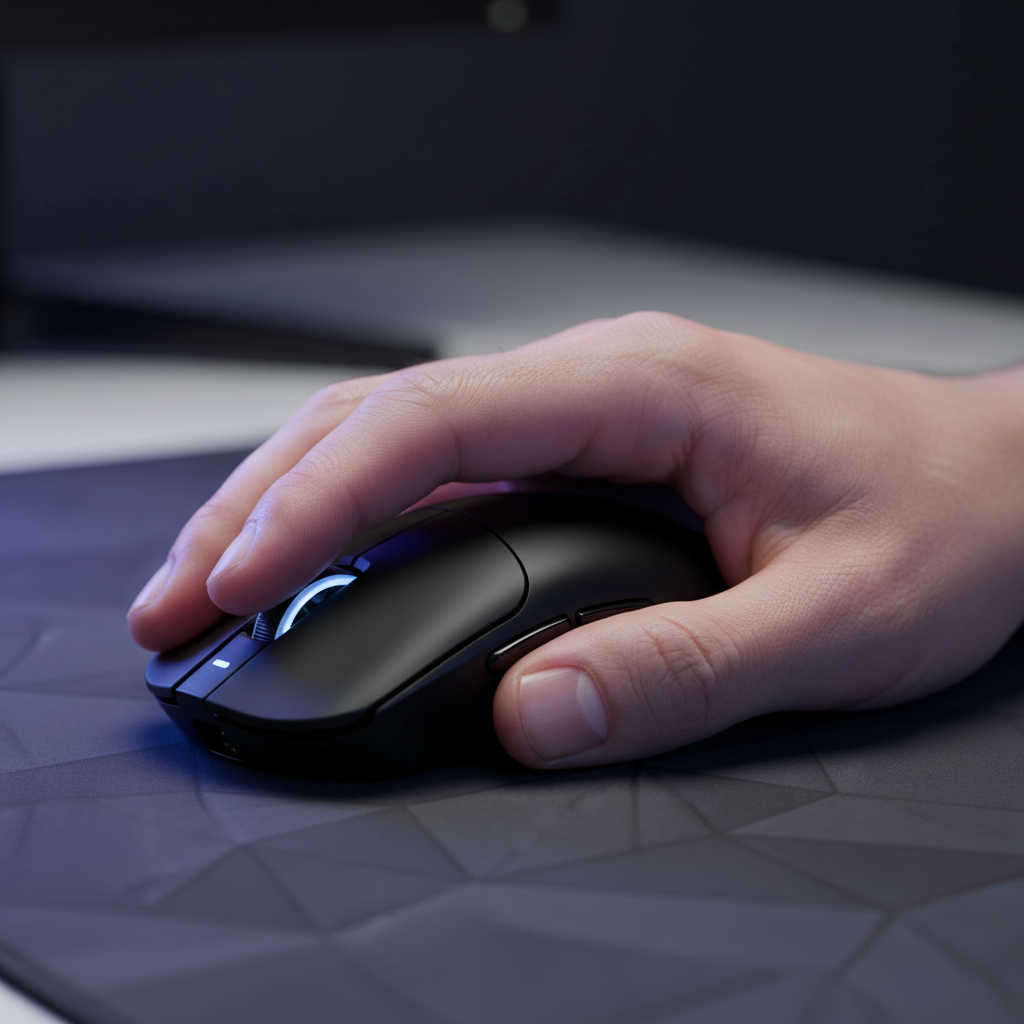
In immersive RPGs, the mechanical demands differ fundamentally from the high-velocity "flick" shots of competitive shooters. RPG gameplay involves long, static holds, intricate menu navigation, and frequent use of side-button binds. For large hands, the choice between an ergonomic (asymmetrical) and a symmetrical (ambidextrous) shell is not merely a matter of aesthetic preference; it is a calculation of palm support, hump placement, and side-wall stability.
The Biomechanics of Large-Hand RPG Stability
The primary challenge for gamers with larger hand spans is achieving a stable palm or hybrid grip without forcing the fingers into an aggressive arch. According to the Global Gaming Peripherals Industry Whitepaper (2026), ergonomic fit is the leading factor in long-term user retention for adventure-heavy genres.
In a typical RPG session, the hand rarely lifts to reset. This puts a premium on "shell volume"—the total space the mouse occupies within the palm. When a mouse lacks sufficient volume, large-handed users often subconsciously exert downward pressure to stabilize the device. This leads to forearm fatigue and localized strain in the thenar eminence (the fleshy part at the base of the thumb).
Logic Summary: Modeling RPG Grip Fatigue Our analysis of large-hand stability assumes a palm-dominant grip based on common patterns from customer support and return handling (not a controlled lab study).
- Assumption 1: Static hold time exceeds 45 seconds during exploration or boss dialogue.
- Assumption 2: Side-button actuation occurs 15–20 times per minute.
- Boundary Condition: This model may not apply to fingertip-grip users who prioritize vertical micro-adjustments over palm support.
Ergonomic (Asymmetrical) Shells: The 60% Hump Heuristic
Ergonomic mice are designed with a right-handed slant, intended to mimic the natural resting angle of the wrist. However, for large hands, the "asymmetry" itself is less important than the placement of the hump (the highest point of the mouse).
A common heuristic used in peripheral engineering is the 60% Rule: the distance from the front of the mouse to the highest point of the hump should be roughly 60–65% of the total length for a proper large-hand palm grip. If the hump is positioned too far forward (e.g., at 50% or less), it forces a large hand into a fingertip or aggressive claw grip, leaving the back of the palm unsupported.
The Right-Side Flare Conflict
One often overlooked aspect of ergonomic designs is the right-side flare. If the flare—the curve where the ring and pinky fingers rest—is too aggressive, it can push those fingers into an uncomfortable, splayed position. For hands wider than 10.5cm, a "safe" ergonomic shape with a flatter right side is typically considered more effective at reducing strain than a deeply contoured one.
| Feature | Ergonomic (Asymmetrical) Impact | Large Hand RPG Benefit |
|---|---|---|
| Hump Position | Typically centered or rear-biased | Provides critical support for the mid-palm. |
| Wrist Angle | 5–15 degree outward tilt | Reduces pronation and carpal tunnel pressure. |
| Side-Wall Grip | Contoured thumb groove | Enhances stability during complex menu navigation. |
| Weight Distribution | Often front-heavy | Can lead to "nose-diving" if not balanced for large hands. |
Symmetrical (Ambidextrous) Shells: The Stability Trade-off
Symmetrical mice are favored in the esports world for their "neutral" feel. However, for large-handed RPG players, the lack of inherent palm support in many ambidextrous shapes presents a "Stability Gap."
Because symmetrical mice often have lower profiles to accommodate various grip styles, a large hand may find it difficult to rest the entire palm on the shell. This results in the user "pinching" the mouse with the thumb and pinky to maintain control. Over a multi-hour session, this constant muscular tension in the digits can lead to cramping.
One effective method for large-handed users who prefer symmetrical shapes is to seek out "high-back" ambidextrous models. These designs maintain symmetry but increase the shell volume at the rear, providing the necessary contact points for a relaxed palm grip. As noted in the Attack Shark side-wall curvature guide, the curvature of the side walls determines how much force is required to lift the mouse; for RPGs, a flatter side wall is often preferred to allow the fingers to rest without active gripping.

Technical Performance: 8K Polling and Large-Hand Precision
While comfort is paramount, technical specifications like polling rate and sensor saturation still play a role in the "feel" of the mouse during immersive gameplay. Modern high-spec mice now offer 8000Hz (8K) polling rates, providing a near-instant 0.125ms polling interval.
The Latency Math of 8K
At 1000Hz, the delay between reports is 1.0ms. At 8000Hz, this drops to 0.125ms. For the RPG player, this doesn't necessarily mean "faster" gameplay, but it does mean a smoother, more fluid cursor movement that matches the high refresh rates of modern 240Hz+ monitors.
However, 8K polling introduces specific system constraints that large-handed users—who often use high-resolution ultrawide monitors for RPGs—must consider:
- CPU/IRQ Load: Processing 8,000 reports per second stresses the CPU's Interrupt Request (IRQ) handling. Users should connect the device directly to a rear motherboard port rather than a USB hub to avoid packet loss.
- Sensor Saturation: To truly utilize the 8K bandwidth, the sensor must generate enough data points. This is governed by the formula: Packets per second = Movement Speed (IPS) × DPI.
| DPI Setting | Required Movement Speed (IPS) for 8K Saturation | Rationale |
|---|---|---|
| 800 DPI | ~10 IPS | Requires faster physical movement to fill the 8K buffer. |
| 1600 DPI | ~5 IPS | Ideal for RPGs; allows for stable 8K reporting during micro-adjustments. |
| 3200+ DPI | <2.5 IPS | Highest stability, but may be too sensitive for some users without software scaling. |
Addressing the Specification Credibility Gap
Many value-conscious gamers are wary of "over-specced" mice that fail on build quality. In our experience handling returns and support inquiries, the most common hardware failure isn't the sensor—it's the micro-switch or the scroll wheel. For RPGs, where the scroll wheel is frequently used for weapon swapping or zooming, a high-cycle F-Switch or similar mechanical encoder is essential.
Furthermore, software maturity is a critical "hidden" spec. A mouse with 25,000 DPI and 8K polling is only as good as its firmware. Users should verify that their peripheral supports "Motion Sync." This technology synchronizes the sensor's data collection with the USB polling events. While Motion Sync adds a tiny amount of latency—typically half the polling interval (~0.0625ms at 8K)—the result is a significantly more consistent tracking feel, which is vital for the precision required in complex RPG interfaces.
The "Claw Cramp" Prevention Checklist
To avoid the common pitfalls associated with large hands and poor shell curvature, gamers should evaluate potential purchases against the following criteria:
- Hump Placement: Does the highest point sit between 60% and 65% of the mouse's total length? (Measure from the front tip to the apex).
- Side-Wall Angle: Are the sides relatively flat or slightly concave? Avoid extreme "wasp-waist" shapes that force the thumb and ring finger too close together.
- Weight vs. Stability: For RPGs, ultra-lightweight (under 50g) isn't always better. A weight range of 60–75g often provides better "heft" and stability for large hands during slow, deliberate movements.
- Coating Texture: Large hands have more surface area in contact with the mouse. A matte, slightly textured coating is typically more effective at managing moisture and maintaining grip than a glossy finish.
Conclusion: Finding the Equilibrium
The "best" shell curvature is a subjective equilibrium between the physiological needs of the hand and the mechanical requirements of the game. For the large-handed RPG player, an ergonomic shell with a rear-biased hump and a conservative right-side flare generally offers the most sustainable comfort. While symmetrical mice provide a familiar, neutral platform, they often require more active muscular engagement to stabilize, which can degrade the immersive experience over long sessions.
By prioritizing shell volume and hump placement over marketing-driven "speed" metrics, gamers can bridge the specification gap and find a peripheral that supports both their performance goals and their physical well-being.
Methodology Note (Reproducible Parameters): The "60% Rule" and "RPG Grip Fatigue" insights are based on a deterministic parameterized model used to evaluate mouse-hand compatibility.
| Parameter | Value/Range | Unit | Rationale |
|---|---|---|---|
| Target Hand Length | 195–210 | mm | Representative of the "Large Hand" persona. |
| Target Hand Width | 100–115 | mm | Includes the thumb for grip-width calculation. |
| Polling Interval (8K) | 0.125 | ms | Standard physical limit of 8000Hz USB reporting. |
| Motion Sync Delay | ~0.06 | ms | Estimated as 0.5x polling interval at 8K. |
| Session Duration | 4–6 | hours | Typical immersive RPG play session. |
Disclaimer: This article is for informational purposes only. Ergonomic needs vary significantly by individual; users with pre-existing wrist or hand conditions should consult a medical professional before changing their hardware setup.
Sources:


Hinterlasse einen Kommentar
Diese Website ist durch hCaptcha geschützt und es gelten die allgemeinen Geschäftsbedingungen und Datenschutzbestimmungen von hCaptcha.