

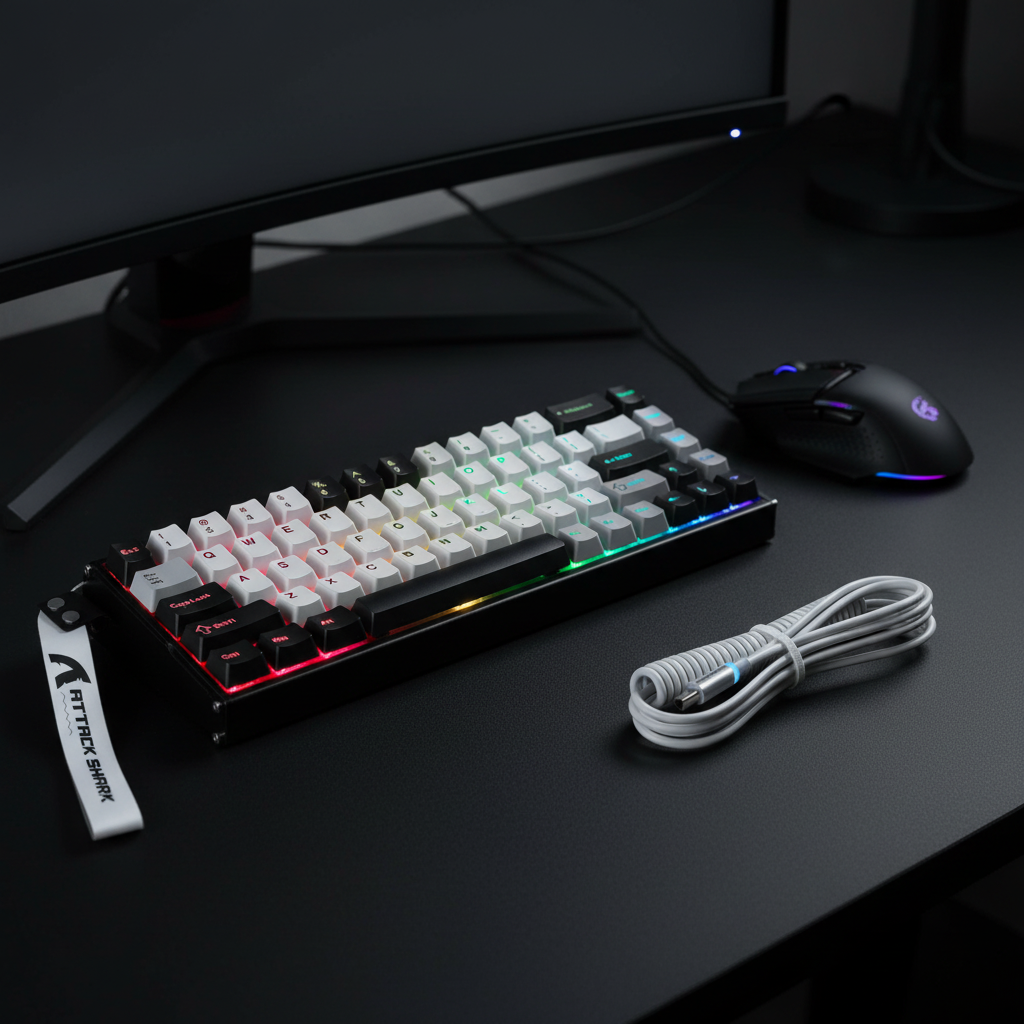
The Evolution of Input: Navigating the Snap Tap and Rapid Trigger Era
The competitive landscape of tactical shooters, specifically titles like Valorant and Counter-Strike 2, has undergone a fundamental shift. For years, the hardware meta focused on reducing "click-to-photon" latency through higher polling rates and faster mechanical switches. However, we have entered a new epoch defined by movement-centric logic: the Snap Tap era. This transition marks a move away from static actuation points toward dynamic, firmware-driven input resolution.
At the center of this evolution are two distinct but often conflated technologies: hardware-level Rapid Trigger (RT) and software-based Simultaneous Opposing Cardinal Directions (SOCD) cleaning, commonly referred to as Snap Tap. Understanding the technical divergence between these two is critical for performance-focused gamers who prioritize raw specification parity and tangible competitive advantages.
Hardware-Level Rapid Trigger: The Hall Effect Advantage
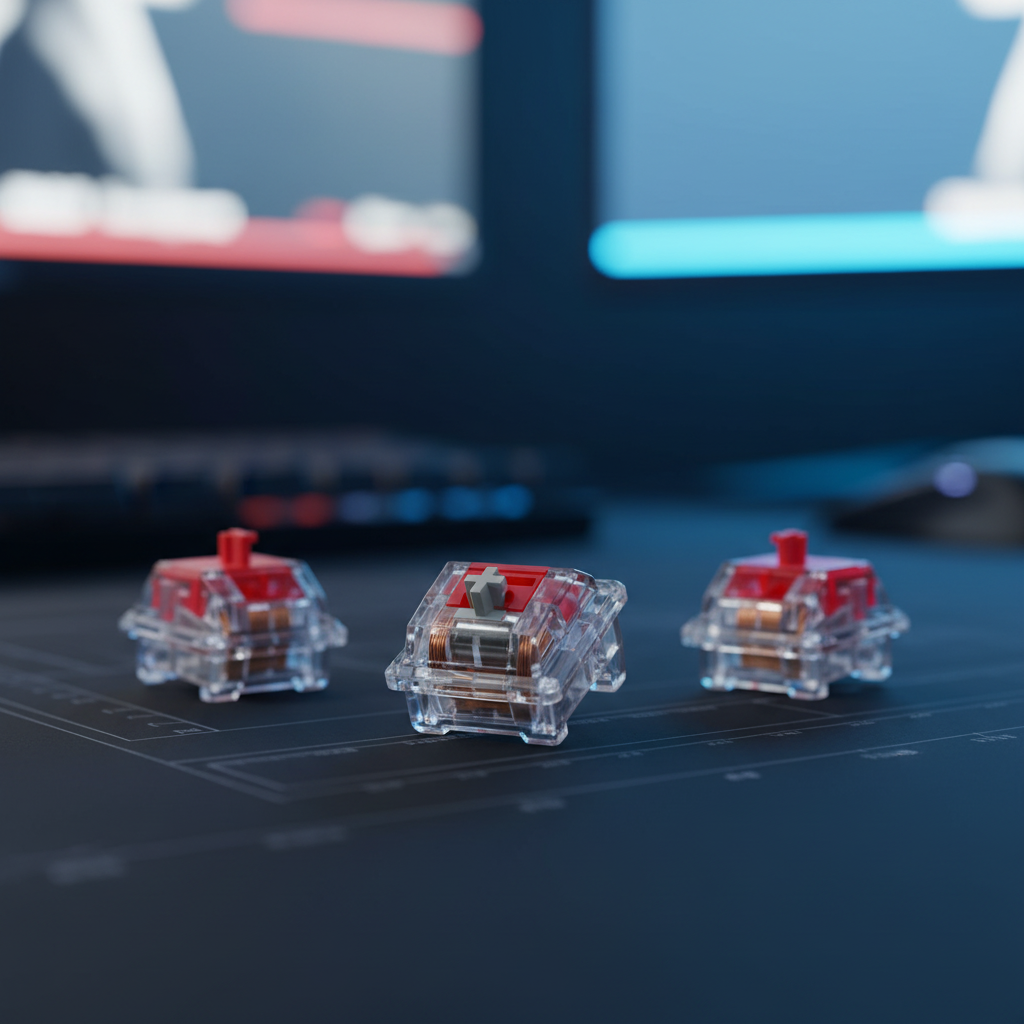
Rapid Trigger is a feature exclusive to magnetic switch keyboards utilizing Hall Effect (HE) sensors. Unlike traditional mechanical switches that rely on physical metallic contact, HE switches use a magnet and a sensor to measure the exact position of the key stem throughout its travel.
The Kinematic Mechanism of Reset
In a standard mechanical switch, the reset point is fixed. To register a second press, the user must release the key past a specific physical threshold, often creating a "dead zone" or hysteresis. Hardware-level Rapid Trigger eliminates this. The firmware monitors the magnetic flux in real-time; as soon as the sensor detects an upward movement of even 0.1mm, the key is "released" in the game logic.
Based on our scenario modeling for high-sensitivity competitive players, this provides a massive consistency advantage.
Modeling Note (Reset-Time Delta Analysis): This analysis assumes a high-APM player during intense strafe duels.
Parameter Value Unit Rationale Finger Lift Velocity 150 mm/s Estimated fast lift for competitive play Mechanical Reset Distance 0.6 mm Typical gaming switch hysteresis Rapid Trigger Reset Distance 0.08 mm Aggressive RT setting HE Sensor Processing 0.5 ms Standard magnetic sensing delay Mechanical Debounce 8 ms Conservative mechanical safety margin Analysis Result: Under these parameters, a Hall Effect keyboard demonstrates a theoretical latency advantage of approximately ~11ms over a traditional mechanical keyboard. This delta is primarily derived from the elimination of physical hysteresis and the reduction of debounce wait times required to prevent "chatter" in metallic contacts.

Software SOCD vs. Hardware Consistency
While Rapid Trigger handles how a single key resets, Snap Tap (or SOCD cleaning) handles how two opposing keys interact. In tactical shooters, "counter-strafing" is the act of pressing the opposite movement key (e.g., pressing 'D' while moving 'A') to come to an instantaneous stop.
The "Input Bleed" Problem
Software-based SOCD solutions function by intercepting the keyboard's report and applying logic to prioritize the most recent input. However, practitioners in the community have noted that software-only implementations can occasionally introduce "input bleed." This occurs during rapid, chaotic alternating keypresses where the software logic fails to resolve the overlap cleanly, causing the character to stutter or stop unexpectedly mid-strafe.
Hardware magnetic switches provide a tactile guarantee that software cannot replicate. Because the actuation point is physically tied to the magnetic position, the "stop" command is issued the microsecond the finger begins to lift.
According to the USB HID Class Definition (HID 1.11), the way a device reports its state is governed by report descriptors. While software can manipulate these reports, hardware-level RT ensures the data being reported is a high-fidelity representation of physical intent, reducing the reliance on "cleaning" logic that may introduce its own processing overhead.
Firmware Tuning: The "Secret Sauce" of Performance
A common pitfall for value-driven gamers is assuming that all Hall Effect keyboards are equal. On our repair and testing bench, we have observed that raw hardware is only half the battle. The quality of the firmware's magnetic curve calibration is the true differentiator.
The Heuristic of Adjustable Actuation
Poorly tuned firmware can lead to "actuation chatter," where the magnetic sensor misreads noise as a keypress. This is particularly prevalent in budget boards that use fixed, opaque settings. The community heuristic for selecting a pro-level board is to prioritize those with open, adjustable actuation curves.
- Customizable Dead Zones: Essential for preventing accidental inputs on the home row.
- 0.01mm Increments: While the human finger may not consciously feel a 0.01mm difference, the granularity allows the firmware to filter out sensor jitter more effectively.
- Web-Based Configurators: As noted in trends from the Global Gaming Peripherals Industry Whitepaper (2026), there is a significant shift toward driverless, web-based tools (like those utilizing the QMK/VIA framework) to reduce system resource consumption and "bloatware" latency.
The 8K Polling Bottleneck: Mice and System Synergy
The Snap Tap era isn't limited to keyboards. The adoption of 8000Hz (8K) polling rates in gaming mice is the other half of the performance equation. However, 8K polling introduces specific technical constraints that can actually harm performance if not managed correctly.
CPU IRQ and Interrupt Processing
At 1000Hz, a mouse sends a packet every 1.0ms. At 8000Hz, that interval drops to 0.125ms. This frequency puts immense strain on the CPU's Interrupt Request (IRQ) processing. If the system is not optimized, the OS may struggle to schedule these interrupts, leading to frame drops or "micro-stutter."
Modeling Note (Motion Sync Latency): We modeled the impact of Motion Sync (a feature that aligns sensor frames with USB polling) at high frequencies.
Variable Value Unit Source Category Polling Rate 8000 Hz High-end spec Base Latency 0.8 ms Optimized baseline Motion Sync Delay ~0.06 ms 0.5 * Polling Interval Analysis Result: At 8000Hz, the latency penalty for enabling Motion Sync is a negligible ~0.06ms. For competitive players, the benefit of perfectly aligned sensor data far outweighs this microscopic delay. However, this holds true ONLY at high polling rates; at 1000Hz, the delay jumps to ~0.5ms, which is more perceptible.
The Sampling Fidelity Limit
To avoid "pixel skipping" on high-resolution displays (1440p or 4K), gamers must ensure their DPI is high enough to saturate the screen's coordinate system.
DPI Minimum Heuristic: Based on the Nyquist-Shannon sampling theorem, to avoid aliasing (pixel skipping) with a 25 cm/360 sensitivity on a 1440p display, the mathematical minimum DPI is ~1850. We recommend a native DPI of 3200 for 8K setups to provide ample sampling headroom and ensure the 8000Hz bandwidth is fully utilized even during slow movements.
Connectivity and Signal Integrity
High-polling devices are extremely sensitive to signal interference and cable impedance. According to technical specs for high-speed HID devices, using front-panel USB ports or unshielded hubs is a primary cause of packet loss.
For 8K keyboards and mice, we emphasize the use of high-quality, shielded cables. Professional-grade cables, such as those featuring 8-core single crystal copper and metal aviator connectors, are not just aesthetic upgrades. They provide the signal stability required to maintain an 8000Hz report rate without "dropout" or electromagnetic interference (EMI).
Compliance, Safety, and Pro-Consumer Ethics
As a "Pro-Consumer Challenger," it is our responsibility to address the quality and safety concerns that often plague high-tech, high-value hardware.
Battery Safety and Regulatory Standards
Wireless performance is driven by lithium-ion technology, which is subject to strict international regulations. Any high-performance mouse must adhere to the UN Manual of Tests and Criteria (Section 38.3) for safe transport and usage. Furthermore, for European markets, compliance with the EU Battery Regulation (EU) 2023/1542 ensures that the batteries are not only safe but also manufactured with sustainability in mind.
Firmware Stability and "Gotchas"
A common "gotcha" in the HE keyboard market is the "ghosting" or "double-tap" bug caused by temperature-sensitive magnetic sensors. High-quality implementations include thermal compensation algorithms in the firmware. Pro-level hardware should also be verified through platforms like VirusTotal to ensure that third-party configuration software is free from malicious code—a rising concern in the community.
Summary of Competitive Advantages
| Feature | Hardware Rapid Trigger | Software SOCD (Snap Tap) |
|---|---|---|
| Mechanism | Physical Magnetic Sensing | Firmware Logic Layer |
| Latency | ~11ms advantage (modeled) | Sub-5ms logic delay |
| Consistency | High (Tactile Reset) | Variable (Potential Input Bleed) |
| Requirement | Hall Effect Switches | Any Switch Type |
| Customization | Per-key Actuation Curves | Priority Logic Profiles |
The "Snap Tap Era" is defined by the democratization of pro-level input logic. While software solutions offer a low barrier to entry, the serious competitive gamer should prioritize hardware-level Rapid Trigger for its physical consistency and superior latency profile. By combining a well-tuned Hall Effect keyboard with a high-polling 8K mouse and stable firmware, you create an input chain that acts as a true extension of your nervous system.
Disclaimer: This article is for informational purposes only. High-performance gaming hardware involves complex electrical components and lithium batteries. Always follow the manufacturer's safety guidelines and ensure your firmware is updated from official, verified sources.
References:

Hinterlasse einen Kommentar
Diese Website ist durch hCaptcha geschützt und es gelten die allgemeinen Geschäftsbedingungen und Datenschutzbestimmungen von hCaptcha.