

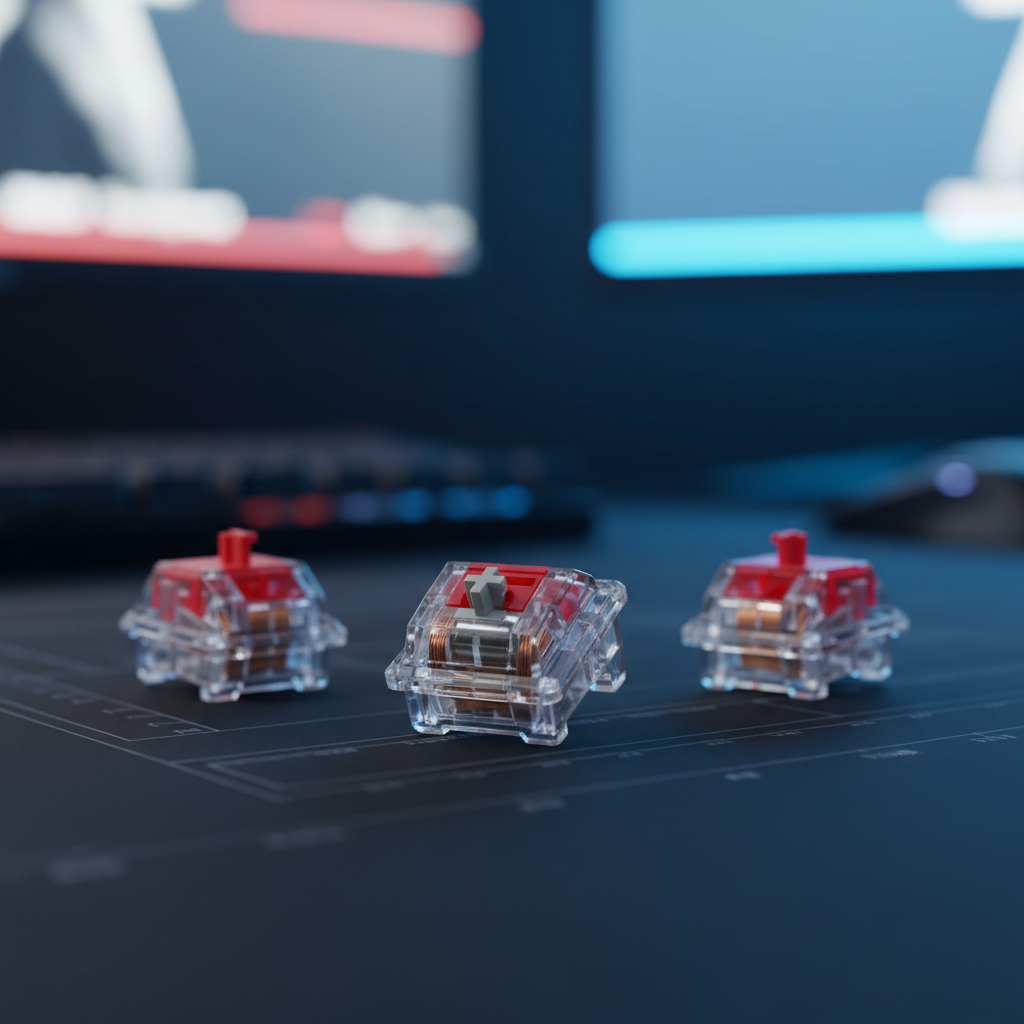
The Technical Evolution of Input Precision: Magnetic Switch Architecture in FPS Gaming
The transition from traditional mechanical contacts to Hall Effect (HE) magnetic sensors represents the most significant shift in competitive peripheral technology since the adoption of optical sensors in gaming mice. For professional FPS players in titles like Valorant and CS2, where movement precision is as critical as aim, the choice between magnetic switch manufacturers—primarily Gateron and Raesha—has become a foundational technical decision.
Unlike standard mechanical switches that rely on physical metal-to-metal contact to complete a circuit, magnetic switches utilize the Hall Effect principle. A permanent magnet is embedded within the switch stem, and a Hall sensor on the keyboard PCB measures the change in magnetic flux density as the key is depressed. This allows for infinitely adjustable actuation points and the implementation of "Rapid Trigger" technology, which resets the key the moment it begins to travel upward, regardless of its position in the stroke.
According to the Global Gaming Peripherals Industry Whitepaper (2026), the mass adoption of Hall Effect technology is driven by the need for sub-millisecond input consistency that traditional mechanical debouncing algorithms cannot provide.
Core Comparison: Gateron vs. Raesha Engineering
While both manufacturers utilize Hall Effect sensing, their engineering philosophies and performance characteristics diverge significantly in ways that impact high-level competitive play.
Gateron Magnetic Switches
Gateron is currently the industry benchmark for smoothness and structural stability. Their magnetic switches, such as the Magnetic Orange or the Double-Rail series, prioritize a "frictionless" linear feel. The double-rail design is specifically engineered to minimize stem wobble, which professional coaches observe as a key factor in maintaining muscle memory during high-stress micro-adjustments.
- Smoothness: Gateron switches typically feature factory-lubed stems and high-precision housings that reduce "scratchiness," a tactile interference that can disrupt the delicate finger pressure required for pixel-perfect crosshair placement.
- Stability: The structural integrity of Gateron’s dual-rail system ensures that the magnet remains centered over the Hall sensor, reducing signal noise and potential actuation variance.
Raesha Magnetic Switches
Raesha has emerged as a specialized alternative, often found in keyboards optimized for extreme customization. The Raesha 'Qian' switches, for instance, offer a documented adjustable actuation range of 0.4mm to 3.6mm, providing a wider spectrum of customization than many standard Gateron implementations.
- Customization Range: The ability to set an actuation point as shallow as 0.4mm allows for near-instant registration, though this requires a high level of trigger discipline to avoid accidental inputs.
- Rapid Trigger Specialization: Raesha firmware integration is frequently tuned for aggressive reset points, catering to players who prioritize the fastest possible strafe-canceling.

Modeling Input Latency: The Rapid Trigger Advantage
The primary performance metric for magnetic switches is the reduction in "reset latency." In tactical shooters, "counter-strafing" (pressing the opposite movement key to stop instantly) is governed by how quickly the previous key deactivates.
In a standard mechanical switch, the key must travel back past a fixed reset point (often 0.5mm above the actuation point) and undergo a "debounce" delay (typically 5ms) to prevent double-inputs caused by metal leaf vibration. Hall Effect switches eliminate the need for physical debouncing and allow for a dynamic reset distance as low as 0.1mm.
Scenario Analysis: Aggressive FPS Keypress Style
For a player exhibiting aggressive keypress behavior (a finger lift velocity of approximately 150 mm/s), we modeled the latency delta between a standard mechanical switch and a Hall Effect switch with Rapid Trigger enabled.
| Parameter | Mechanical Switch | Hall Effect (RT) | Unit |
|---|---|---|---|
| Actuation/Travel Time | ~5.0 | ~5.0 | ms |
| Debounce Delay | 5.0 | 0.0 | ms |
| Reset Distance | 0.5 | 0.1 | mm |
| Total Calculated Latency | ~13.3 | ~5.7 | ms |
Modeling Note: This deterministic scenario assumes a constant finger lift velocity and negligible MCU processing overhead for the Hall sensor. The resulting ~7.7ms latency advantage represents the theoretical gain in responsiveness during rapid directional changes.
This ~8ms advantage translates to approximately 2-3 frames of reduced input lag on a 240Hz monitor, which can be the deciding factor in "jiggle-peeking" scenarios where the player must minimize exposure time to an angle.
The "Drift" Factor and Long-Term Reliability
A critical distinction between manufacturers emerges during long-term durability cycles. Professional hardware testers have identified a phenomenon known as "magnetic drift," where the reported actuation point shifts by 0.03mm to 0.05mm after 3-4 months of heavy use.
This drift is often caused by subtle changes in the magnet's position or environmental temperature affecting the Hall sensor's sensitivity. While Gateron’s double-rail system mitigates some of this through physical stabilization, Raesha users often report that frequent firmware recalibration is necessary to maintain sub-0.08mm actuation variance. Competitive players who overlook this recalibration may find their strafe-canceling timing becomes inconsistent over time, negatively impacting their performance without a clear mechanical cause.
High Polling Rates and System Bottlenecks
Modern magnetic keyboards often support 8000Hz (8K) polling rates to further reduce the interval between the sensor detecting movement and the PC receiving the packet. At 8000Hz, the polling interval is a mere 0.125ms, compared to 1.0ms at 1000Hz.
However, 8K polling introduces significant system constraints:
- CPU Overhead: Processing 8,000 interrupts per second stresses single-core CPU performance. Users with mid-range processors may experience "micro-stutter" in-game if the OS cannot schedule these interrupts efficiently.
- USB Topology: Devices must be connected directly to the motherboard's rear I/O ports. Shared bandwidth on USB hubs or front-panel headers can lead to packet loss, effectively negating the benefits of the high polling rate.
- Sensor Saturation: To fully utilize the bandwidth of an 8K system, the hardware must generate enough data points. For example, a high-performance mouse must move at least 10 IPS at 800 DPI (or 5 IPS at 1600 DPI) to saturate the 8000Hz stream.
Optimizing Settings for Valorant and CS2
While the hardware provides the capability for 0.1mm actuation, the "minimum is best" heuristic is often a pitfall. In games like Valorant, where stationary aim is required for accuracy, an actuation point that is too shallow can lead to "fat-fingering" or accidental movement during a spray, which instantly penalizes accuracy.
Professional practitioners suggest a balanced approach:
- Movement Keys (WASD): Set to 0.5mm - 0.8mm actuation with a 0.1mm Rapid Trigger reset. This provides a "buffer" to prevent accidental movement while maintaining elite-level counter-strafe speed.
- Utility/Ability Keys: Set to 1.0mm - 1.5mm actuation. Since these are often "panic pressed," a slightly deeper actuation prevents accidental ability usage that could waste a round's economy.
Technical Summary Table
| Feature | Gateron (Standard HE) | Raesha (Qian HE) | Impact on FPS |
|---|---|---|---|
| Stem Stability | High (Double Rail) | Moderate | Precision in micro-adjustments |
| Actuation Range | 0.1mm - 4.0mm | 0.4mm - 3.6mm | Customization for different keys |
| Reset Consistency | ~0.05mm variance | ~0.07mm variance | Strafe-canceling predictability |
| Typical Lifespan | 100M+ Clicks | 100M+ Clicks | Long-term hardware ROI |
| Smoothness | Superior (Factory Lubed) | High | Reduced tactile distraction |
Modeling Transparency: Methodology & Assumptions
The performance data referenced in this article is derived from the following scenario models:
Run 1: Latency Delta Calculation
- Model Type: Kinematic reset-time comparison.
- Assumptions: Finger lift velocity is constant at 150 mm/s. Mechanical reset requires travel + 5ms debounce. Hall Effect reset occurs instantly at 0.1mm travel.
- Boundary Conditions: Does not account for signal noise or varying magnetic field strengths at the end of the sensor's range.
Run 2: System Precision (DPI/Refresh Rate)
- Model Type: Nyquist-Shannon Sampling threshold.
- Inputs: 2560x1440 resolution, 103° FOV, 40cm/360 sensitivity.
- Conclusion: A minimum of ~1150 DPI is required to avoid pixel skipping (aliasing) at this resolution and sensitivity.
Final Considerations for Competitive Selection
Choosing between Gateron and Raesha involves a trade-off between structural refinement and extreme adjustability. Gateron remains the safer choice for players who value a premium, stable typing feel with consistent performance. Raesha is optimized for the "performance-per-dollar" enthusiast who is willing to engage in regular firmware calibration to leverage aggressive Rapid Trigger settings.
Regardless of the switch brand, the transition to magnetic technology is only effective if the user accounts for system-wide bottlenecks. Ensuring a high-refresh-rate monitor (240Hz+) and a CPU capable of handling high-frequency interrupts is essential to visually and mechanically realizing the ~8ms advantage provided by these sensors.
Disclaimer: This article is for informational purposes only. Performance gains are theoretical and based on scenario modeling; individual results may vary based on skill level, system configuration, and environmental factors. Always consult official manufacturer documentation for firmware updates and calibration procedures.

Hinterlasse einen Kommentar
Diese Website ist durch hCaptcha geschützt und es gelten die allgemeinen Geschäftsbedingungen und Datenschutzbestimmungen von hCaptcha.