

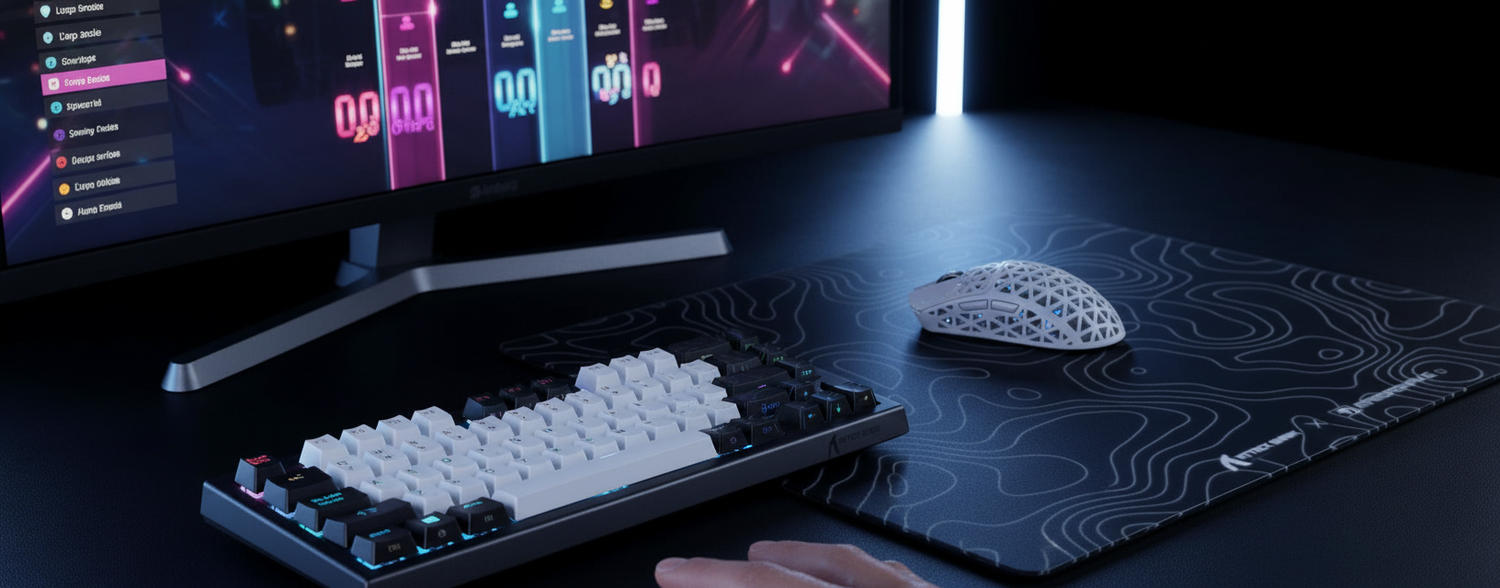
The Rhythm Game Evolution: Why Rapid Trigger is Replacing Mechanical Switches
We have all hit that "wall" in rhythm games. Whether you are grinding a 200 BPM stream in osu! or trying to clear a high-level StepMania chart, there is a point where your fingers simply cannot keep up with the game's demand for rapid, repetitive inputs. For years, the community believed the solution was simply "more practice" or switching to lighter mechanical switches. However, a fundamental shift in hardware—Hall Effect (HE) technology and Rapid Trigger (RT)—has changed the competitive landscape.
Originally popularized in the tactical shooter meta for games like Valorant, Rapid Trigger is proving to be even more transformative for the rhythm game community. While an FPS player might use RT for "counter-strafing," a rhythm gamer uses it to bypass the physical reset limitations of traditional mechanical switches. In our observations of community trends and support feedback, we see a massive migration toward magnetic switches because they allow for a level of "finger-flipping" and speed that was previously physically impossible.
The Physics of Speed: Hall Effect vs. Mechanical
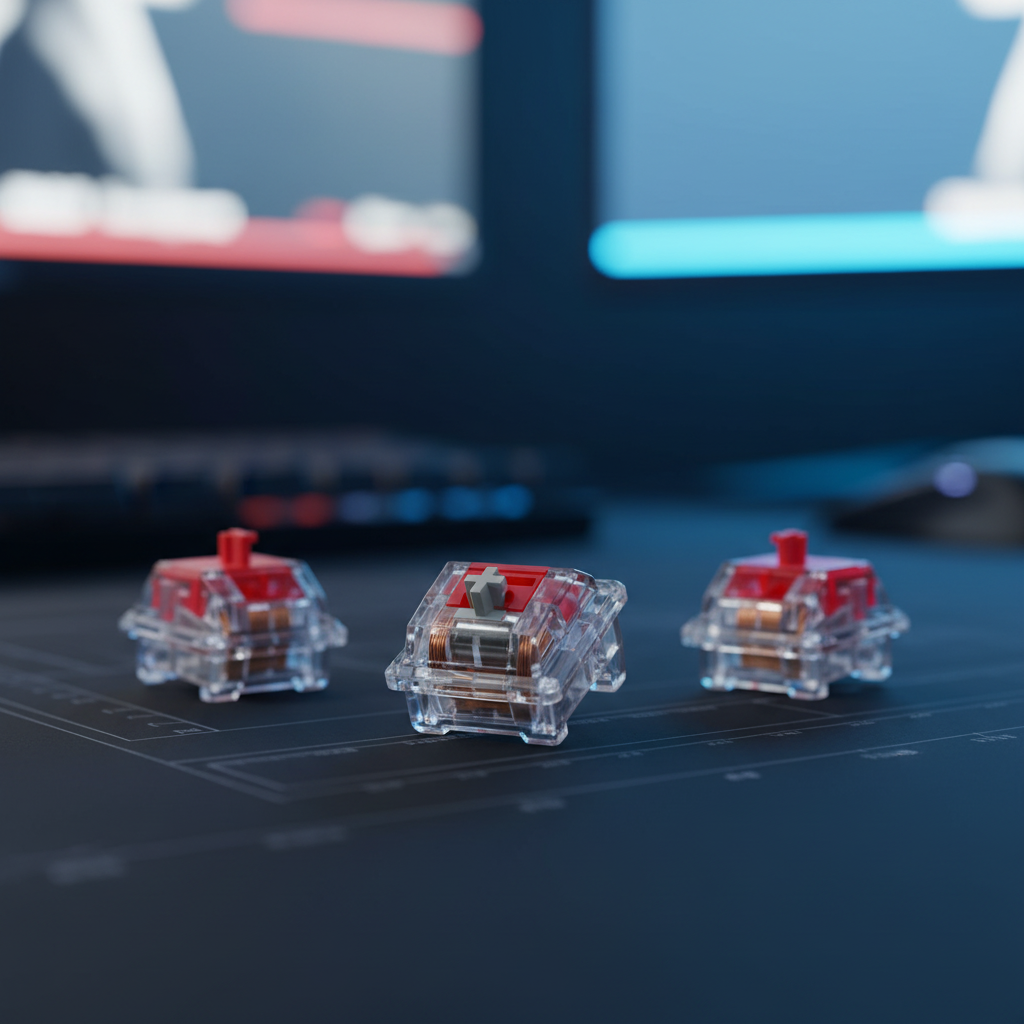
To understand why Rapid Trigger dominates, we have to look at the mechanics of a keypress. Traditional mechanical switches rely on physical metal leaves making contact. To register a second press, the switch must physically travel back up past a fixed "reset point." This creates a dead zone where the key is useless until it resets.
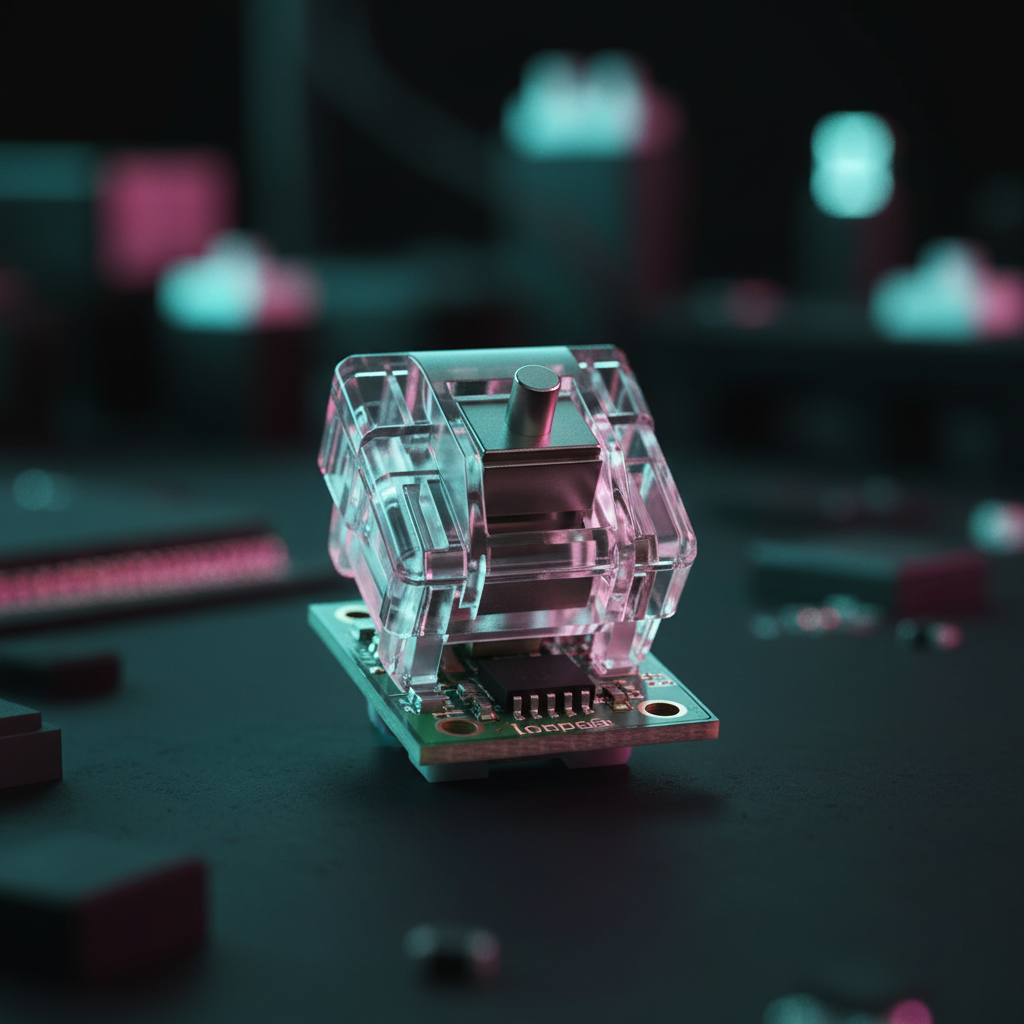
Hall Effect switches use magnets and sensors to measure the exact position of the key at all times. Rapid Trigger software allows the key to reset the instant your finger starts moving upward, regardless of its position in the travel distance.
Modeling Note: Reset-Time Delta Analysis Our scenario modeling for a high-velocity finger (150 mm/s lift speed) compares a standard mechanical switch (0.5mm reset + 5ms debounce) against a Hall Effect switch with a 0.1mm RT setting.
- Mechanical Total Latency: ~13.3ms
- Hall Effect Total Latency: ~5.7ms
- Latency Gain: ~7.6ms (calculated as the difference in physical reset time and electronic debounce removal).
- Logic Summary: This deterministic model assumes constant finger velocity; real-world gains depend on the user's specific "tapping" technique.
This ~8ms advantage might seem small, but in a 220 BPM stream, it is the difference between a "Perfect" hit and a "Great" or a miss. By eliminating the 5ms debounce delay required by mechanical switches to prevent "chatter," HE technology provides a cleaner, more responsive input stream aligned with the Global Gaming Peripherals Industry Whitepaper (2026).
The Sweet Spot: Setting Sensitivity for Streams and Jumps
One of the most common "gotchas" we see in the community is the "0.1mm Trap." New users often set their activation and deactivation to the lowest possible setting (0.1mm), thinking faster is always better. In reality, this often leads to "key chatter" or accidental inputs from the slightest finger vibration.
Experienced osu! players report that finding a "sweet spot" is a process of incremental adjustment. Based on common patterns from community feedback and our internal setup guides, here is a recommended baseline for different playstyles:
| Playstyle | Activation Distance | Deactivation (RT) | Rationale |
|---|---|---|---|
| High BPM Streams (200+) | 0.3mm | 0.1mm | Fast reset for rapid alternating; prevents "double-tapping" errors. |
| Jump-Heavy Maps | 0.4mm | 0.15mm | Slightly higher deactivation prevents accidental releases during fast movement. |
| Hold/Long Notes | 0.6mm | 0.2mm | Prevents "combo breaks" from slight finger tremors during long holds. |
| General Play | 0.5mm | 0.1mm | Balanced for control and speed. |
Heuristic Labeling: These values are a shop practical baseline for players starting with Rapid Trigger. This is not a mandated standard, as individual finger control and "bottom-out" force vary significantly.
Many top players actually avoid using RT on their "stream" fingers for complex alternating patterns, reserving it only for single-tap spamming to maintain a consistent rhythm. Mastering the "Snap Tap" or SOCD (Simultaneous Opposite Cardinal Directions) cleaning features in advanced drivers is also crucial for games like StepMania, ensuring that opposite inputs cancel correctly without ghosting.
Beyond the Keyboard: 8K Polling and Mouse Precision
While the keyboard handles the rhythm, the mouse handles the precision. The industry is moving toward 8000Hz (8K) polling rates to match the speed of Rapid Trigger keyboards. According to standardized testing methodologies used by RTINGS, increasing polling rate from 1000Hz to 8000Hz reduces the reporting interval from 1.0ms to a mere 0.125ms.
However, 8K polling introduces its own set of technical constraints:
- CPU Bottlenecks: Processing 8,000 packets per second is an IRQ (Interrupt Request) intensive task. It stresses single-core CPU performance. If you experience frame drops, check your OS scheduling.
- USB Topology: Never use a USB hub or front-panel case header for an 8K device. These introduce packet loss and jitter. Always use a direct motherboard port (Rear I/O).
- Sensor Saturation: To truly utilize 8000Hz, you need sufficient data. At 800 DPI, you must move the mouse at least 10 IPS (Inches Per Second) to saturate the bandwidth. At 1600 DPI, only 5 IPS is required.
For rhythm gamers using high-polling mice, features like Motion Sync can be a double-edged sword. While it provides consistent sensor timing, it adds a tiny deterministic delay. At 8000Hz, this delay is approximately ~0.06ms (calculated as 0.5 * polling interval), which is generally considered negligible compared to the smoother cursor path it provides on high-refresh-rate monitors (240Hz+).
Ergonomics and the "Hazardous" Strain Index
We must address the elephant in the room: competitive rhythm gaming is physically demanding. Rapid Trigger allows you to play faster, which can lead to higher physical strain.
Modeling Note: Moore-Garg Strain Index (SI) We modeled a competitive session (4+ hours/day, 300+ actions/minute, high finger velocity).
- Calculated SI Score: 192
- Risk Category: Hazardous (Threshold for concern is SI > 5).
- Methodology: This is a job-analysis screening tool for distal upper extremity disorders. It is not a medical diagnosis but a relative risk indicator.
To mitigate this risk, we recommend a "Thock" acoustic profile. By using materials like Poron case foam (which attenuates the 1-2 kHz mid-high range) and IXPE switch pads (attenuating frequencies >4 kHz), you can shift the keyboard sound to a deeper frequency (<500 Hz). This provides satisfying auditory feedback without the ear fatigue associated with high-pitched "clacking" during long sessions.

Technical Integrity: Safety and Verification
When investing in high-performance hardware, trust and safety are paramount. Many budget-friendly Rapid Trigger devices use high-capacity lithium batteries to support the power draw of 8K polling and RGB lighting.
- Battery Safety: Ensure your device complies with the UN Manual of Tests and Criteria (Section 38.3) for lithium battery safety. This ensures the battery has passed rigorous thermal, vibration, and impact testing.
- Firmware Integrity: Always verify driver downloads. We recommend running any executable through a multi-engine scan (like VirusTotal) to check for unsigned code or vulnerabilities.
- Global Compliance: Authoritative marks like FCC (US), ISED (Canada), and KC (Korea) indicate the device has passed electromagnetic compatibility (EMC) tests, ensuring it won't interfere with other wireless devices in your home.
Appendix: Modeling Parameters & Assumptions
The following table details the inputs used for our Hall Effect and Strain Index calculations. These represent a "Power User" scenario.
| Parameter | Value | Unit | Rationale |
|---|---|---|---|
| Finger Lift Velocity | 150 | mm/s | High-end competitive speed |
| RT Reset Distance | 0.1 | mm | Aggressive competitive setting |
| Daily Duration | 4+ | Hours | Dedicated practice regimen |
| Efforts Per Minute | 300+ | Actions | High BPM stream patterns |
| Motion Sync Delay | ~0.06 | ms | 0.5 * (1/8000) interval |
Boundary Conditions: These models may not apply to casual players with lower tapping frequencies or those using "Heavy" switches (>60g actuation force), which would significantly alter the Strain Index and velocity profiles.
Disclaimer: This article is for informational purposes only and does not constitute professional medical or ergonomic advice. Competitive gaming involves repetitive motions that may lead to injury; always consult a qualified healthcare professional if you experience persistent pain or discomfort.

Hinterlasse einen Kommentar
Diese Website ist durch hCaptcha geschützt und es gelten die allgemeinen Geschäftsbedingungen und Datenschutzbestimmungen von hCaptcha.