

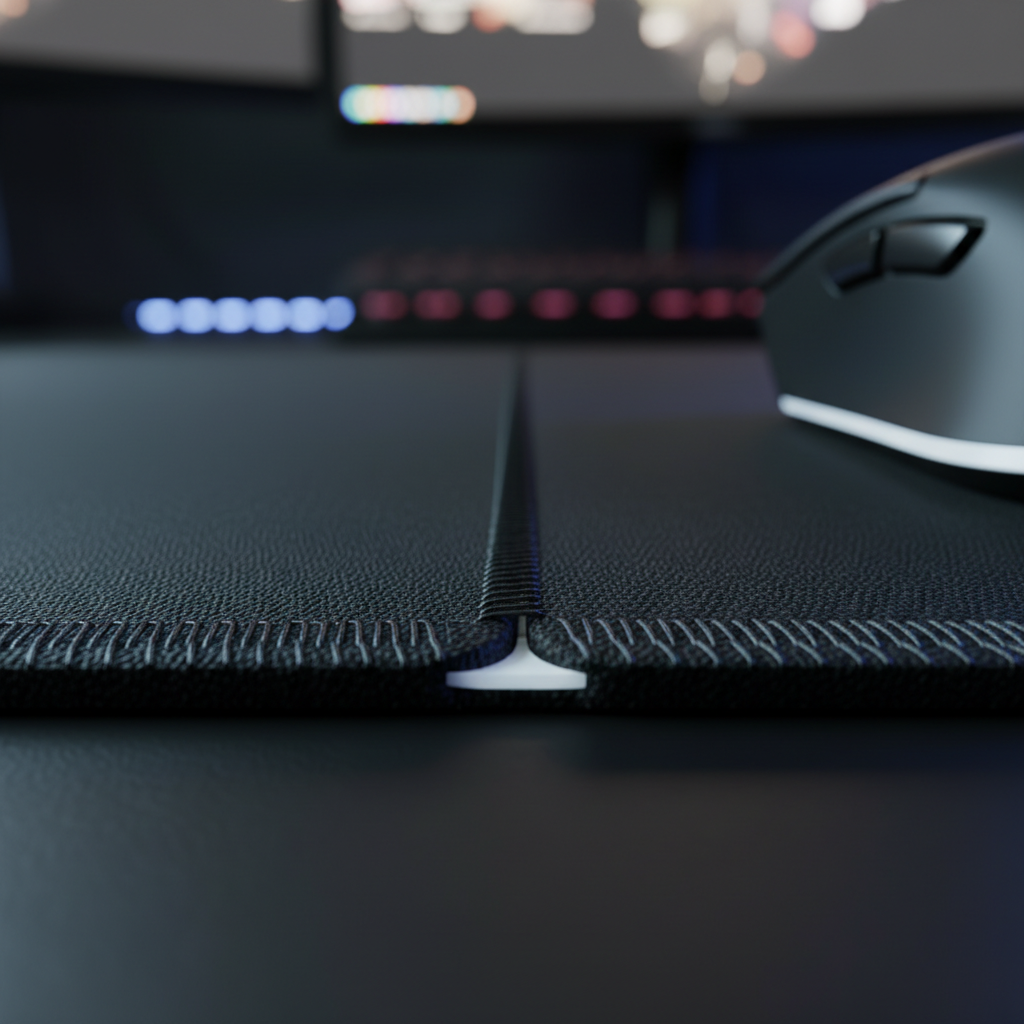
The Physics of the Perimeter: Why Low-Profile Stitching Defines the Competitive Edge
For the low-sensitivity FPS gamer, the entire desk mat is a field of play. Unlike wrist-aimers who operate within a tight 5-10 cm radius, arm-aimers utilizing sensitivities such as 40cm/360° or 50cm/360° treat the mouse pad's perimeter not as a boundary, but as a frequent point of contact. In high-stakes environments, the transition from the center of the pad to its extreme edges must be mathematically consistent.
A common frustration among performance-focused enthusiasts is the "edge ridge"—a physical elevation caused by standard raised stitching. While stitching is historically implemented to prevent the top fabric from delaminating from the rubber base, poor execution creates a "graveyard" of discarded pads that fail during wide-sweep flick shots. Understanding the engineering behind low-profile, recessed stitching is essential for maintaining muscle memory and sensor fidelity during large-scale maneuvers.
The Biomechanics of Large-Sweep Aiming
Large-sweep aiming relies on a full-arm pivot originating from the elbow or shoulder. According to the Global Gaming Peripherals Industry Whitepaper (2026), the consistency of the surface-to-base bond is a primary driver of aiming predictability. When a player performs a 180-degree turn or a wide flick, the mouse often travels to the very edge of the mat.
If the stitching sits 0.5mm to 1.0mm above the primary playing surface, two critical failures occur:
- Sensor Deviation: As the mouse skates cross the raised ridge, the sensor’s lift-off distance (LOD) may be triggered, or the angle of the sensor relative to the pad changes. This leads to "pixel skipping" or a complete loss of tracking at the most crucial moment of a flick.
- Tactile Disruption: The PTFE feet of a high-performance mouse, such as the ATTACK SHARK G3 Tri-mode Wireless Gaming Mouse 25000 DPI Ultra Lightweight, are designed for a flat plane. Hitting a raised stitch produces an audible "click" and a tactile "thump" that breaks the player's focus and adds unplanned resistance to the movement.
Modeling the Large-Handed Low-Sensitivity Scenario
To understand the scale of this issue, we modeled the requirements for a competitive gamer with large hands (approximately 20.5 cm in length) using a claw grip.
Modeling Note (Reproducible Parameters): This analysis uses a deterministic scenario model based on standard ergonomic heuristics (not a controlled lab study).
Parameter Value/Range Unit Rationale Hand Length 20.5 cm 95th Percentile Male (ANSUR II) Mouse Sensitivity 40 cm/360° Standard Low-DPI Competitive Range Stitching Height 0.8 mm Average Budget Stitched Edge Glide Frequency 120-150 Crossings/30m Estimated Edge Contact in Aim Training Target DPI 1150 DPI Nyquist-Shannon Minimum for 1440p
Our analysis indicates that for this specific persona, an undersized mouse or a pad with a raised edge increases the Moore-Garg Strain Index toward hazardous levels. The frequent overextension required to reach the pad's edge, combined with the physical obstacle of the stitching, concentrates fatigue near the elbow and wrist.

Engineering the Low-Profile Edge: Manufacturing Nuances
The difference between "stitched" and "low-profile stitched" is not merely aesthetic; it is a manufacturing distinction involving thread density and base preparation.
1. The Recessed Channel
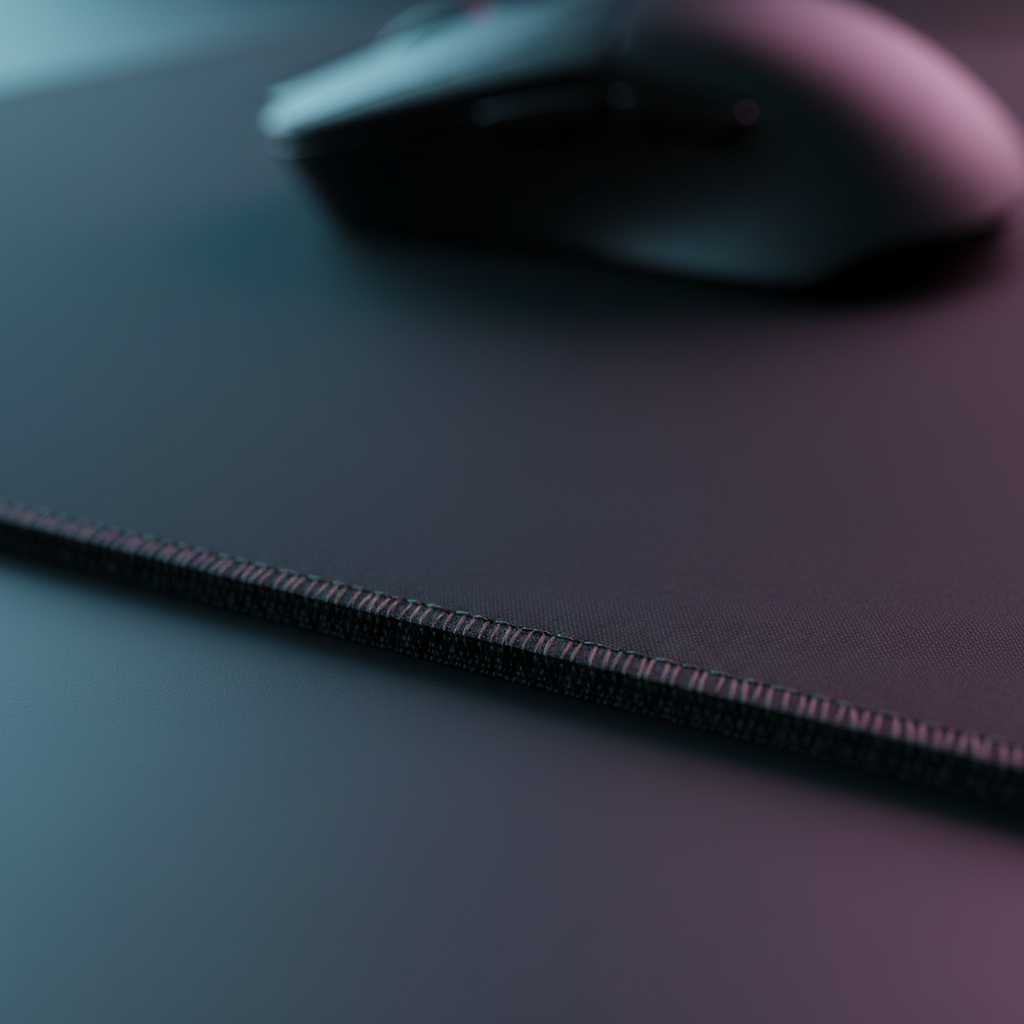
In pro-grade pads, the rubber base (often SBR or natural rubber) is not simply cut and then sewn. Instead, a precise channel is often compressed or cut into the perimeter of the rubber. This allows the stitching to sit flush with or slightly below the fabric surface. When you run a fingertip along the edge of a high-quality mat, the transition should feel seamless. If there is a detectable "lip," the pad will likely cause glide inconsistency.
2. Thread Density and Material
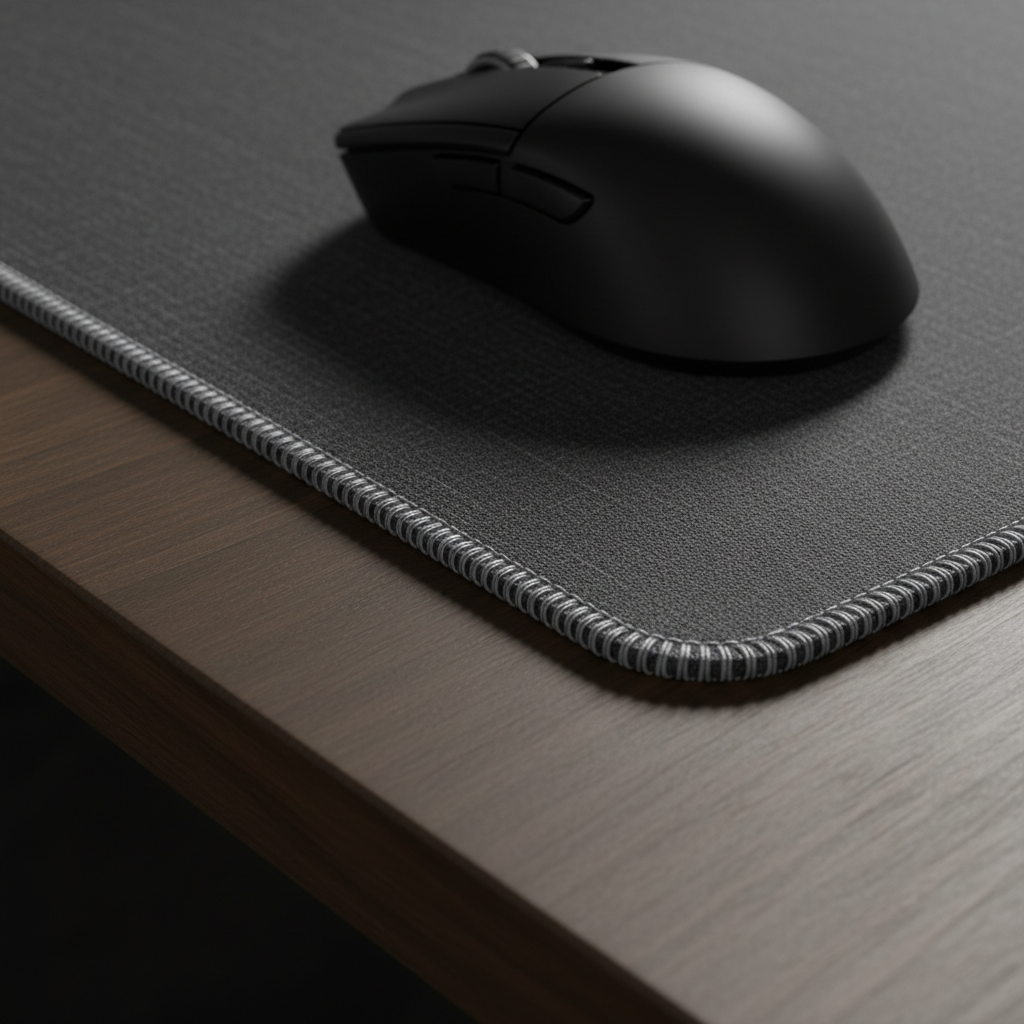
Standard budget pads use thick, abrasive nylon thread with a high stitch-per-inch (SPI) count that creates a hard, "bumpy" ridge. Advanced engineering utilizes fine-denier polyester or specialized micro-fibers. These materials allow for a denser, flatter weave that resists fraying without adding vertical height.
3. Surface Contamination and Longevity
A hidden cost of traditional stitching is its tendency to act as a trap for skin oils, sweat, and environmental debris. Over months of use, the fabric at the edge can become "mushy" or contaminated, altering the friction coefficients (μ) of the perimeter. Low-profile stitching minimizes the surface area of the thread exposed to the arm, reducing this localized contamination. This is particularly vital in damp climates where humidity can alter surface tactility, as noted in our guide on Maintaining Surface Tactility in Damp Climates.
Sensor Fidelity at the Boundary
When discussing large-sweep aiming, sensor performance is non-negotiable. Using a high-precision sensor like the PixArt PAW3311 found in the ATTACK SHARK G3 Tri-mode Wireless Gaming Mouse 25000 DPI Ultra Lightweight provides the necessary IPS (Inches Per Second) tracking to handle rapid arm movements.
However, even the best sensor can be defeated by surface irregularities. According to the Nyquist-Shannon Sampling Theorem, maintaining pixel fidelity on a 1440p display requires a minimum DPI of approximately 1150 for a 40cm/360° sensitivity. If the mouse crosses a 0.8mm stitching ridge, the resulting micro-lift can cause the sensor to miscalculate the movement vector, leading to a "spin-out" or a missed shot.
The Role of Connectivity and Cables
For those who prefer a wired connection or need to charge while playing, the cable itself must not add to the edge-contact problem. A stiff cable can "snag" on the stitched edge, adding tug and resistance. Using a flexible, high-quality cable like the ATTACK SHARK C03 COILED CABLE or the ATTACK SHARK C06 Coiled Cable For Mouse ensures that the "swing" of the mouse remains unobstructed, even when reaching the mat's limits.
Ergonomic Implications of the Edge Profile
Ergonomics in gaming is often reduced to the shape of the mouse, but the "interface" between the arm and the pad edge is equally important. A raised, abrasive stitch acts like a dull saw against the forearm during repetitive sweeps. This can lead to "mousepad burn" or localized skin irritation, which often forces players to adopt "tilted" or awkward arm postures to avoid the edge.
As discussed in our exploration of Wrist vs Arm Aiming, the grip dictates the motion. If the edge of the pad is uncomfortable, a player may subconsciously limit their range of motion, effectively "shrinking" their usable pad space and forcing them to increase their sensitivity—a move that often degrades long-range precision.
Case Study: The "Cloud" Approach
For players who prioritize comfort without sacrificing the benefits of a dedicated surface, the ATTACK SHARK Cloud Mouse Pad offers an integrated memory foam wrist rest. While this design is more common in office settings, the ergonomic principles of reducing wrist extension are applicable to gamers who suffer from fatigue during long sessions. However, for "pure" arm-aimers, a flat, large-format mat with low-profile stitching remains the gold standard for unrestricted movement.
Comparative Analysis: Stitching Profiles
To help you identify the right construction for your playstyle, consider the following comparison based on typical manufacturing standards:
| Feature | Standard Stitched | Low-Profile (Recessed) | Heat-Treated (Seamless) |
|---|---|---|---|
| Edge Height | 0.5mm - 1.2mm above surface | Flush or <0.1mm above | Level with surface |
| Fray Resistance | High | High | Moderate (can peel over time) |
| Sensor Impact | High risk of LOD trigger | Negligible | Zero |
| Tactile Feel | Noticeable ridge | Seamless transition | Smooth but can be sharp |
| Best For | Casual/High-DPI | Competitive Low-DPI | Speed/Glass Pads |
Maintenance and the "Graveyard" Effect
Why do so many pads end up in the "graveyard"? It is rarely because the surface itself wears out. Instead, the edge stitching often becomes the failure point. On budget pads, the stitching can begin to "pills" or fray, creating loose threads that snag on the mouse feet.
Furthermore, the "mushy bump" effect occurs when the binding fabric is too thick. Even if the stitch is recessed, a thick binding can create a soft zone at the edge where the mouse "sinks" slightly. This alters the friction and makes the edge feel slower than the center. Professional-grade construction solves this by using a high-density rubber base that maintains its structural integrity right up to the stitch line.
Technical Checklist for Large-Sweep Aiming
When selecting your next surface and mouse combination, use this technical checklist to ensure specification parity:
- Surface Consistency: Run a fingertip across the edge. If you feel a "step up" or a "lip," it will disrupt your glide.
- Sensor Compatibility: Ensure your mouse uses a high-end optical sensor (e.g., PixArt 3395 or 3311) that can handle the high-velocity sweeps typical of low-DPI play.
- Base Firmness: A "Mid" or "Firm" base is typically preferred for large sweeps to prevent the mouse from sinking during heavy-handed flicks. Refer to our guide on Impact of Base Firmness for more details.
- Cable Management: If using a wired setup, ensure the cable is "paracord-like" or use a high-quality coiled cable to prevent edge snags.
- Hand-to-Mouse Fit: Ensure your mouse dimensions align with your hand size and grip. For large hands (20cm+), a mouse length of ~125mm to 130mm, like the ATTACK SHARK G3, offers a more ergonomic fit ratio.
Final Technical Synthesis
Low-profile stitching is not a luxury; it is a mechanical necessity for the low-sensitivity competitive gamer. By eliminating the physical and sensory disruptions of a raised edge, manufacturers allow the player to utilize 100% of their desk mat's surface area. This consistency is the foundation of muscle memory, allowing for repeatable, pixel-perfect flicks that aren't hampered by a 1mm ridge of nylon thread.
Whether you are upgrading to a high-performance mouse or selecting a new desk mat, the interaction between the mouse feet and the pad's perimeter should be your primary concern. A seamless edge ensures that your focus remains on the crosshair, not on the physical limitations of your equipment.
Disclaimer: This article is for informational purposes only. Ergonomic recommendations are based on general modeling and should not replace professional advice from a qualified ergonomist or physical therapist, especially for individuals with pre-existing repetitive strain injuries.
Sources:
- Global Gaming Peripherals Industry Whitepaper (2026)
- RTINGS - Mouse Click Latency and Performance Methodology
- NVIDIA Reflex Analyzer - System Latency and Peripheral Measurement
- PixArt Imaging - High-Performance Optical Sensor Specifications
- ISO 9241-410: Ergonomics of human-system interaction - Physical input devices
- IEEE - Nyquist-Shannon Sampling Theorem and Signal Fidelity

Hinterlasse einen Kommentar
Diese Website ist durch hCaptcha geschützt und es gelten die allgemeinen Geschäftsbedingungen und Datenschutzbestimmungen von hCaptcha.