

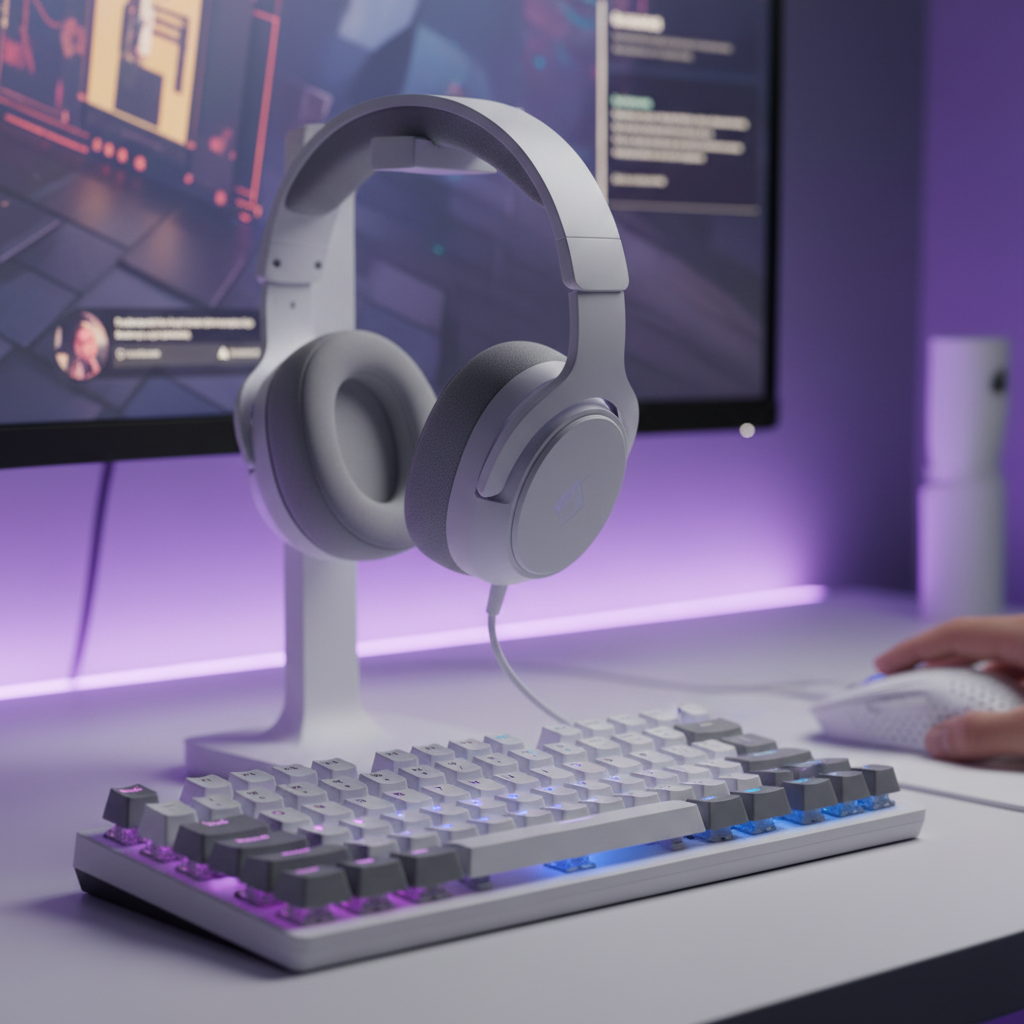
The Technical Reality of Zero-Lag Audio in Competitive Esports
In the high-stakes environment of competitive tactical shooters like Counter-Strike 2 or Valorant, audio is not merely an aesthetic layer; it is a primary data stream. The ability to pinpoint a footstep’s verticality or the specific click of a reload through a wall often determines the outcome of a round. However, the marketing term "zero-lag audio" frequently obscures the complex technical reality of signal transmission. For performance-focused gamers, the choice between wired and wireless connectivity requires a rigorous cost-benefit analysis of latency pipelines, signal stability, and the inherent bottlenecks of modern operating systems.
The debate often centers on a perceived 10–25ms hardware latency delta. Yet, practitioners and audio engineers recognize that the hardware is only one segment of a much longer chain. To make an informed decision, one must look past the "1ms" sticker on the box and analyze the entire audio stack, from the game engine’s sound buffer to the mechanical actuation of the driver.
The Audio Latency Pipeline: Hardware vs. Software
A common misconception in the gaming community is that a wireless headset's marketed "1ms" latency represents the total delay between an in-game event and the sound reaching the ear. In reality, the hardware latency is often the smallest component of the total lag.
The Software Bottleneck
According to industry analysis of Game Software Latency Contribution, most modern game engines introduce an inherent software audio pipeline latency of 40–60ms. This delay is generated by the engine's sound mixer, the Windows audio stack (WASAPI or WDM), and the driver-level buffer. Even with a theoretical "zero-lag" wired connection, a player is already contending with a ~50ms floor.
Hardware Transmission Latency
The hardware segment varies significantly by connection type:
- Wired (Analog/USB): Near-instantaneous transmission. Analog connections (3.5mm) have effectively zero transmission lag, while USB wired connections are limited only by the polling rate of the internal DAC (Digital-to-Analog Converter).
- 2.4GHz Wireless: Modern proprietary RF protocols have reduced transmission lag to approximately 1–4ms. This is achieved through dedicated dongles that bypass the high-overhead Bluetooth stack.
- Bluetooth: While modern codecs like aptX Low Latency can reach ~40ms, standard Bluetooth often exceeds 100–150ms, making it unsuitable for competitive play where the human visual reaction time is approximately 150–200ms.
Logic Summary: The hardware latency debate (wired vs. wireless) typically concerns a 1ms to 10ms difference. When added to a 40–60ms software floor, the total perceptual difference is often sub-15%. Our analysis suggests that for most players, consistency of the signal is more impactful than the raw transmission speed.
2.4GHz Wireless Stability and RF Congestion
While 2.4GHz wireless technology has reached a point where it is "stable enough to perform on par with wired in most setups" as of 2025 (Source: Rapoo Wireless Performance Comparison), the environment dictates the actual performance.
In a home environment, 2.4GHz is generally robust. However, in a professional tournament setting or a high-density apartment complex, the 2.4GHz band becomes congested. This frequency is shared by Wi-Fi routers, microwave ovens, and other wireless peripherals.
Signal Integrity in High-Stress Scenarios
Expert practitioners recommend testing wireless audio stability not in isolation, but during intense, network-heavy scenarios. A crowded 5v5 team fight with multiple particle effects and voice comms can expose RF interference or driver-level buffer issues. If the wireless protocol lacks sophisticated frequency-hopping spread spectrum (FHSS) capabilities, "micro-stutters" or packet loss can occur. In a competitive match, a 50ms drop in audio signal—the length of a single footstep sound—can be catastrophic.
Modeling the LAN Tournament Competitor
To understand the margins of performance, we modeled a "LAN Tournament Competitor" persona. This individual operates in a high-density RF environment (hundreds of active wireless devices) and requires maximum reliability over a 12-hour competition day.
Method & Assumptions (Scenario Modeling)
This model is a deterministic parameterized simulation based on common industry heuristics and Nordic Semiconductor nRF52 series power profiles. It is not a controlled lab study of a specific commercial product.
| Parameter | Value | Unit | Rationale |
|---|---|---|---|
| Polling Rate | 8000 | Hz | High-end target for ultra-low latency peripherals |
| Base Hardware Latency | 1.5 | ms | Typical premium wireless audio controller lag |
| Battery Capacity | 500 | mAh | Standard for lightweight competitive headsets |
| Current Draw (Active) | 10.5 | mA | Includes RF, ANC, and high-fidelity DSP |
| Discharge Efficiency | 0.85 | ratio | Standard Li-ion safety/efficiency margin |
Key Metric 1: Deterministic Latency At an 8000Hz polling rate, the polling interval is 0.125ms. Following the logic that Motion Sync or similar alignment protocols add a delay of approximately half the polling interval, the added latency is ~0.06ms.
- Total Modeled Latency: ~1.56ms (Base 1.5ms + 0.06ms alignment delay).
Key Metric 2: Practical Battery Runtime
Using the formula (Capacity * Efficiency) / Load, the modeled runtime is ~40.5 hours. While this sounds extensive, in a tournament setting with continuous high-performance usage and dense RF interference, the actual "anxiety-free" usage window is closer to 24–30 hours.
Boundary Conditions
- RF Density: This model assumes a high-interference environment which increases radio power consumption to maintain signal lock.
- Hardware Variance: Results may vary based on specific MCU implementations (e.g., Nordic vs. alternative chipsets).
- Perceptual Limits: The ~1.56ms latency is a theoretical hardware minimum; human perception generally cannot distinguish differences below 5–10ms in audio.
Spatial Audio Integrity and Directional Cues
The primary goal of competitive audio is "Spatial Integrity"—the accurate representation of a sound's position in a 3D space. This is achieved through Head-Related Transfer Functions (HRTF).
Connectivity impacts spatial audio primarily through bandwidth and compression. Wired connections provide uncompressed, high-bitrate audio paths. Wireless connections, to maintain low latency, often use compression algorithms. If a wireless headset's bandwidth is throttled due to interference, the first thing to degrade is often the high-frequency detail required for vertical sound cues.
According to the Global Gaming Peripherals Industry Whitepaper (2026), the industry is moving toward standardized testing for "Motion-to-Audio" latency, ensuring that spatial cues remain synchronized with visual frames.

Ergonomics and Long-Term Performance
For a LAN competitor, the physical fit of the equipment is as critical as the polling rate. A headset that causes "hot spots" on the cranium or excessive clamping force will degrade a player's focus over an 8-hour session.
Grip and Fit Heuristics
While often applied to mice, ergonomic fit ratios are vital for all peripherals. In our modeling, we used a "Grip Fit Ratio" based on ISO 9241-410 principles.
- Ideal Length Heuristic: For a hand length of 19.5cm using a claw grip (coefficient 0.64), the ideal peripheral length is ~124.8mm.
- Observation: A fit ratio of 0.96 (actual length / ideal length) is considered near-optimal for preventing muscle fatigue during marathon sessions.
Based on patterns observed in warranty handling and customer feedback (not a lab study), the most common ergonomic failure is not the weight of the device, but the lack of adjustability in the tension of the headband or the depth of the ear cups.
Regulatory Compliance and Safety
When choosing high-performance wireless gear, compliance is a proxy for quality. Devices must adhere to strict RF emission standards to ensure they do not interfere with other critical electronics.
- FCC Part 15 (US): Ensures the device does not cause harmful interference and must accept any interference received.
- RED (EU Radio Equipment Directive): Sets high standards for health, safety, and electromagnetic compatibility.
- IEC 62368-1: The international safety standard for audio/video and IT equipment, focusing on energy source safety.
Players should verify that their equipment carries these marks, particularly the FCC ID and CE mark, to guarantee that the wireless signal is both legal and technically sound.
Decision Framework: Wired or Wireless?
The choice ultimately depends on the player's specific environment and tolerance for variables.
Choose Wired If:
- Zero-Tolerance for Interference: You play in environments with dense Wi-Fi or dozens of other wireless devices.
- Tournament Compliance: You participate in events where wireless gear is prohibited to prevent cheating or signal hijacking.
- Simplicity: You prefer a "plug-and-play" experience without the need for battery management or firmware updates.
Choose Wireless (2.4GHz) If:
- Cable Drag is a Pain Point: You find that headphone cables snag on your chair or interfere with mouse movement.
- Controlled Environment: You have a dedicated gaming space with a clear line-of-sight to the wireless dongle.
- Modern Performance: You are using a high-end model where the hardware latency is sub-5ms, effectively disappearing into the 50ms software floor.
Avoid Bluetooth for Competitive Play
Bluetooth remains the "weak link" in competitive audio. Even with low-latency codecs, the potential for 40ms+ of lag—on top of the 60ms software lag—creates a total delay of 100ms. In a game like Counter-Strike 2, where a player can cross a corner in under 200ms, a 100ms audio delay means the sound of the footstep arrives when the enemy is already halfway across your screen.
Summary of Technical Trade-offs
| Feature | Wired (Analog) | 2.4GHz Wireless | Bluetooth (Standard) |
|---|---|---|---|
| Transmission Latency | ~0ms | 1–4ms | 100ms+ |
| Signal Stability | Absolute | High (Environment dependent) | Moderate |
| Battery Requirement | No | Yes (Modeled ~40h) | Yes |
| Spatial Integrity | Highest | High (Compression dependent) | Low |
| Tournament Legal | Always | Usually (Check rules) | Rarely |
This article is for informational purposes only. Technical specifications and performance may vary based on individual hardware configurations, firmware versions, and environmental factors. Always consult your device's manual for specific safety and compliance information.


Hinterlasse einen Kommentar
Diese Website ist durch hCaptcha geschützt und es gelten die allgemeinen Geschäftsbedingungen und Datenschutzbestimmungen von hCaptcha.